
Zeno the Prophet
June 19·5th century·Egypt
Zeno the Prophet was an Egyptian monk and Desert Father, known for his spiritual guidance and miraculous deeds. He served as a disciple of Silvanus of Gaza and became the spiritual mentor to Peter the Iberian. Zeno is primarily remembered for his ascetic life and his role as a spiritual teacher within the monastic communities of Palestine and Egypt.
Key Facts
- ›He was an Egyptian monk and a Desert Father.
- ›Zeno was a disciple of the hermit Silvanus of Gaza.
- ›He served as the spiritual guide for Peter the Iberian.
- ›Zeno was known for working miracles and giving spiritual direction.
- ›He lived in seclusion as a hermit towards the end of his life.
- ›Zeno is venerated as a saint in the Eastern Orthodox Church.
Zeno the Wonderworker
About Zeno the Prophet
Zeno the Prophet, also known as Zeno the Wonderworker, was an Egyptian monk and Desert Father who lived during the 5th century AD. He is recognized for his spiritual leadership and asceticism within the early Christian monastic tradition.
Life and Historical Context
Zeno's early life is not extensively documented, but he is known to have been a disciple within the community of Silvanus of Gaza, who had relocated from Egypt to Gaza. Although much of his life was spent in Palestine, he maintained connections with Egypt, with monks from there seeking his counsel. Zeno was a spiritual teacher to many, notably including Peter the Iberian and his companion John the Prophet, whom he encountered in Jerusalem. He frequently traveled between various monastic centers, often staying in Jerusalem where he performed miracles and offered spiritual direction.
Around 440 AD, Zeno established himself in Kefar Shearta, a location now identified with Horvat Se'orah, situated north of Nahal Besor. In the final year of his life, he embraced complete seclusion as a hermit, a practice noted as customary for Palestinian monasticism. Zeno's death is estimated to have occurred around 451 AD.
Legacy and Veneration
The primary sources for Zeno's life include John Rufus' eighth chapter of Plerophoriae, which is dedicated to him, and Rufus' Life of Peter the Iberian. Additional information is available in the Apophthegmata, where he is presented as an exemplary figure of the eremitic ideal, characterized by his itinerant lifestyle. He is also mentioned in the apologetic work Theophrastus by Aeneas of Gaza. Zeno is honored as a saint in the Eastern Orthodox Church, with his feast day celebrated on June 19.
Source: Wikipedia ↗
Frequently Asked Questions
Who was Zeno the Prophet?
Zeno the Prophet was an Egyptian monk and Desert Father who lived around the 5th century AD. He is venerated as a saint in the Eastern Orthodox Church.
Who were Zeno the Prophet's spiritual influences or disciples?
Zeno was a disciple of the hermit Silvanus of Gaza and became the spiritual guide for Peter the Iberian, a famous Georgian figure.
Where did Zeno the Prophet live?
Zeno lived in Scetis in Egypt during his early life and later in Palestine, particularly settling in Kefar Shearta (modern Horvat Se'orah) north of Nahal Besor. He also spent time in Jerusalem.
What is Zeno the Prophet remembered for?
He is remembered for his ascetic life, his spiritual guidance to other monks and disciples, and for working miracles. He is also noted as an example of the eremitic ideal.
When is Zeno the Prophet's feast day?
Zeno the Prophet is venerated as a saint in the Eastern Orthodox Church on June 19.
Related Saints
Bessarion the Great
Bessarion the Great was an Egyptian Christian monk and Desert Father of the 4th to 5th centuries, known for his extreme asceticism and spiritual wisdom. He is venerated as a saint for his profound humility, miraculous abilities, and dedication to prayer and self-denial in the Nitrian Desert. He is chiefly remembered for his legendary endurance and his role in the Sayings of the Desert Fathers.
Onuphrius
Saint Onuphrius was a 4th or 5th-century hermit who lived in the desert of Upper Egypt. He is venerated in Catholic and Orthodox traditions for his ascetic life and dedication to prayer in the harsh desert environment. Onuphrius is remembered for his encounter with Paphnutius the Ascetic, who recorded his life story and spiritual guidance.
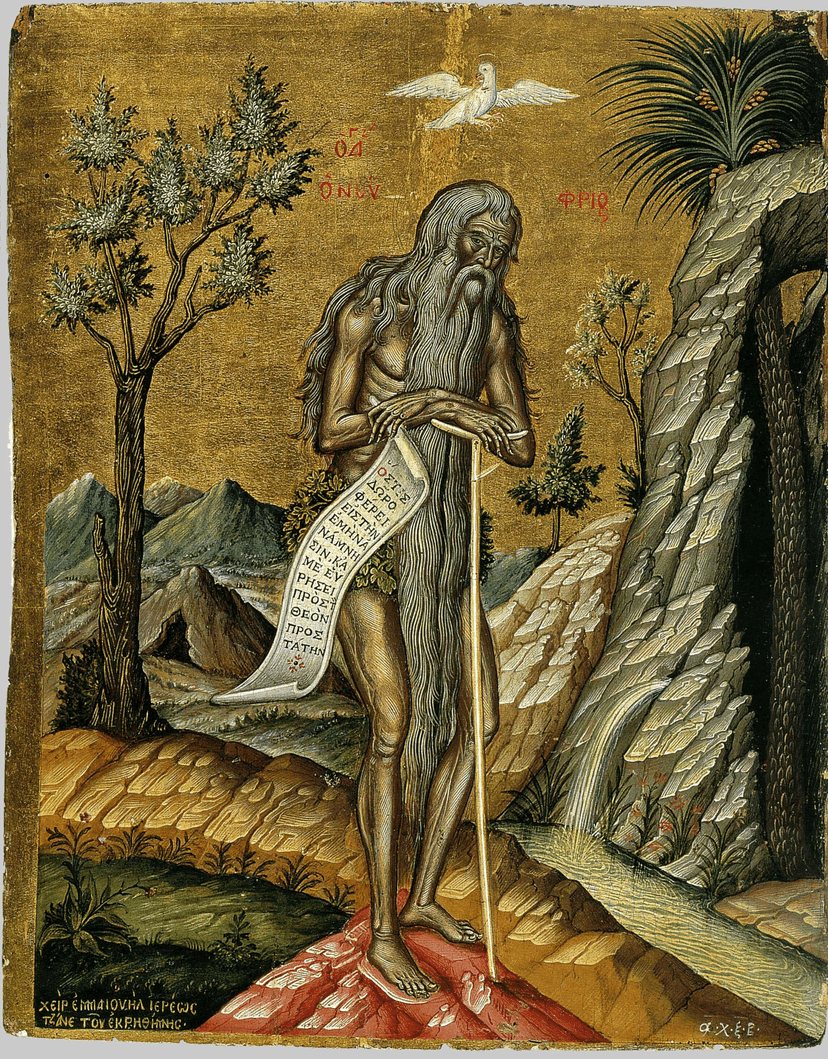
Onuphrius the Great
Onuphrius the Great was a hermit who lived in the desert of Upper Egypt during the 4th or 5th centuries. He is remembered for his extreme asceticism and solitary life of prayer in the desert. His legend, primarily recorded by Paphnutius the Ascetic, highlights his encounter with an angel and divine sustenance during his 70 years as a hermit.