
Onuphrius the Great
June 12·5th century·Egypt
Onuphrius the Great was a hermit who lived in the desert of Upper Egypt during the 4th or 5th centuries. He is remembered for his extreme asceticism and solitary life of prayer in the desert. His legend, primarily recorded by Paphnutius the Ascetic, highlights his encounter with an angel and divine sustenance during his 70 years as a hermit.
Key Facts
- ›Onuphrius lived as a hermit in the desert of Upper Egypt.
- ›His life is known primarily through the account of Paphnutius the Ascetic.
- ›He is said to have lived as a hermit for 70 years, sustained by an angel.
- ›His name is a Hellenized form of the Coptic Unnufer, meaning "perfect one".
- ›He is venerated on June 12 in both Roman Catholic and Eastern Orthodox churches.
- ›He is the patron saint of weavers and co-patron of the city of Palermo.
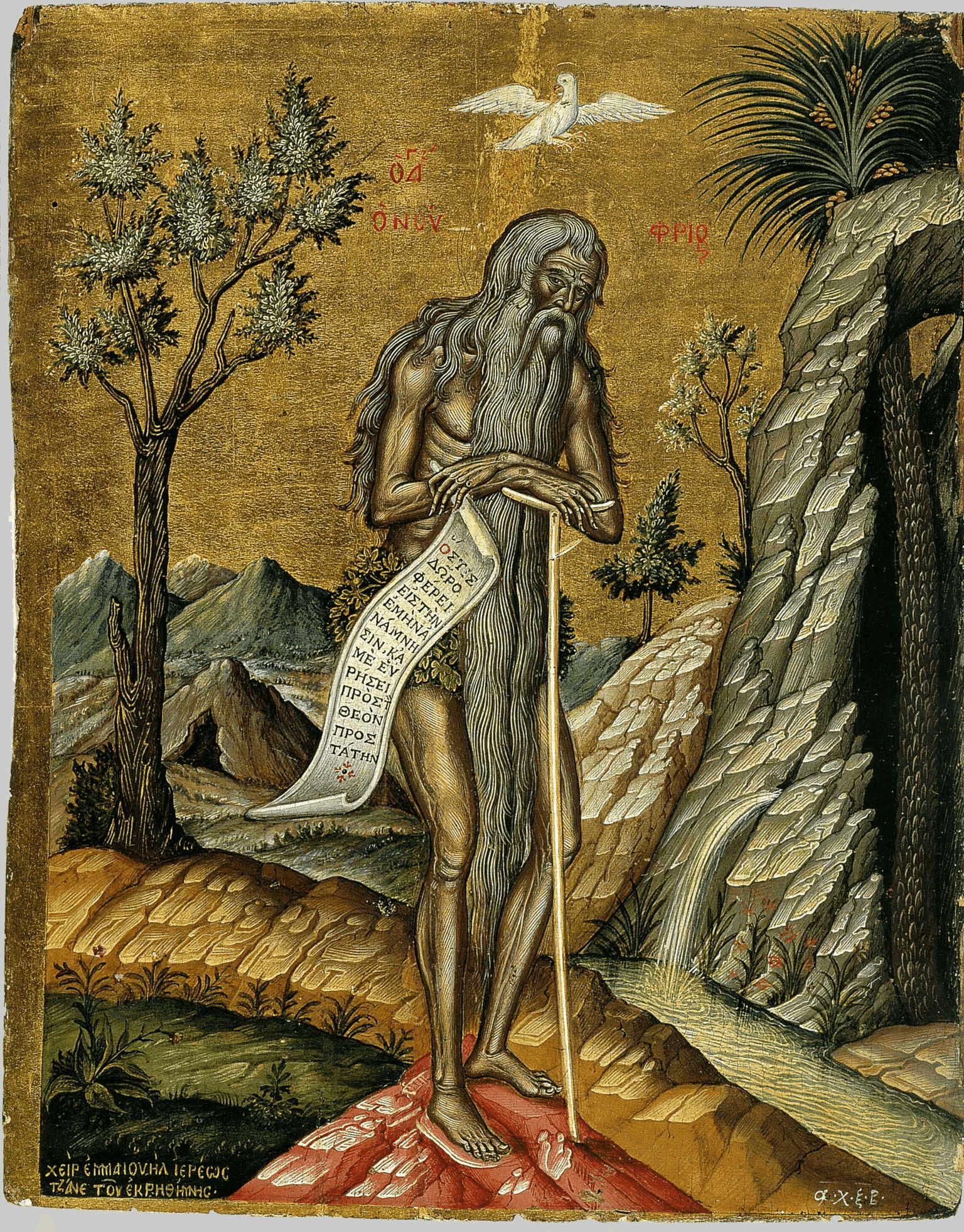
Onoufrios, Nofer the Anchorite, Abū Nufir, Humphrey (Anglicized)
Weavers, Palermo, Lost Items
Loincloth of Leaves, Abundant Hair, Icon of Himself
About Onuphrius the Great
Onuphrius the Great, also known as Onoufrios or Nofer the Anchorite, was a hermit who lived in the desert of Upper Egypt, likely during the 4th or 5th centuries. He is a significant figure in Eastern spirituality, particularly among the Desert Fathers, who sought lives of extreme asceticism and prayer in harsh environments.
Life and Legends
The primary source for Onuphrius' life is the account attributed to Paphnutius the Ascetic. According to this tradition, Onuphrius was a monk who eventually went into the desert to live as a hermit for seventy years. His solitary existence was marked by extreme hardship, thirst, and hunger, yet he was sustained by divine intervention, with an angel reportedly bringing him the Eucharist every Sunday. His legend depicts him as a wild figure, covered in hair and wearing a loincloth of leaves, a visual representation that has influenced his iconography.
Veneration
Onuphrius is venerated as a saint in the Roman Catholic, Eastern Catholic, and Eastern Orthodox Churches, as well as in Oriental Orthodoxy. His feast day is celebrated on June 12. Churches and chapels have been dedicated to him, notably Sant'Onofrio al Gianicolo in Rome. His relics were historically conserved in Constantinople, and his icon is venerated at the Monastery of St. Onuphrius in Jablechna, Poland.
Iconography and Patronage
In artistic depictions, Onuphrius is frequently portrayed as a wild man, a motif that likely arose from the visual description of his hermit's life. This imagery, combined with his asceticism, led to his patronage of weavers. He is also invoked by Sicilians when searching for lost items, and he is a co-patron of the city of Palermo.
Legacy
Onuphrius the Great remains a symbol of extreme asceticism and solitary devotion in the Christian tradition. His legend continues to inspire veneration and prayer, particularly in Eastern Christianity, and his image is recognizable through his unique iconographic representation.
Source: Wikipedia ↗
Frequently Asked Questions
Who was Onuphrius the Great?
Onuphrius the Great was a hermit who lived in the Egyptian desert during the 4th or 5th centuries. He is venerated in various Christian traditions for his ascetic life and devotion.
What is Onuphrius known for?
He is chiefly remembered for his extreme asceticism, living as a hermit for 70 years in the desert, enduring hardship and reportedly receiving sustenance from an angel. His legend emphasizes solitary prayer and detachment from the world.
What is the source of information about Onuphrius?
Our knowledge of Onuphrius' life comes almost entirely from the account of Paphnutius the Ascetic, though the authorship and exact dating of this account are uncertain.
When is Saint Onuphrius' feast day?
His feast day is traditionally celebrated on June 12 in both the Eastern Orthodox and Roman Catholic churches.
How is Onuphrius depicted in art?
In art, Onuphrius is often depicted as a wild man, completely covered in hair and wearing a loincloth of leaves, a conflation with medieval "wild man" imagery.
What is Onuphrius the patron saint of?
He is the patron saint of weavers, and was named co-patron of the city of Palermo in 1650. Sicilians also pray to him for help in finding lost items.
Related Saints
Bessarion the Great
Bessarion the Great was an Egyptian Christian monk and Desert Father of the 4th to 5th centuries, known for his extreme asceticism and spiritual wisdom. He is venerated as a saint for his profound humility, miraculous abilities, and dedication to prayer and self-denial in the Nitrian Desert. He is chiefly remembered for his legendary endurance and his role in the Sayings of the Desert Fathers.
Onuphrius
Saint Onuphrius was a 4th or 5th-century hermit who lived in the desert of Upper Egypt. He is venerated in Catholic and Orthodox traditions for his ascetic life and dedication to prayer in the harsh desert environment. Onuphrius is remembered for his encounter with Paphnutius the Ascetic, who recorded his life story and spiritual guidance.
Joseph of Panephysis
Joseph of Panephysis was an Egyptian Christian monk and Desert Father who lived in the desert of Lower Egypt during the 4th and 5th centuries. He is remembered for his ascetic life and for being consulted by other prominent Desert Fathers. He is venerated as a saint in the Eastern Orthodox and Coptic Orthodox traditions.