
Bessarion the Great
June 6 or June 17·5th century·Egypt
Bessarion the Great was an Egyptian Christian monk and Desert Father of the 4th to 5th centuries, known for his extreme asceticism and spiritual wisdom. He is venerated as a saint for his profound humility, miraculous abilities, and dedication to prayer and self-denial in the Nitrian Desert. He is chiefly remembered for his legendary endurance and his role in the Sayings of the Desert Fathers.
Key Facts
- ›He was an Egyptian Christian monk living in the 4th to 5th century.
- ›He was a Desert Father, venerated in the Eastern Orthodox, Oriental Orthodox, and Roman Catholic Churches.
- ›He practiced extreme asceticism, including sleeping in the open air and eating only once a week.
- ›Legends attribute to him the gift of performing miracles, such as making rivers flow through prayer.
- ›He is noted for his profound humility, once exclaiming 'I too am a sinner' to comfort a wayward novice.
- ›He is sometimes mentioned in connection with the legend of the conversion of Saint Thaïs.
Bessarion of Egypt, Bessarion of Scetis, Bessarion the Great
About Bessarion the Great
Bessarion the Great, also known as Bessarion of Egypt or Bessarion of Scetis, was a prominent Egyptian Christian monk and Desert Father who lived between the 4th and 5th centuries. His life and spiritual teachings are primarily preserved through the hagiographical traditions of early Christian monasticism, particularly in the "Sayings of the Desert Fathers."
Life and Asceticism
Bessarion's life was characterized by extreme asceticism and a deep devotion to prayer. After being baptized in his teens, he embarked on a pilgrimage and studied monastic life in Jordan. Upon his return to Egypt, he became a monk and a disciple of Saint Isidore of Pelusium. His hagiography emphasizes his rigorous self-denial, including sleeping in the open air without shelter, wearing minimal clothing, and enduring severe heat and cold. He reportedly ate only once a week and spent much of his time wandering the desert, often sleeping while standing or sitting, never lying down. One legend recounts him remaining forty days and nights without eating or sleeping, solely in prayer.
Miracles and Humility
According to the "Sayings of the Desert Fathers," Bessarion was granted the gift of performing miracles by God. These abilities were reportedly used to aid his disciples, such as making rivers flow in desolate areas through prayer alone. His humility was also a defining characteristic. A notable anecdote describes him running to a priest and a novice, exclaiming, "I too am a sinner," when the priest was chastising the novice for a sin. His name is sometimes associated with the legend of the conversion of Saint Thaïs, where it is sometimes substituted for that of Saint Paphnutius of Thebes.
Veneration
Bessarion the Great is venerated as a saint by several major Christian traditions, including the Eastern Orthodox Church, the Oriental Orthodox Churches, and the Roman Catholic Church. His feast day is observed on June 6 in the Eastern and Oriental traditions, and on June 17 in the Roman Catholic Church. He is remembered as a confessor and a model of monastic dedication and spiritual endurance.
Source: Wikipedia ↗
Frequently Asked Questions
Who was Bessarion the Great?
Bessarion the Great was an Egyptian Christian monk and Desert Father who lived during the 4th to 5th centuries. He is known for his rigorous ascetic practices and spiritual depth.
Where did Bessarion the Great live?
Bessarion the Great lived in Egypt, wandering in the desolate Nitrian Desert. This region was a significant center for early Christian monasticism.
What is Bessarion the Great remembered for?
He is remembered for his extreme asceticism, including sleeping outdoors, abstaining from food for long periods, and constantly praying. Legends also speak of his miraculous abilities and profound humility.
Which Christian traditions venerate Bessarion the Great?
Bessarion the Great is venerated as a saint by the Eastern Orthodox Church, the Oriental Orthodox Churches, and the Roman Catholic Church.
What were some of Bessarion the Great's ascetic practices?
He despised his own body by sleeping in the open air without shelter, wearing only a few rags, and enduring harsh weather. He ate only once a week and often remained standing or sitting to sleep.
Related Saints
Onuphrius
Saint Onuphrius was a 4th or 5th-century hermit who lived in the desert of Upper Egypt. He is venerated in Catholic and Orthodox traditions for his ascetic life and dedication to prayer in the harsh desert environment. Onuphrius is remembered for his encounter with Paphnutius the Ascetic, who recorded his life story and spiritual guidance.
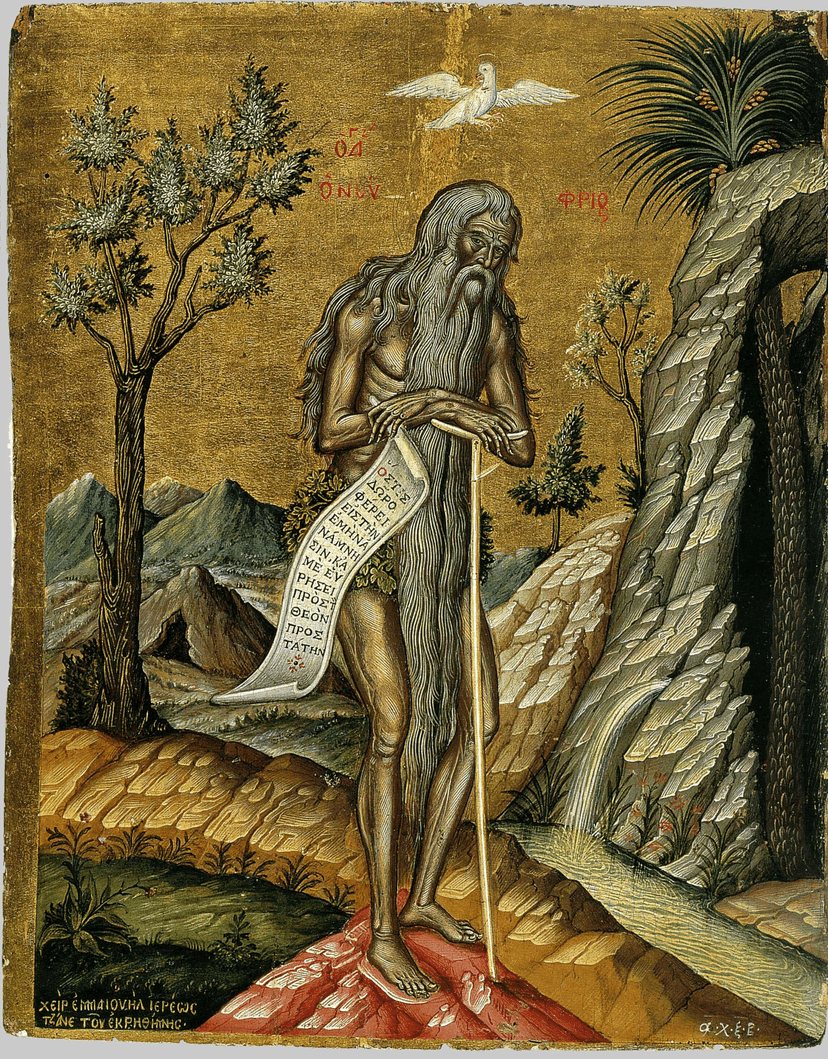
Onuphrius the Great
Onuphrius the Great was a hermit who lived in the desert of Upper Egypt during the 4th or 5th centuries. He is remembered for his extreme asceticism and solitary life of prayer in the desert. His legend, primarily recorded by Paphnutius the Ascetic, highlights his encounter with an angel and divine sustenance during his 70 years as a hermit.
Zeno the Prophet
Zeno the Prophet was an Egyptian monk and Desert Father, known for his spiritual guidance and miraculous deeds. He served as a disciple of Silvanus of Gaza and became the spiritual mentor to Peter the Iberian. Zeno is primarily remembered for his ascetic life and his role as a spiritual teacher within the monastic communities of Palestine and Egypt.