
Stephen the Great
Stephen the Great, also known as Ștefan cel Mare, was the Voivode of Moldavia from 1457 to 1504. He is remembered for his exceptionally long reign, his skilled military leadership in defending Moldavia against powerful neighbors like the Ottoman Empire, and his role as a protector of Christianity. His efforts in nation-building and his role as a national hero in Romania and Moldova are central to his legacy.
Key Facts
- ›Stephen the Great reigned as Voivode of Moldavia from 1457 to 1504.
- ›He successfully defended Moldavia against invasions from the Ottoman Empire, Poland, and Hungary.
- ›Stephen was noted for his astute diplomacy and nation-building efforts.
- ›Pope Sixtus IV referred to him as Athleta Christi, meaning 'Champion of Christ'.
- ›He is canonized by the Romanian Orthodox Church as 'Stephen the Great and Holy'.
- ›His reign is considered a period of stability and contributed to the development of Moldavian architecture.

Ștefan cel Mare, Stephen III, Stephen the Great and Holy
Moldavia, Christianity
Champion of Christ
About Stephen the Great
Stephen the Great (Romanian: Ștefan cel Mare; died July 2, 1504) was the Voivode of Moldavia from 1457 until his death. He is regarded as one of the most significant rulers of late medieval Eastern Europe, distinguished by his remarkably long reign, exceptional military acumen, and shrewd diplomatic skills. His enduring legacy stems from his determined efforts to preserve Moldavia's independence against the formidable pressures of neighboring powers such as the Ottoman Empire, Poland, and Hungary.
Life and Historical Context
Born between 1433 and 1440, Stephen was the son of Bogdan II, himself a descendant of Alexander the Good, Prince of Moldavia. His early life was marked by political turmoil, including the assassination of his father in 1451, which led Stephen to seek refuge in Transylvania. He ascended the Moldavian throne in 1457 following internal strife and with the support of his cousin, Vlad the Impaler.
Stephen's reign was characterized by continuous conflict and strategic maneuvering. He faced numerous invasions and challenges from larger states, but through a combination of military strength and diplomatic alliances, he managed to maintain Moldavia's sovereignty. His efforts to recapture key ports like Chilia and Cetatea Albă from the Ottomans were a central theme of his foreign policy. He was known to both pay tribute to the Ottoman Sultan and wage war against him, depending on the geopolitical situation.
Major Contributions and Defense of Christianity
A key aspect of Stephen's reign was his role as a defender of Eastern European Christianity. His victory against a large Ottoman army at the Battle of Vaslui in 1475 earned him significant recognition, with Pope Sixtus IV bestowing upon him the title Athleta Christi ("Champion of Christ"). Although Moldavia often lacked substantial military aid from Western European powers, Stephen's resistance was seen as a crucial bulwark against Ottoman expansion.
Stephen also focused on strengthening Moldavia internally. He oversaw the restoration of existing fortresses and the construction of new ones, enhancing the principality's defensive capabilities. Furthermore, his reign saw the flourishing of religious architecture, with numerous stone churches and monasteries built in a distinctive Moldavian style, many of which still stand today.
Legacy
From the 16th century onwards, Stephen the Great was remembered as a great ruler by both his subjects and foreign observers. Modern Romanians and Moldovans consider him one of their greatest national heroes. His canonization by the Romanian Orthodox Church in 1992 as "Stephen the Great and Holy" (Ștefan cel Mare și Sfânt) underscores his profound spiritual and historical significance in the region.
Source: Wikipedia ↗
Frequently Asked Questions
When did Stephen the Great rule Moldavia?
Stephen the Great reigned as Voivode of Moldavia from 1457 until his death on July 2, 1504. His reign was one of the longest in Moldavian history.
Why is Stephen the Great considered a national hero?
He is revered as a national hero for his exceptional military leadership in defending Moldavia's autonomy against powerful neighbors like the Ottoman Empire, Poland, and Hungary. His efforts in nation-building and his reputation as a protector of Christianity also contribute to his heroic status.
What were Stephen the Great's major military achievements?
Stephen the Great is credited with numerous military victories, including repelling invasions from the Ottoman Empire at the Battle of Vaslui and the Battle of the Cosmin Forest against Poland. He also successfully defended Moldavia against Hungarian and Wallachian incursions.
How did Stephen the Great contribute to Moldavian culture and infrastructure?
During his reign, Stephen the Great focused on strengthening Moldavia's defenses by restoring old fortresses and building new ones. He also commissioned the construction of many stone churches and monasteries, which significantly contributed to the development of a unique Moldavian architectural style.
Was Stephen the Great recognized by the Pope?
Yes, Pope Sixtus IV recognized Stephen the Great's significant role in defending Christendom. He referred to Stephen as Athleta Christi, meaning 'Champion of Christ', for his efforts against the Ottoman expansion.
Is Stephen the Great canonized?
Yes, Stephen the Great was canonized by the Romanian Orthodox Church in 1992. He is venerated as 'Stephen the Great and Holy' (Ștefan cel Mare și Sfânt).
Related Saints

Daniel the Hesychast
Daniel the Hesychast was a renowned Moldavian Orthodox spiritual guide and advisor to Stephen the Great. He is remembered for his prophecies, his encouragement of Stephen the Great in defending Christendom, and for founding a hermit movement. Canonized in 1992, he is commemorated for his wisdom and spiritual guidance.
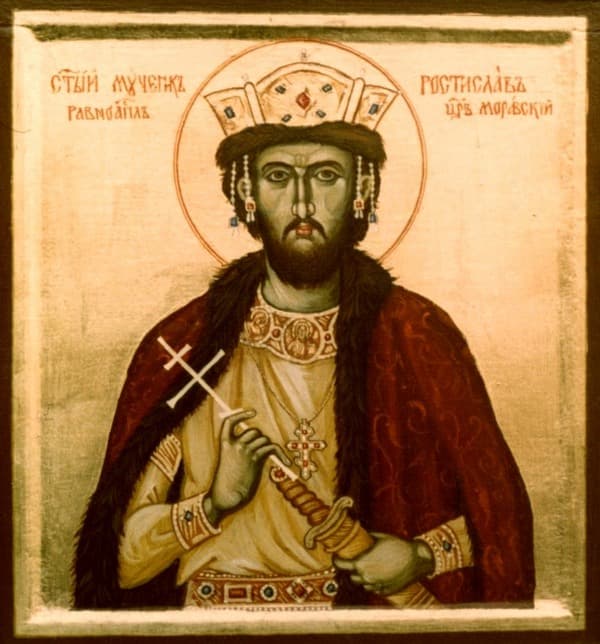
Rastislav of Moravia
Rastislav was the second known ruler of Moravia, reigning from 846 to 870. He is chiefly remembered for consolidating his rule to repel Frankish attacks and for initiating the mission of Saints Cyril and Methodius, who translated Christian liturgical books into Slavonic. Rastislav was eventually dethroned by his nephew and died in captivity.

Olga of Kiev
Olga of Kiev was a regent of Kievan Rus' for her son Sviatoslav and is venerated as a saint in the Eastern Orthodox Church. She is chiefly remembered for her decisive and brutal revenge against the Drevlians who killed her husband, Igor, and for being the first Rurikid ruler to be baptized.