
Sergius of Valaam
June 28·14th century·Russia
Sergius of Valaam was a Greek monk credited with bringing Orthodox Christianity to the Karelians and Finns. Church traditions vary widely on his life, placing him from the 10th to the 14th century. He is chiefly remembered as a founder of the Valaam Monastery and a missionary figure.
Key Facts
- ›He was a Greek monk and wonderworker.
- ›He is credited with bringing Orthodox Christianity to the Karelians and Finns.
- ›Conflicting traditions place his activity from the 10th to the 14th century.
- ›He is considered a founder of the Valaam Monastery along with Herman of Valaam.
- ›His feast day is celebrated on June 28.
- ›The earliest record of his activity claims he arrived in Valaam in 1329.
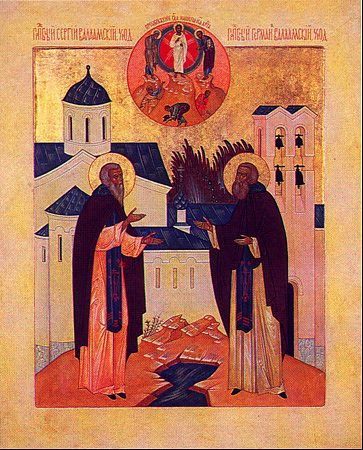
Sergiy Valaamskiy
About Sergius of Valaam
Sergius of Valaam was a Greek monk and wonderworker central to the tradition of Orthodox Christianity's introduction to the Karelians and Finns. The precise dates of his life and ministry are subject to conflicting church traditions, with some placing him as early as the 10th century and others as late as the 14th century. He is most prominently remembered as one of the founders of the Valaam Monastery, an important spiritual center.
Life and Historical Context
Church legends concerning Sergius of Valaam were not extensively documented until the 18th century. These accounts often describe him as an Athonite monk dispatched by the Byzantine emperor to evangelize the tribal populations of Karelia. His journey is depicted as following the ancient trade route from the Varangians to the Greeks, passing through significant settlements of Kievan Rus' before reaching the northern shores of Lake Ladoga and eventually settling on Valaam Island.
Historical and archaeological evidence suggests the arrival of Christianity in Finland occurred between the 10th and 11th centuries. Some traditions place Sergius's arrival on Valaam as early as 992, potentially making him a contemporary of Emperor Basil II. Conversely, other pious legends link him to Apostle Andrew's supposed visit to Crimea in the 1st century AD. However, the earliest surviving record of his activity suggests he arrived in Valaam in 1329. His missionary work was continued by figures such as Herman of Valaam, though their exact temporal relationship remains unclear.
The exact date of the Valaam Monastery's foundation is uncertain due to the destruction of early records, often during conflicts such as the Russo-Swedish Wars. A tradition from the 18th century indicates that the relics of Sergius and Herman were relocated to Novgorod in 1162 or 1163 for safekeeping, possibly in anticipation of Swedish military actions. These relics were reportedly returned to Valaam in 1182 or 1180, and September 11 continues to be observed as a commemoration day by the Orthodox Church of Finland for this translation.
Legacy
Sergius of Valaam, alongside Herman of Valaam, is venerated as a foundational figure of the Valaam Monastery. His role in bringing Orthodox Christianity to the region has left a lasting spiritual and cultural imprint, shaping the religious landscape of Karelia and Finland.
Source: Wikipedia ↗
Frequently Asked Questions
When did Sergius of Valaam live?
Conflicting church traditions place Sergius of Valaam's life from as early as the 10th century to as late as the 14th century. The earliest record of his activity claims he arrived in Valaam in 1329, while another tradition dates his death to 1353. However, these dates are not validated by medieval documents.
What is Sergius of Valaam known for?
Sergius of Valaam is known as a Greek monk and wonderworker credited with bringing Orthodox Christianity to the Karelians and Finns. He is also recognized as a founder of the Valaam Monastery.
Who was Herman of Valaam?
Herman of Valaam is a figure associated with Sergius of Valaam and is also considered a founder of the Valaam Monastery. It is unclear from historical records if he was a contemporary of Sergius.
Where are Sergius of Valaam's relics kept?
According to an 18th-century church chronicle, the relics of Sergius and Herman were moved to Novgorod for safety in 1162 or 1163. They were reportedly returned to Valaam in 1182 or 1180. The date of their translation to Novgorod is still commemorated by the Orthodox Church of Finland.
Related Saints
Anna of Kashin
Anna of Kashin was a Russian princess consort of Mikhail of Tver, known for her enduring faith amidst immense personal tragedy and for her complex canonization history. She is venerated as a patroness of Kashin and Tver, remembered for her humility and the miracles attributed to her relics.
Stephen of Perm
Stephen of Perm was a Russian Orthodox bishop, painter, and missionary credited with the conversion of the Komi peoples to Christianity. He is most remembered for creating the Old Permic script, establishing the first bishopric of Perm, and being a significant figure in the spiritual and cultural revival of late 14th and early 15th century Russia.
Abraham of Galich
Abraham of Galich was an abbot of the Russian Orthodox Church and a disciple of Sergius of Radonezh. He is remembered for founding four monasteries in the region of Galich, establishing a significant monastic presence there. His feast day is celebrated on July 20th.