
Maximus the Greek
January 21·16th century·Russia
Maximus the Greek was a 15th-century Greek monk, scholar, and translator who became a prominent figure in Russia. He is remembered for his extensive writings and translations, his advocacy for religious reform, and his courageous criticism of the Muscovite authorities, which led to his imprisonment and exile. Canonized as a saint, he is venerated for his intellectual contributions and his steadfast adherence to his Christian ideals.
Key Facts
- ›He was born Michael Trivolis in Arta, Ottoman Empire, around 1475.
- ›Maximus studied in Italy alongside prominent Renaissance scholars like Angelo Poliziano and Marsilio Ficino.
- ›He arrived in Moscow in 1518 and became a leader of the religious reform movement.
- ›Maximus translated religious texts and corrected books for divine service in Russia.
- ›He was imprisoned and exiled for criticizing the Muscovite clergy and government.
- ›Maximus died in 1556 at the Troitse-Sergiyeva Lavra and is buried there.
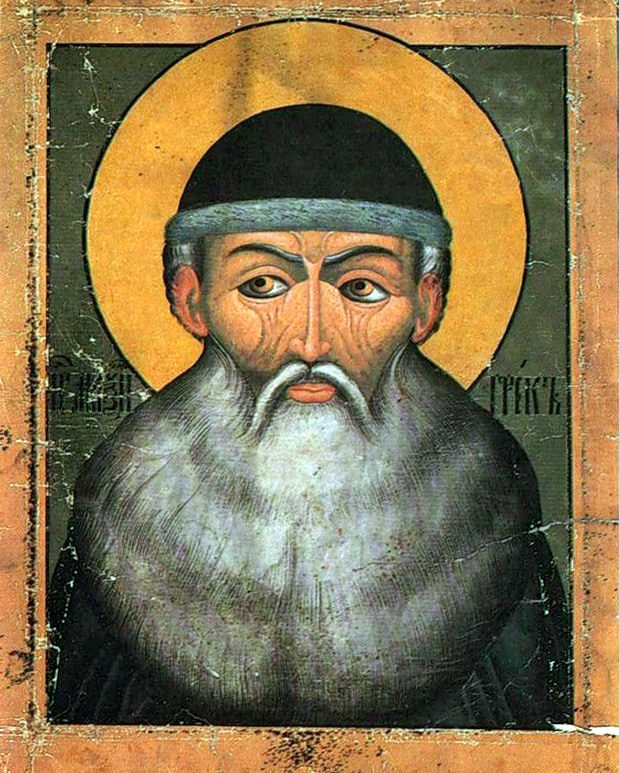
Maximos the Greek, Maksim Grek, Maximos the Hagiorite, Maximus the Philosopher, Michael Trivolis, Maxim Grek, Maximus Grecus Lakedaimon
About Maximus the Greek
Maximus the Greek (c. 1475 – c. 1556), born Michael Trivolis, was a Greek monk, publicist, writer, scholar, and translator who became a significant figure in Russia. Known also as Maximos the Hagiorite and Maximus the Philosopher, his intellectual journey began in Greece and Italy, where he studied ancient languages and philosophy, interacting with prominent Renaissance thinkers and being influenced by the reformist preacher Girolamo Savonarola. He took monastic vows on Mount Athos before being invited to Russia in 1518.
Upon his arrival in Moscow, Maximus became a leader in a movement for religious reform. He undertook the translation and correction of religious texts for divine service, working alongside Russian scholars. However, his observations of "defects" and injustices within Muscovite society led him to openly criticize the authorities and the clergy. His critical stance aligned him with the Non-Possessors faction in the debate over monastic land ownership, making him an adversary of the powerful Josephites.
Maximus's criticisms and his perceived nonconformism led to his downfall. In 1525, he was accused of heresy based on his translations and views, resulting in his imprisonment and exile. Despite attempts by Eastern patriarchs to secure his release, he remained in confinement for many years, eventually being transferred to the Troitse-Sergiyeva Lavra. He died there in 1556 and is buried in the Refectory Church.
Canonization and Legacy
Maximus the Greek was canonized by the Eastern Orthodox Church in 1988 and is venerated with a feast day on January 21st. His enduring legacy lies in his substantial body of original writings and translations, which played a crucial role in shaping Russian Christian tradition. He introduced Muscovite readers to a wider understanding of ancient and biblical history, Orthodox practices, and the world beyond Russia, notably being the first to bring news of the New World to their attention. His life serves as an example of intellectual engagement and principled resistance against perceived societal and religious failings.
Source: Wikipedia ↗
Frequently Asked Questions
Who was Maximus the Greek?
Maximus the Greek, born Michael Trivolis, was a Greek monk, scholar, writer, and translator active in Russia in the late 15th and early 16th centuries. He was known for his intellectual pursuits and his critical stance on the state of the Russian Orthodox Church and society.
What was Maximus the Greek's early life like?
Born into a noble Greek family around 1475, Maximus studied in Italy where he encountered prominent Renaissance scholars and was influenced by the teachings of Girolamo Savonarola. He later took monastic vows on Mount Athos before being invited to Russia.
Why was Maximus the Greek imprisoned?
Maximus was imprisoned and later exiled due to his outspoken criticism of the "defects" and injustices he observed in Muscovite life, including the lifestyle of the clergy and the exploitation of peasants. His translations were also questioned, leading to accusations of heresy.
What is Maximus the Greek remembered for?
He is remembered for his voluminous writings and translations into Russian Church Slavonic, his role in religious reform, and his courage in speaking out against perceived wrongdoings. He is venerated as a saint by the Eastern Orthodox Church.
When is Maximus the Greek's feast day?
His feast day is celebrated by Eastern Orthodox Christians on January 21st.
Did Maximus the Greek have any connection to ancient Sparta?
Yes, his family origins were likely from Mystras in Laconia, the geographical site of ancient Sparta, and he sometimes signed himself as Maximus Grecus Lakedaimon, meaning "Maximus the Greek of Lakedaimonia."
Related Saints
Jacob of Edessa
Jacob of Edessa was a Syriac Orthodox bishop, scholar, and translator renowned for his multilingualism and significant contributions to biblical revision, canon law, grammar, and liturgy. He played a crucial role in standardizing theological terminology and synthesizing Greek and Syriac traditions, profoundly shaping Syriac Christianity and facilitating the transmission of Hellenistic thought into the Islamic world. He is venerated as one of the most important scholars of the Christian-Aramean tradition.
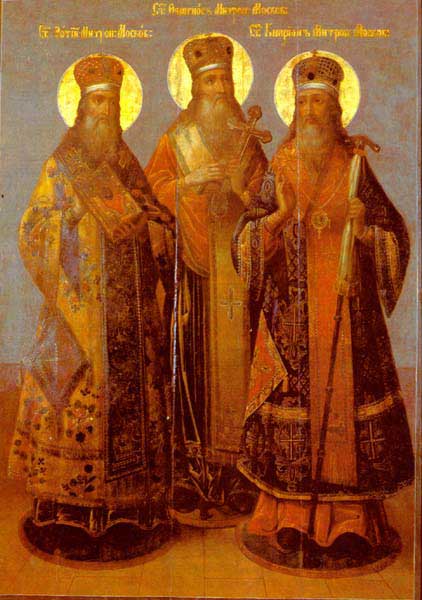
Cyprian of Kiev
Cyprian was a prelate of Bulgarian origin who served as Metropolitan of Kiev and all Rus' in the Ecumenical Patriarchate of Constantinople. He is remembered as a skilled church administrator who worked to unify the Church in the Grand Duchy of Moscow and the Grand Duchy of Lithuania, facing significant opposition. He was also an erudite writer, editor, and translator, overseeing the creation of important historical and ecclesiastical works.
Jerome
Jerome was an early Christian priest, theologian, and historian, best known for his Latin translation of the Bible, the Vulgate. He is recognized as one of the four Great Latin Church Fathers and is revered for his extensive biblical commentaries and his teachings on Christian moral life, particularly for women. His scholarly endeavors and translation work significantly shaped Western Christianity.