
Hypomone
Hypomone, born Helena Dragaš, was the Empress consort of Byzantine Emperor Manuel II Palaiologos and mother to the last two Byzantine emperors. She is venerated as a saint in the Eastern Orthodox Church for her piety and her role as regent and influential political advisor during a tumultuous period for the Byzantine Empire. She is chiefly remembered for her wisdom, justice, and her steadfast opposition to the union of the Orthodox and Catholic churches.
Key Facts
- ›Helena Dragaš was born into Serbian nobility and married Byzantine Emperor Manuel II Palaiologos in 1392.
- ›She served as regent of the Byzantine Empire from 1448 until her son Constantine XI's enthronement in 1449.
- ›After her husband's abdication and death, she became a nun, taking the monastic name Hypomone (Patience).
- ›She was a prominent figure in the anti-unionist faction opposing the proposed union of the Orthodox and Catholic churches.
- ›Her son Constantine XI Palaiologos took her surname, Dragases, in her honor.
- ›She died on March 23, 1450, in Constantinople.
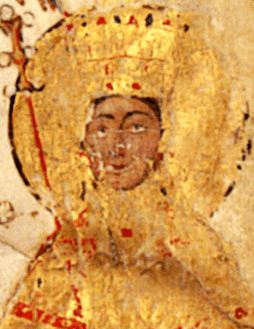
Helena Dragaš, Saint Patience
About Hypomone
Helena Dragaš (Saint Hypomone)
Helena Dragaš, later known as Saint Hypomone, was an influential Empress consort of the Byzantine Empire and a significant figure in its later years. Born into Serbian nobility around 1372, she married Emperor Manuel II Palaiologos in 1392, becoming Empress and later Empress Dowager. She is venerated in the Eastern Orthodox Church under her monastic name, Hypomone, which translates to Patience, a virtue often associated with her life and influence.
Life and Role
Helena Dragaš was the daughter of Serbian magnate Konstantin Dejanović. Her marriage to Manuel II Palaiologos was a dynastic alliance. While details of her personal life as empress are scarce, she is described as possessing beauty, piety, wisdom, and justice. After her husband's abdication and death in 1425, she took monastic vows and became a nun, adopting the name Hypomone at the Monastery of Kyra Martha.
Even after becoming a nun, Helena remained a central figure at court, acting as a crucial political advisor to her sons, Emperors John VIII Palaiologos and Constantine XI Palaiologos. She played a vital role in the succession of Constantine XI, serving as regent from 1448 until his arrival from Mistra in 1449. She was instrumental in persuading Sultan Murad II to support Constantine's claim to the throne. Her influence was so significant that Constantine XI adopted her surname, Dragases, in her honor.
Ecclesiastical Influence and Legacy
Empress Helena Dragaš was deeply involved in ecclesiastical matters. She was a leading voice in the anti-unionist faction that opposed the proposed union between the Orthodox and Catholic Churches, a major political issue during her sons' reigns. Her steadfast opposition is credited with hindering the union's progress.
Helena died on March 23, 1450, in Constantinople. Her legacy is marked by her devotion, her political acumen, and her role in preserving Orthodox identity. She is commemorated by the Orthodox Church on May 29, the anniversary of the Fall of Constantinople and the death of her son Constantine XI, linking her memory to the final days of the Byzantine Empire.
Source: Wikipedia ↗
Frequently Asked Questions
Who was Hypomone?
Hypomone, born Helena Dragaš, was the Empress consort of Byzantine Emperor Manuel II Palaiologos. She was also the mother of the last two Byzantine emperors and served as regent for a period.
Why is Hypomone venerated as a saint?
She is venerated by the Eastern Orthodox Church as Saint Hypomone, meaning Saint Patience. This veneration stems from her piety, wisdom, and her significant role in Byzantine politics and ecclesiastical matters.
What was Hypomone's role in the Byzantine Empire?
As Empress and later Empress Dowager, Hypomone was a key political advisor to her sons. She served as regent after her son John VIII's death and was influential in the succession of her son Constantine XI.
What was Hypomone's stance on church union?
Hypomone was a prominent figure in the anti-unionist faction at court, opposing the proposed union between the Orthodox and Catholic churches. Her influence is believed to have stalled and slowed down the progress of this union.
When did Hypomone die?
Hypomone died on March 23, 1450, in Constantinople. Her memory is commemorated on May 29, the day of the Fall of Constantinople.
Related Saints
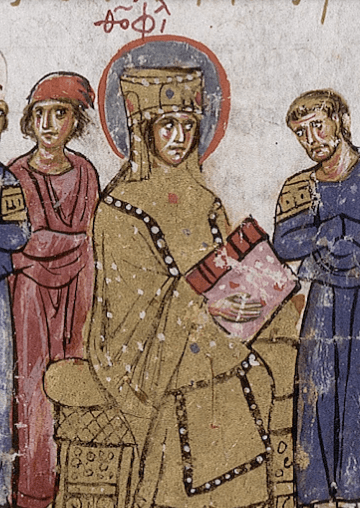
Theodora (wife of Theophilos)
Theodora (c. 815 – c. 867) was the Byzantine empress consort and later regent for her young son, Michael III. As an iconophile, she played a pivotal role in ending the second Byzantine Iconoclasm, an act for which she is recognized as a saint in the Eastern Orthodox Church. Despite losing territory and facing internal political challenges, she managed foreign policy and maintained relative peace for the empire.
Olga of Kiev
Olga of Kiev was a regent of Kievan Rus' for her son Sviatoslav and is venerated as a saint in the Eastern Orthodox Church. She is chiefly remembered for her decisive and brutal revenge against the Drevlians who killed her husband, Igor, and for being the first Rurikid ruler to be baptized.
Anno II
Anno II was Archbishop of Cologne from 1056 until his death in 1075, and served as regent of the Holy Roman Empire for the minor Emperor Henry IV from 1063 to 1065. He is venerated as a saint in the Catholic Church, remembered for his role in imperial politics, his ascetic life, and his founding of the Benedictine abbey of Michaelsberg.