
Cyriacus the Anchorite
Kyriakos the Anchorite was a 5th and 6th-century Greek Orthodox monk and saint, known for his ascetic life and fervent opposition to the Origenist heresy. He is remembered for his deep spiritual devotion, his work in strengthening Orthodox faith, and his life of prayer and solitude in the Judean desert.
Key Facts
- ›His father was a priest named John and his mother was Eudoxia.
- ›He was tonsured a monk by Euthymius the Great and guided by Gerasimus.
- ›He spent ten years in total silence pursuing asceticism.
- ›Kyriakos was ordained a deacon at 37 and later a priest, serving for eighteen years as a canonarch.
- ›He actively worked against the Origenist religious movement.
- ›The Theotokos is said to have appeared to him to strengthen his efforts against Origenism.
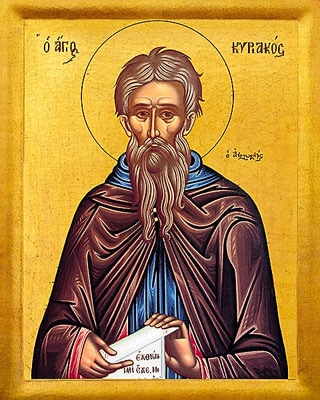
Cyriacus the Hermit, Kyriakos ho Anachōrētēs
About Cyriacus the Anchorite
Cyriacus the Anchorite, also known as Kyriakos ho Anachōrētēs or Cyriacus the Hermit, was a prominent Greek Orthodox monk and saint of the 5th and 6th centuries. Born in 448 and dying in 557, his life was dedicated to intense asceticism and the defense of Orthodox doctrine.
Life and Historical Context
Born into a priestly family, Cyriacus's spiritual calling led him to Jerusalem at a young age. He entered monastic life, coming under the tutelage of influential figures such as Euthymius the Great and Gerasimus. He pursued a rigorous ascetic path, characterized by severe fasting, minimal sleep, and prolonged periods of solitude, including ten years of complete silence. He was ordained a deacon at 37 and later a priest, serving for eighteen years as a canonarch at the monastery of Chariton.
Cyriacus was a staunch opponent of the Origenist heresy, actively working to counter its spread through prayer and word. According to Eastern Orthodox tradition, he received divine encouragement from the Theotokos to strengthen his efforts against this theological movement. His life was marked by profound spiritual devotion and a deep commitment to the monastic ideal.
Veneration and Legacy
Cyriacus the Anchorite is venerated in the Eastern Orthodox Church. His life of unwavering faith and his efforts against heresy left a lasting spiritual legacy. In Serbia, his feast day is traditionally associated with the end of the grape harvest and is celebrated with a Slava, highlighting his enduring presence in popular devotion.
Source: Wikipedia ↗
Frequently Asked Questions
Who was Kyriakos the Anchorite?
Kyriakos the Anchorite was a Greek Orthodox monk and saint who lived from 448 to 557 AD. He is known for his ascetic lifestyle and his opposition to the Origenist heresy.
What was Kyriakos the Anchorite's early life like?
Born to a priest father and Eudoxia, Kyriakos was inspired by scripture to pursue a saintly life. Before the age of 18, he traveled to Jerusalem and began his monastic journey, eventually coming under the guidance of Euthymius the Great and Gerasimus.
What kind of asceticism did Kyriakos the Anchorite practice?
Kyriakos practiced strict fasting, praying fervently, and sleeping little. He often ate only every other day, nourishing himself with bread and water. He also spent significant periods in solitude and silence.
What is Kyriakos the Anchorite remembered for in terms of faith?
He is remembered for his strong opposition to the Origenist religious movement. Eastern Orthodox tradition states that the Theotokos appeared to him to give him strength in his efforts to lead people back to a strengthened Orthodox faith.
Where did Kyriakos the Anchorite live and practice his asceticism?
Kyriakos the Anchorite spent much of his life in the wilderness of Palestine, dwelling in various monasteries and solitary cells, including near Sion, the Lavra of Euthymius the Great, the monastery of Theoctistus, and the Souka monastery of Chariton. He also lived in the Natoufa and Rouva wilderness areas.
What is the significance of Kyriakos the Anchorite's feast day in Serbia?
In Serbia, the feast of Saint Cyriacus marks the end of the grape harvest and is celebrated with a traditional Slava, a Serbian Orthodox custom of celebrating a family's patron saint.
Related Saints
Sabbas the Sanctified
Sabbas the Sanctified was a Cappadocian Greek monk, priest, and founder of several monasteries, most notably Mar Saba in Palestine. He is remembered for his ascetic life, his role as a church leader, and his staunch opposition to Monophysitism and Origenism. His monastic rule, the Jerusalem Typikon, guided Byzantine monasteries.
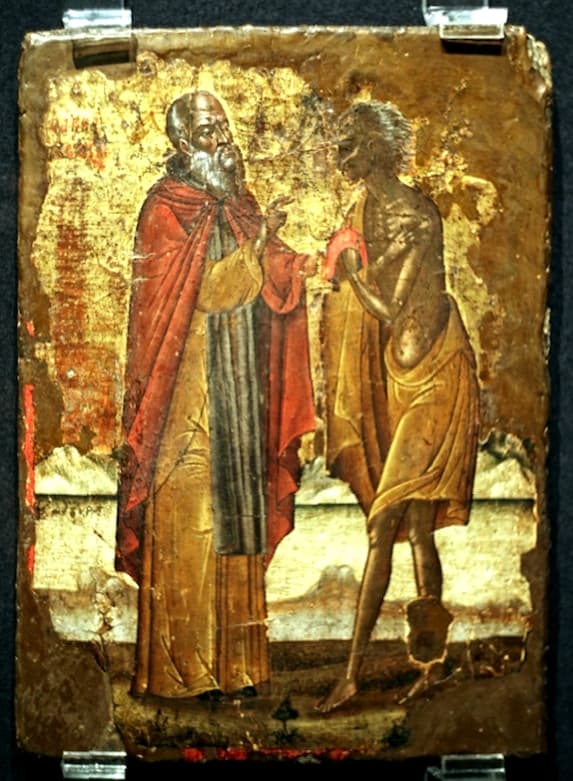
Zosimas of Palestine
Zosimas of Palestine was a Palestinian saint and ascetic monk who lived in the late 5th and early 6th centuries. He is primarily remembered for his encounter with Mary of Egypt, a penitent sinner, in the desert near the Jordan River. Their meeting and his subsequent care for her spiritual needs are detailed in the hagiography of Mary of Egypt.
Barsanuphius
Barsanuphius was a sixth-century Christian hermit and writer, considered one of the Desert Fathers. He is chiefly remembered for his extensive correspondence, alongside John the Prophet, offering spiritual direction through over 850 preserved letters that significantly influenced Orthodox monasticism. He is venerated as a saint in both the Eastern Orthodox and Roman Catholic Churches.