
Mount Terich Mir
Mount Terich Mir is the highest peak in the Hindu Kush range, standing as the 33rd highest mountain globally and the tallest outside the Himalayas–Karakoram. Located in the Chitral District of Pakistan, it is a significant landmark visible from the town of Chitral and holds deep spiritual and mythological importance for local communities, including the Kalash and Chitrali people.
Key Facts
- ›Highest mountain in the Hindu Kush range.
- ›33rd highest peak in the world.
- ›Composed primarily of Cretaceous granitic rock.
- ›First successfully summited on July 21, 1950, by a Norwegian-British expedition.
- ›The "normal route" for climbers is via the Upper Tirich Glacier and northwest ridge.
- ›Considered the domain of the goddess Krumai by the Kalash people and home to fairies for the Chitrali people.

Terichmir, Tirich Mir, Turch Mir
Kalash Polytheism, Islam
- Domain of the Goddess Krumai For the Kalash People.
- Believed To Be the Home of Fairies By the Chitrali People.
- Identified With the Sacred Mount Meru In Hindu, Buddhist, and Jain Literature.
- Subject of the 1952 Documentary Film "Tirich Mir Til Topps".
Krumai, Arne NæSs, Per Kvernberg, Henry Berg, Tony Streather, Kazuya Hiraide, Kenro Nakajima
About Mount Terich Mir
Mount Terich Mir is the commanding highest peak of the Hindu Kush mountain range, situated in the Chitral District of Pakistan. It ranks as the 33rd highest mountain globally and holds the distinction of being the tallest peak outside the vast Himalayan and Karakoram ranges. Its imposing presence is readily apparent from the town of Chitral, where it is a constant visual landmark.
Geography and Geology
The mountain's geography is defined by the Tirich valley and the extensive Tirich Glacier at its head. This glacial system is fed by numerous sub-valleys and its meltwaters contribute significantly to the Torkhow and Chitral Rivers. Geologically, Mount Terich Mir is predominantly composed of a mid-Cretaceous granitic pluton, known as the Tirich Mir pluton, which is cut by various dykes. This plutonic rock intrudes a high-grade metamorphic belt comprising metagabbros, peridotites, and gneisses, referred to as the Tirich Boundary Zone.
Mountaineering History
The first successful ascent of Mount Terich Mir was achieved on July 21, 1950, by a Norwegian-British expedition. The team, which included Arne Næss, Per Kvernberg, Henry Berg, and Tony Streather, approached the peak via the South Barum glacier and ascended its south ridge. In 1967, a Czechoslovak expedition charted a route through the Upper Tirich Glacier and northwest ridge, which has since become recognized as the 'normal route' for climbers. More recently, in July 2023, Japanese mountaineers Kazuya Hiraide and Kenro Nakajima completed the first ascent of the mountain's challenging 2,200-meter north face.
Cultural and Spiritual Significance
Mount Terich Mir holds profound cultural and spiritual importance for the local populations. The polytheist Kalash people consider it the domain of the goddess Krumai, who is associated with childbirth and is depicted in their folklore as a wild goat. Conversely, the Muslim Chitrali people believe the mountain is inhabited by fairies known as 'Bohtan Doyak' (stone throwers), and tradition dictates that climbing the peak will result in death for any trespasser. Scholars have also identified Terich Mir with the sacred Mount Meru, a central cosmological mountain in Hindu, Buddhist, and Jain traditions dating back to the Vedic period.
Source: Wikipedia ↗
Frequently Asked Questions
What is the elevation of Mount Terich Mir?
Mount Terich Mir stands at an elevation of 7,708 meters (25,289 feet) above sea level. This significant height makes it the highest peak in the Hindu Kush mountain range and a considerable challenge for mountaineers.
Where is Mount Terich Mir located?
Mount Terich Mir is situated in the Chitral District of Khyber Pakhtunkhwa, Pakistan. It is a prominent feature overlooking the town of Chitral, easily visible from its main bazaar.
What is the geological composition of Mount Terich Mir?
The mountain is primarily composed of the mid-Cretaceous granitic Tirich Mir pluton. This pluton is intersected by numerous dykes and cuts through a belt of metagabbros, peridotites, and gneisses, known as the Tirich Boundary Zone.
When was Mount Terich Mir first climbed?
The first recorded ascent of Mount Terich Mir was on July 21, 1950. A Norwegian-British expedition, including Arne Næss, Per Kvernberg, Henry Berg, and Tony Streather, successfully reached the summit.
What are the spiritual beliefs associated with Mount Terich Mir?
The Kalash people believe the mountain is the domain of the goddess Krumai, who appears as a wild goat and is linked to childbirth. The Muslim Chitrali people regard it as the home of 'Bohtan Doyak,' or mountain fairies, and believe climbing it brings death to trespassers.
What is the common route for climbing Mount Terich Mir?
The route established by a Czechoslovak expedition in 1967, via the Upper Tirich Glacier and northwest ridge, is now considered the 'normal route' for climbing Mount Terich Mir. This route is favored for its accessibility and relative feasibility.
Related Sacred Mountains
Takht-e-Sulaiman
Takht-e-Sulaiman, meaning 'Throne of Solomon,' is a prominent peak in the Sulaiman Mountains of Pakistan's Khyber Pakhtunkhwa province. It holds significant mythological importance, with legends attributing its name to Prophet Solomon and Pashtun mythology identifying it as the burial place of their ancestor, Qais Abdur Rashid. The mountain is characterized by its olive groves and pine-nut forests, and is known for its diverse wildlife.

Mount Diamer
Nanga Parbat, also known by its Shina name Diamer, is the ninth-highest mountain on Earth, reaching an elevation of 8,126 meters (26,660 ft). It is situated in the Gilgit-Baltistan region of Pakistan and serves as the western anchor of the Himalayas. Renowned for its extreme difficulty and high climber fatality rate, it has earned the ominous nickname "Killer Mountain."
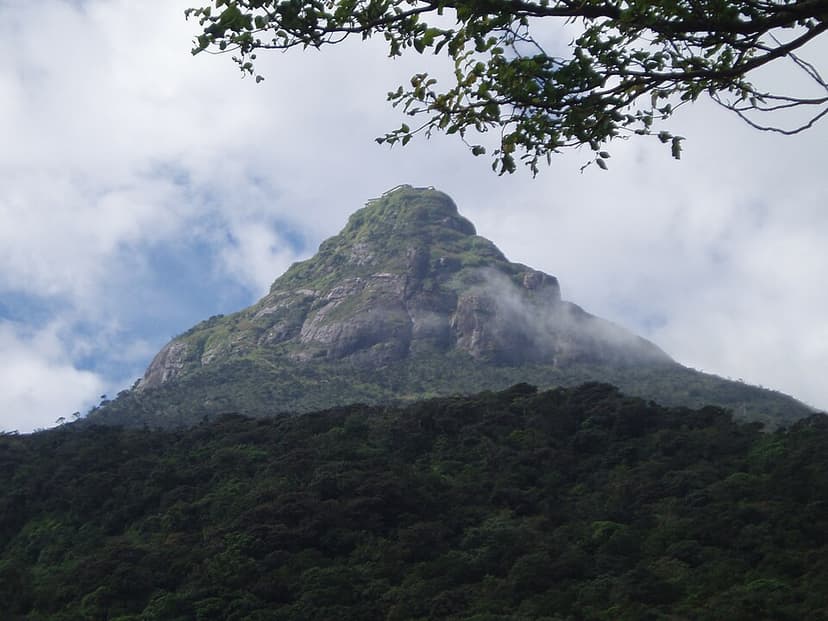
Adam's Peak
Adam's Peak, also known as Sri Pada, is a 2,243-meter-tall conical mountain in central Sri Lanka famed for a sacred footprint-shaped rock formation near its summit. This "sacred footprint" is revered by Buddhists as the Buddha's, by Hindus as Shiva's or Hanuman's, and by some Islamic and Christian traditions as Adam's or St. Thomas the Apostle's, making it a significant pilgrimage site for multiple faiths.