
Mount Diamer
Nanga Parbat, also known by its Shina name Diamer, is the ninth-highest mountain on Earth, reaching an elevation of 8,126 meters (26,660 ft). It is situated in the Gilgit-Baltistan region of Pakistan and serves as the western anchor of the Himalayas. Renowned for its extreme difficulty and high climber fatality rate, it has earned the ominous nickname "Killer Mountain."
Key Facts
- ›Nanga Parbat is the ninth-highest mountain globally, with a summit at 8,126 meters (26,660 ft).
- ›It is the westernmost major peak of the Himalayas and the western anchor of the range.
- ›The mountain is known for its immense vertical relief, including the Rupal Face, one of the highest mountain faces in the world.
- ›It has the second-highest prominence among the 100 tallest mountains on Earth, surpassed only by Mount Everest.
- ›The name "Nanga Parbat" translates from Sanskrit to "naked mountain," referring to its often snowless south face.
- ›Nanga Parbat is considered one of the most difficult and dangerous mountains to climb, earning it the nickname "Killer Mountain."

Diamer, Deo Mir
- the Name "Nanga Parbat" Translates To "Naked Mountain" From Sanskrit, Referencing Its South Face.
- Its Shina Name, Diamer Or Deo Mir, Translates To "Mountain of God" Or "Heavenly Mountain."
- the Mountain's Formidable Reputation Has Led To Its Nickname, "Killer Mountain."
Albert F. Mummery, Willy Merkl, Peter Aschenbrenner, Herbert Kunigk, Alfred Drexel, Erwin Schneider, Ulrich Wieland, Willo Welzenbach, Ang Tsering, Karl Wien, Peter Aufschnaiter, Heinrich Harrer, Hermann Buhl, Toni Kinshofer, Siegfried LöW, A. Mannhardt, GüNther Messner, Reinhold Messner, Ivan Fiala, Michal Orolin, Lilliane Barrard, Maurice Barrard, Jerzy Kukuczka, Zygmunt Heinrich, Slawomir Lobodzinski, Carlos Carsolio, Wanda Rutkiewicz, Krystyna Palmowska, Anna Czerwinska, Barry Blanchard, Mark Twight, Ward Robinson, Kevin Doyle, Tomaž Humar, Vince Anderson, Steve House, José Antonio Delgado, Karl Unterkircher, Walter Nones, Simon Kehrer, Go Mi-Young, Sandy Allan, Rick Allen, Vadim Druelle, Ali Sadpara, Alex Txikon, Simone Moro, Tomasz Mackiewicz, éLisabeth Revol, Maciej Berbeka, Piotr Konopka, Andrzej Osika, John Tinker, Eric Monier, Monique Loscos, Andrzej Zawada, Zbigniew Trzmiel, Krzysztof Pankiewicz, Victor Saunders, Dane Rafael Jensen, Pakistani Ghulam Hassan, Ryszard PawłOwski, Wolfgang GöSchl, Gerfried GöSchl, Krzysztof Wielicki, Jan Szulc, Artur Hajzer, Dariusz ZałUski, Jacek Jawień, Jacek Berbeka, PrzemysłAw łOzińSki, Robert Szymczak, Simone La Terra, Meherban Karim, Jacek Teler, JarosłAw żUrawski, Sergei Nikolayevich Cygankow, Marek Klonowski, Krzaq, Denis Urubko, JoëL Wischnewski, Daniele Nardi, Elisabeth Revol, David Klein, Zoltan Acs, Ian Overton, Emilio Previtali, Paweł Dunaj, Michał Obrycki, Michał Dzikowski, Ralf Dujmovits, David GöTtler
About Mount Diamer
Nanga Parbat: The "Killer Mountain"
Nanga Parbat, also known by its local Shina name Diamer, is a colossal peak in the Gilgit-Baltistan region of Pakistan, holding the distinction of being the ninth-highest mountain on Earth, with its summit reaching 8,126 meters (26,660 ft) above sea level. It marks the westernmost major peak of the Himalayas and serves as the range's western anchor, situated immediately southeast of the Indus River's northernmost bend. The mountain's immense vertical relief is a defining characteristic, featuring the Rupal Face, often cited as the world's highest mountain face, and the Rakhiot Flank, which rises dramatically from the Indus River valley to the summit in a short distance. Nanga Parbat is renowned for its extreme climbing difficulty and has tragically earned the ominous nickname "Killer Mountain" due to a high number of fatalities among those who have attempted to conquer it.
Etymology and Significance
The name "Nanga Parbat" is derived from Sanskrit words meaning "naked mountain," a description that alludes to its south face, which is typically free of snow. The local Shina name, Diamer or Deo Mir, translates to "mountain of God" or "heavenly mountain," reflecting its sacred status in local traditions. Its geological prominence is also remarkable; Nanga Parbat ranks second in prominence among the 100 tallest mountains globally, surpassed only by Mount Everest. This significant prominence underscores its independent stature and dramatic rise above the surrounding landscape.
Climbing History and Challenges
Attempts to climb Nanga Parbat began in the late 19th century, with early expeditions facing significant challenges and casualties. The 1930s saw intense German interest in the mountain, leading to several expeditions marked by hardship and loss. The first successful ascent was achieved on July 3, 1953, by Austrian climber Hermann Buhl, who made a dramatic solo push to the summit. Subsequent ascents have explored various routes, including the Diamir Face, which has become the mountain's "standard route," and the Rupal Face. The ascent of Nanga Parbat remains a formidable undertaking, with climbers like Reinhold Messner achieving notable feats, including the first completely solo ascent of an 8,000-meter peak on its Diamir Face in 1978. The mountain was first climbed in winter on February 26, 2016.
Source: Wikipedia ↗
Frequently Asked Questions
What is the elevation of Nanga Parbat?
Nanga Parbat's summit stands at 8,126 meters (26,660 ft) above sea level, making it the ninth-highest mountain on Earth.
Where is Nanga Parbat located?
Nanga Parbat is located in the Gilgit-Baltistan region of Pakistan-administered Kashmir, immediately southeast of the northernmost bend of the Indus River.
What is the meaning of the name Nanga Parbat?
The name Nanga Parbat is derived from Sanskrit words meaning "naked mountain." Locally, it is known as Diamer or Deo Mir, meaning "mountain of God" or "heavenly mountain."
Why is Nanga Parbat called the "Killer Mountain"?
Nanga Parbat has earned the nickname "Killer Mountain" due to its extreme difficulty and the high number of climber fatalities recorded over its history.
What are the notable faces of Nanga Parbat?
The mountain features three primary faces: the Diamir Face, the Rakhiot Face, and the Rupal Face. The Rupal Face is particularly notable for being one of the highest mountain faces in the world.
When was Nanga Parbat first summited?
Nanga Parbat was first successfully climbed on July 3, 1953, by Austrian climber Hermann Buhl via the Rakhiot Flank (East Ridge).
Related Sacred Mountains

Mount Terich Mir
Mount Terich Mir is the highest peak in the Hindu Kush range, standing as the 33rd highest mountain globally and the tallest outside the Himalayas–Karakoram. Located in the Chitral District of Pakistan, it is a significant landmark visible from the town of Chitral and holds deep spiritual and mythological importance for local communities, including the Kalash and Chitrali people.
Takht-e-Sulaiman
Takht-e-Sulaiman, meaning 'Throne of Solomon,' is a prominent peak in the Sulaiman Mountains of Pakistan's Khyber Pakhtunkhwa province. It holds significant mythological importance, with legends attributing its name to Prophet Solomon and Pashtun mythology identifying it as the burial place of their ancestor, Qais Abdur Rashid. The mountain is characterized by its olive groves and pine-nut forests, and is known for its diverse wildlife.
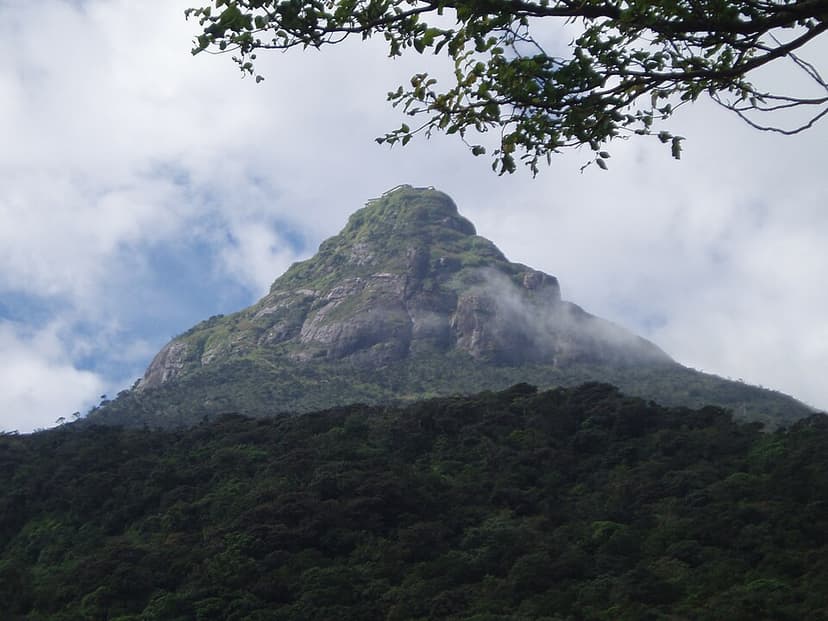
Adam's Peak
Adam's Peak, also known as Sri Pada, is a 2,243-meter-tall conical mountain in central Sri Lanka famed for a sacred footprint-shaped rock formation near its summit. This "sacred footprint" is revered by Buddhists as the Buddha's, by Hindus as Shiva's or Hanuman's, and by some Islamic and Christian traditions as Adam's or St. Thomas the Apostle's, making it a significant pilgrimage site for multiple faiths.