
Cyclops Mountains
The Cyclops Mountains, also known as Dafonsoro or Dobonsolo, are a mountain range in the Indonesian province of Papua, west of Jayapura and north of Lake Sentani. Parts of the range have long been considered sacred by local Papuan people and are recognized for their rich biodiversity, including numerous endemic species.
Key Facts
- ›The mountains were named by Louis de Bougainville after observing them from his ship.
- ›The highest point in the range is Ifar Gunung, reaching an elevation of approximately 2,160 meters.
- ›The Cyclops Mountains were designated as a nature reserve in 1978 and reaffirmed in 1995.
- ›The range is a habitat for many endemic species, including the Cyclops long-beaked echidna (Zaglossus attenboroughi).
- ›A unique cave system within the mountains has been found to harbor several endemic species.
- ›The mountains are part of the Northern New Guinea montane rain forests ecoregion.

Pegunungan Cyclops, Dafonsoro, Dobonsolo
Local Papuan Beliefs
Considered Sacred By Local Papuan People
Louis De Bougainville, Evelyn Cheesman, David Attenborough
About Cyclops Mountains
The Cyclops Mountains, known in Indonesian as Pegunungan Cyclops and by local Sentani people as Dobonsolo, are a significant mountain range located in the Indonesian province of Papua. Situated to the west of Jayapura and north of Lake Sentani, this range holds both ecological and cultural importance.
Geography and Ecology
The highest point in the Cyclops Mountains is Ifar Gunung, reaching an elevation of approximately 2,160 meters. The upper portions of the range are part of the Northern New Guinea montane rain forests ecoregion, while the lower slopes and surrounding areas fall within the Northern New Guinea lowland rain and freshwater swamp forests ecoregion. The mountains are renowned for their exceptional biodiversity, hosting numerous endemic species, many of which remain undescribed due to the remoteness and challenging terrain.
Among the unique fauna found here is the Cyclops long-beaked echidna (Zaglossus attenboroughi), named in honor of naturalist David Attenborough. A distinctive cave system, first explored and described in 2023, has revealed a variety of endemic species. The range also supports unusual life forms such as a tree-dwelling shrimp adapted to high humidity and Mayr's honeyeater, a bird species that was thought to be extinct. A species of lizard, Emoia cyclops, is named in reference to the mountains themselves.
History and Naming
The name "Cyclops Mountains" was given by the explorer Louis de Bougainville, who sighted them from his ship while navigating the north coast of New Guinea. The area has a history of scientific study, with Evelyn Cheesman conducting insect fauna research there in the 1930s. Recognizing its ecological value, parts of the Cyclops Mountains were designated as a nature reserve in 1978, a status reaffirmed in 1995.
Cultural Significance
Beyond their natural wonders, the Cyclops Mountains hold deep cultural meaning for the local Papuan communities, who have long considered parts of the range to be sacred. A biodiversity assessment expedition concluded in 2023, involving a collaboration of international and Indonesian institutions, further highlighted the range's scientific importance by identifying new species.
Source: Wikipedia ↗
Frequently Asked Questions
What is the highest peak in the Cyclops Mountains?
The highest point in the Cyclops Mountains is Ifar Gunung. Its elevation is recorded as either 2,160 meters (7,090 ft) or 2,158 meters (7,080 ft) above sea level.
Who named the Cyclops Mountains?
The Cyclops Mountains were named by Louis de Bougainville. He observed the mountains from a distance while sailing along the north coast of New Guinea.
Are the Cyclops Mountains a protected area?
Yes, parts of the Cyclops Mountains have been designated as a nature reserve. This designation was first made in 1978 and was reaffirmed in 1995.
What kind of unique wildlife can be found in the Cyclops Mountains?
The Cyclops Mountains are known for their rich biodiversity and many endemic species. Notable examples include the Cyclops long-beaked echidna (Zaglossus attenboroughi) and a tree-dwelling shrimp adapted to high humidity. Mayr's honeyeater, once thought extinct, also inhabits the area.
What is the local significance of the Cyclops Mountains?
Parts of the Cyclops Mountains have long been considered sacred by the local Papuan people. The range is also known locally by names such as Dafonsoro or Dobonsolo.
Related Sacred Mountains
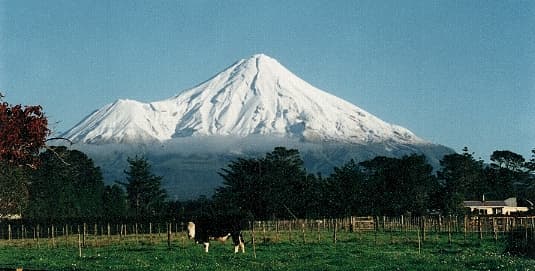
Mount Taranaki
Mount Taranaki, also known as Taranaki Maunga, is a dormant stratovolcano in New Zealand's North Island, revered in Māori mythology and historically significant. It is a prominent natural landmark, recognized for its striking conical shape and its role in local iwi history and culture. The mountain is a popular destination for recreation and pilgrimage, though its unpredictable weather poses significant risks.

Mount Agung
Mount Agung, known locally as Gunung Agung, is Bali's highest point and an active stratovolcano. It holds deep religious significance for the Balinese people, who believe it to be a replica of Mount Meru, the axis of the universe, and is home to the island's most important temple, Pura Besakih. Its eruptions have historically had devastating impacts, but also hold spiritual meaning for the local population.

Mount Bromo
Mount Bromo is an active somma volcano located in East Java, Indonesia, and is a significant Hindu pilgrimage site. Named after the Hindu god of creation, Brahma, it is a prominent feature of the Tengger mountains and a major tourist attraction within Bromo Tengger Semeru National Park. The volcano is situated in the "Sea of Sand" (Segara Wedi), a protected nature reserve.