
Yelizarov Monastery
The Yelizarov Monastery, also known as Yeleazarov Convent, was founded in 1447 by a local peasant named Eleazar. It gained significant prominence in the mid-16th century under the learned hegumen Philotheus of Pskov, becoming known for its icon-painting school and the propagation of the "Third Rome" prophecy. After a period of neglect during the Soviet era, it was revived as a nunnery with patronage from prominent figures.
Key Facts
- ›Founded in 1447 by Eleazar, a local peasant.
- ›Became a significant religious and intellectual center in the MID-16th century.
- ›Associated with the influential hegumen Philotheus of Pskov.
- ›Known for its school of icon-painters.
- ›Revived as a nunnery in the post-Soviet era.
- ›The still-standing cathedral was built during Philotheus's tenure.

Fortified Structures, Icon-Painting School, Cathedral
Yeleazarov Convent, спасо-елеазаровский монастырь
Eleazar, Philotheus of Pskov, Lyudmila Putina, Lyubov Sliska
- Founded In 1447
- Eleazar Interred In 1481
- Eleazar Canonized In 1551
- Became Heavily Fortified and Gained Celebrity In the Mid-16th Century
- Revived As A Nunnery After Soviet Neglect
About Yelizarov Monastery
The Yelizarov Monastery, also known by its Russian name Спасо-Елеазаровский монастырь (Spaso-Yeleazarovsky Monastery) or Yeleazarov Convent, is a significant historical and religious site located north of Pskov, Russia.
Founding and Early History
The monastery was founded in 1447 by a local peasant named Eleazar. He established a wooden church dedicated to the Three Holy Fathers, and upon his death in 1481, he was interred within it. Eleazar's piety and contributions were recognized when he was canonized at the Stoglavy Sobor in 1551.
Rise to Prominence
In the mid-16th century, the Yelizarov Monastery experienced a period of significant growth and importance. It was heavily fortified and gained considerable celebrity, largely due to the influence of its learned hegumen, Philotheus of Pskov. Philotheus is renowned for his authorship of the "Legend of the White Cowl" and the influential "Third Rome" prophecy, which posited Moscow as the successor to Rome and Constantinople as the center of Orthodox Christianity. During his tenure, the monastery also became known for its flourishing school of icon-painters, and its still-standing cathedral was constructed.
Connection to "The Lay of Igor's Campaign"
Some scholarly research suggests a potential link between the monastery and the preservation of ancient Russian literature. Certain academics posit that one of the local monks, possibly under the direction of Philotheus, may have created the only known copy of the epic poem "The Lay of Igor's Campaign."
Revival and Modern Era
Following a prolonged period of neglect during the Soviet era, the Yelizarov Monastery was revived as a nunnery. This revival was notably supported by Lyudmila Putina and Lyubov Sliska, who commissioned a luxurious guest house for their visits. The convent's mother superior at the time was known to have a portrait of Vladimir Putin in her private chambers, and both Putina and Sliska attended her funeral in Moscow in 2010, highlighting the monastery's contemporary connections.
Source: Wikipedia ↗
Frequently Asked Questions
When was the Yelizarov Monastery founded?
The Yelizarov Monastery was founded in 1447 by a local peasant named Eleazar. He constructed a wooden church there and was later interred within it upon his death in 1481.
What significant historical figures are associated with the Yelizarov Monastery?
The monastery is strongly associated with Philotheus of Pskov, a learned hegumen in the mid-16th century. He is credited with authorship of important theological and political prophecies. The founder, Eleazar, was also canonized in 1551.
What made the Yelizarov Monastery important in the 16th century?
In the mid-16th century, the monastery was heavily fortified and achieved great importance and celebrity. This was largely due to its hegumen, Philotheus of Pskov, who was a significant intellectual figure and propagator of the "Third Rome" prophecy.
What is the Yelizarov Monastery known for historically?
Historically, the Yelizarov Monastery was known for its school of icon-painters and its role in the intellectual life of its time, particularly through the writings and influence of Philotheus of Pskov. Some scholars even suggest a connection to the creation of the only known copy of 'The Lay of Igor's Campaign'.
What is the current status of the Yelizarov Monastery?
After suffering neglect during the Soviet era, the Yelizarov Monastery was revived as a nunnery. It has received patronage from notable figures and appears to be an active religious community.
Related Monasteries
Chrysostom Monastery
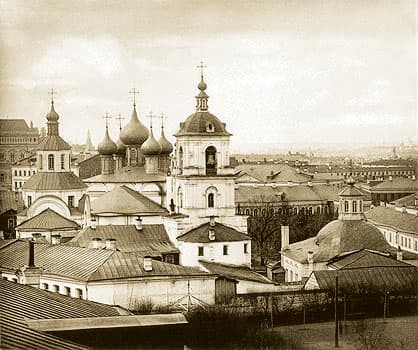
The Chrysostom Monastery was a significant religious institution in Moscow, first mentioned in the early 15th century and consecrated to Saint John Chrysostom. Throughout its history, it endured multiple destructions by fire and conflict, including during the Crimean Khan's attack in 1571 and the Time of Troubles. The monastery was a recipient of noble patronage and royal visits, eventually being secularized and dismantled by the Soviets in 1933, with its former site redeveloped.
Joseph-Volokolamsk Monastery
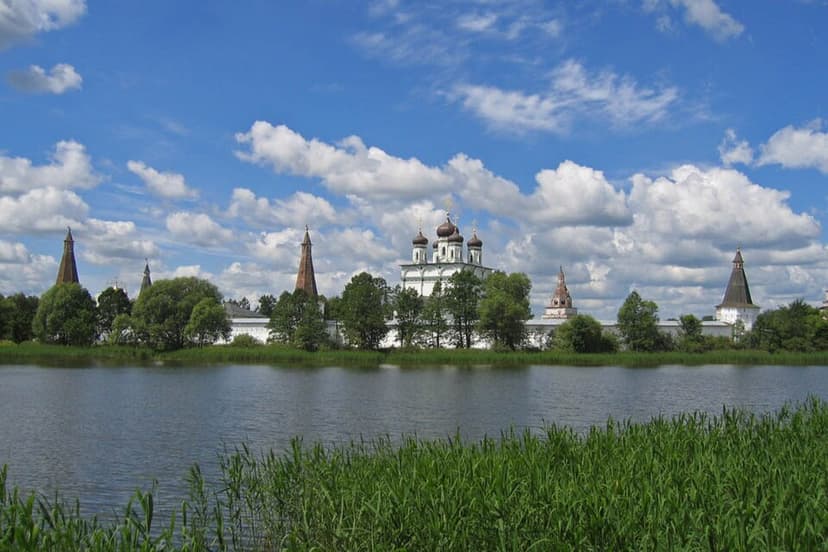
The Joseph-Volokolamsk Monastery, founded in 1479 by Joseph Volotsky, was a prominent Russian Orthodox monastery that rivaled the Trinity Lavra in authority and wealth during the 15th and 16th centuries. It served as a center for Joseph Volotsky's disciples, known as Josephinians, and played a significant role in the political and ecclesiastical life of 16th-century Russia, acting as a stronghold against heresy and a prison for dissenters. Although extensively damaged during World War II and its bell tower destroyed, the monastery's churches have since been restored.

Epiphany Monastery
Epiphany Monastery, also known as Bogoyavlensky Monastyr, is the oldest male Orthodox monastery in Moscow, located in the Kitai gorod district near the Kremlin. Traditionally founded around 1296 by Prince Daniel of Moscow, it has a long history marked by royal patronage, significant fires, and periods of both prosperity and closure. The monastery's surviving Epiphany Cathedral is a notable example of Muscovite Baroque architecture.