
Winchester Cathedral
Winchester Cathedral, officially the Cathedral Church of the Holy Trinity and of Saint Peter and Saint Paul and of Saint Swithun, is a significant medieval cathedral in Winchester, England, renowned for its immense size and architectural evolution. Originally a Norman structure consecrated in 1093, it underwent extensive Gothic expansions and remodels over centuries, resulting in its present form which is the longest medieval cathedral in the world. It serves as the seat of the Bishop of Winchester and is a major tourist attraction, having undergone significant restoration efforts, most notably in the early 20th century to address foundation issues.
Key Facts
- ›The current cathedral was built between 1079 and 1532, with its Norman core dating from 1093.
- ›It is the longest medieval cathedral in the world, measuring 558 feet (170 m) in length.
- ›Its nave is in the Perpendicular Gothic style, while the transepts and tower are Norman.
- ›The cathedral's foundations were famously stabilized in the early 20th century by engineer Francis Fox and diver William Walker.
- ›Jane Austen is buried in the north nave aisle of the cathedral.
- ›It is the mother church for the ancient Diocese of Winchester.

Norman, Early English, Perpendicular Gothic
Longest Medieval Cathedral In the World, Tomb of Jane Austen, Norman Transepts and Tower, Perpendicular Gothic Nave, Early English Retroquire, the Great West Window, Winchester Bible Exhibition
- Cathedral Church of the Holy Trinity and of Saint Peter and Saint Paul and of Saint Swithun In Winchester
King Cenwalh of Wessex, Bishop Wine, Saint Swithun, Bishop æThelwold, Alphege, Alfred the Great, Edward the Elder, William the Conqueror, Walkelin, William Rufus, William Giffard, Godfrey De Luci, Bishop Edington, William of Wykeham, William Wynford, Henry Beaufort, William Waynflete, Peter Courtenay, Thomas Langton, Richard Foxe, Henry Viii, Mary I, Philip of Spain, Robert Horne, Inigo Jones, Daniel Defoe, William Garbett, John Nash, Jane Austen, William Furneaux, Thomas G. Jackson, Francis Fox, William Walker, Abbot of Fleury
- Consecration of the Norman Cathedral In 1093
- Demolition of the Old and New Minsters Beginning In 1093
- Burial of William Rufus Under the Crossing Tower
- Construction of the Early English Retroquire Starting In 1202
- Demolition of the Norman West Front and Construction of the Perpendicular Gothic Facade Starting In 1346
- Remodelling of the Norman Nave Into Perpendicular Gothic Style From the Mid-14th Century
- Dissolution of the Priory of Saint Swithun In 1539
- Marriage of Mary I and Philip of Spain In 1554
- Destruction of Medieval Glass and Imagery By Parliamentarian Soldiers In 1642
- Restoration of the Great West Window As A Mosaic After the Restoration
- Major Restoration Efforts In the Early 19th Century
- Foundation Stabilization and Restoration Project From 1905 To 1911
- Completion of the Nave and West Front Cleaning and Conservation In 2000
- Near-Catastrophic Fire Averted By A Chinese Lantern In 2006
- Completion of A New Single-Storey Extension In 2011
- Extensive Restoration Program From 2012 To 2019, Including Stained-Glass Window Repair and Lead Roof Replacement
- Discovery and Replacement of A Statue On the South Transept Gable End In 2017
- Installation of A Glass Lift For Accessibility In the South Transept In 2017
- Opening of the Kings and Scribes Exhibition In 2019
About Winchester Cathedral
Winchester Cathedral, formally known as the Cathedral Church of the Holy Trinity and of Saint Peter and Saint Paul and of Saint Swithun, stands as one of Northern Europe's largest and most historically significant cathedrals. Located in Winchester, England, it is the seat of the Bishop of Winchester and the mother church of the Diocese of Winchester. The present structure, built primarily between 1079 and 1532, is a testament to centuries of architectural evolution, incorporating Norman, Early English, and Perpendicular Gothic styles.
History and Architecture
While churches have existed on the site since at least the 7th century, with the Old Minster serving as the original cathedral, the current Norman cathedral was initiated by Bishop Walkelin in 1079. Consecrated in 1093, this monumental Norman edifice formed the core of the building. Over subsequent centuries, significant alterations and expansions took place. The Early English retroquire was added starting in 1202, and in the mid-14th century, Bishop Edington began the transformation of the west front into a Perpendicular Gothic facade. This style was further masterfully applied to the nave by Bishop William of Wykeham and his mason William Wynford, who encased the Norman structure in new stonework, creating the soaring Gothic interior seen today. Major rebuilding and expansion of the choir and retroquire continued into the 16th century.
Notable Features and Restoration
Winchester Cathedral holds the distinction of being the longest medieval cathedral in the world, measuring 558 feet (170 meters) in length. It is also the sixth-largest cathedral by area in the UK. A key historical event was the Dissolution of the Monasteries, when the Benedictine Priory of Saint Swithun was dissolved in 1539, and monastic buildings were later demolished. In more recent history, the cathedral faced a grave threat of collapse in the early 20th century due to severe foundation issues. A remarkable restoration project, involving engineer Francis Fox and diver William Walker, stabilized the building by reinforcing its foundations, a feat that saved it from ruin.
Significance and Public Access
Beyond its architectural grandeur, Winchester Cathedral is a significant cultural and religious site. It is the final resting place of many notable figures, most famously the celebrated novelist Jane Austen, whose tomb draws numerous visitors. The cathedral continues to function as an active place of worship and is a major tourist attraction, welcoming hundreds of thousands of visitors annually. Ongoing restoration and conservation efforts ensure the preservation of its rich heritage for future generations, including recent projects to conserve ancient stained-glass windows and the presbytery vault.
Source: Wikipedia ↗
Frequently Asked Questions
What is the history of Winchester Cathedral?
The site has had Christian presence since around 648 AD with the Old Minster. The current Norman cathedral's construction began in 1079 under Bishop Walkelin. It was significantly expanded and remodelled in Gothic styles throughout the medieval period, with major restoration in the 20th century.
What is Winchester Cathedral famous for?
It is renowned for being the longest medieval cathedral in the world and its impressive Norman and Gothic architecture. It also holds the tomb of Jane Austen and significant historical connections to Wessex kings and Norman bishops.
When was Winchester Cathedral built?
The construction of the present Norman cathedral began in 1079 and was consecrated in 1093. However, extensive Gothic expansions and remodelling continued until 1532.
Who is buried at Winchester Cathedral?
Numerous notable figures are buried within Winchester Cathedral. Most famously, the author Jane Austen was interred in the north nave aisle in 1817. Saxon kings and Norman bishops also have tombs within its walls.
What architectural styles can be found at Winchester Cathedral?
The cathedral showcases a blend of architectural styles, reflecting its long construction history. Key styles include Norman (transepts, tower), Early English (retroquire), and Perpendicular Gothic (nave, west front).
Has Winchester Cathedral ever been in danger of collapse?
Yes, at the turn of the 20th century, the cathedral was in severe danger of collapse due to foundation issues. A massive restoration project led by architect Thomas G. Jackson and engineer Francis Fox, with the crucial work of diver William Walker, stabilized the building.
Related Monasteries

Buckfast Abbey
Buckfast Abbey is an active Benedictine monastery located in Buckfast, Devon, England. Originally founded as a Benedictine monastery in 1018, it later became a Savignac and then a Cistercian abbey in 1134. After its dissolution in 1539 and subsequent demolition, French Benedictines refounded the monastery in 1882, and it was formally reinstated as an abbey in 1902. The current abbey church was constructed between 1907 and 1938, and the abbey joined the English Benedictine Congregation in 1960.

Buckfast Monastery
Buckfast Abbey is an active Benedictine monastery located in Buckfast, near Buckfastleigh, Devon, England. Originally founded as a Benedictine abbey in 1018, it later became Savignac and then Cistercian before its dissolution in 1539. Refounded by French Benedictines in 1882, it was formally reinstated as an abbey in 1902 and has since been rebuilt, most notably its abbey church completed in 1938. The abbey is known for its self-sufficiency, producing goods like Buckfast Tonic Wine and being the origin of the Buckfast bee.
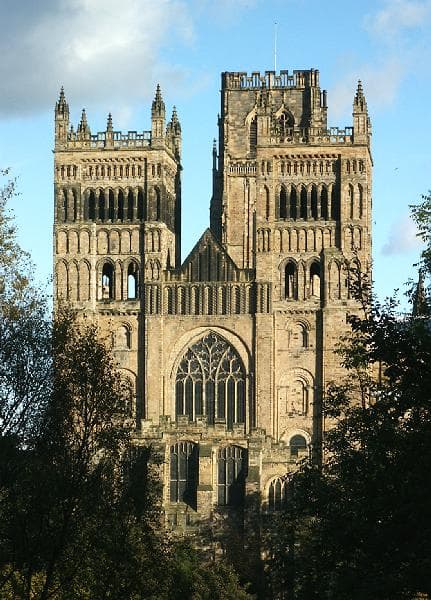
Durham Cathedral Priory
Durham Cathedral Priory, originally the Cathedral Church of Christ, Blessed Mary the Virgin and St Cuthbert of Durham, is a significant Church of England cathedral with a history rooted in Anglo-Saxon monasticism. It succeeded Lindisfarne Priory, becoming a Benedictine monastery until its dissolution in 1541, after which it transitioned to a secular chapter. The current structure is a prime example of Norman Romanesque architecture, notable for its early ribbed vaulting, and houses the shrines of Saints Cuthbert and Bede, making it a long-standing pilgrimage site.