
Tvrdoš Monastery
Tvrdoš Monastery is a Serbian Orthodox monastery located near Trebinje in Bosnia and Herzegovina, with its origins dating back to the late 15th or early 16th century. It historically served as the seat of the archbishops of Herzegovina until its destruction by Venetian forces in 1694. While the current structure was rebuilt in 1924, the monastery is renowned today for its wine production and 15th-century wine cellars, which are a significant tourist draw.
Key Facts
- ›Founded at the end of the 15th or early 16th century.
- ›Served as the seat of the archbishops of Herzegovina.
- ›Destroyed by Venetians in 1694.
- ›Current buildings constructed in 1924.
- ›Famous for its wine production and historic wine cellars.
- ›One of its wine cellars dates back to the 15th century.

15th-Century Wine Cellars, Wine Production Facilities, Chapel of the Resurrection of the Lord
Manastir Tvrdoš
Atanasije Jevtić
Destruction By Venetian Forces In 1694
About Tvrdoš Monastery
Tvrdoš Monastery is a historic Serbian Orthodox monastery situated near the town of Trebinje in Bosnia and Herzegovina. Its foundations were laid at the end of the 15th or in the early 16th century, establishing it as a significant religious and administrative center.
History and Significance
The monastery served as the seat of the archbishops of Herzegovina for a period. Its history took a dramatic turn in 1694 when it was destroyed by Venetian overseas dominion. The current monastery buildings were reconstructed in 1924, preserving the site's continuity.
Modern Day Attractions
Today, Tvrdoš Monastery is widely recognized for its thriving wine production, specializing in local grape varieties such as Vranac and Žilavka. The monastery's ancient wine cellars, with one dating back to the 15th century, are a compelling attraction for visitors, offering a glimpse into centuries of winemaking tradition. The monastery is also a place of spiritual repose, having recently become the burial site for the retired Bishop Atanasije Jevtić.
Source: Wikipedia ↗
Frequently Asked Questions
When was Tvrdoš Monastery established?
Tvrdoš Monastery was established at the end of the 15th century or in the early 16th century. The monastery's history stretches back to this period, making it a significant historical site.
What is Tvrdoš Monastery known for today?
Today, Tvrdoš Monastery is renowned for its wine production, particularly from Vranac and Žilavka grape varieties. Its historic wine cellars, with one dating back to the 15th century, are also a popular tourist attraction.
What happened to the original monastery buildings?
The original monastery was destroyed in 1694 during the Venetian overseas dominion. The current monastery buildings were constructed much later, in 1924.
Is Tvrdoš Monastery an active religious site?
Yes, Tvrdoš Monastery is a Serbian Orthodox monastery. In 2021, the retired Bishop Atanasije Jevtić was buried at the monastery's cemetery, indicating its continued religious significance.
Related Monasteries
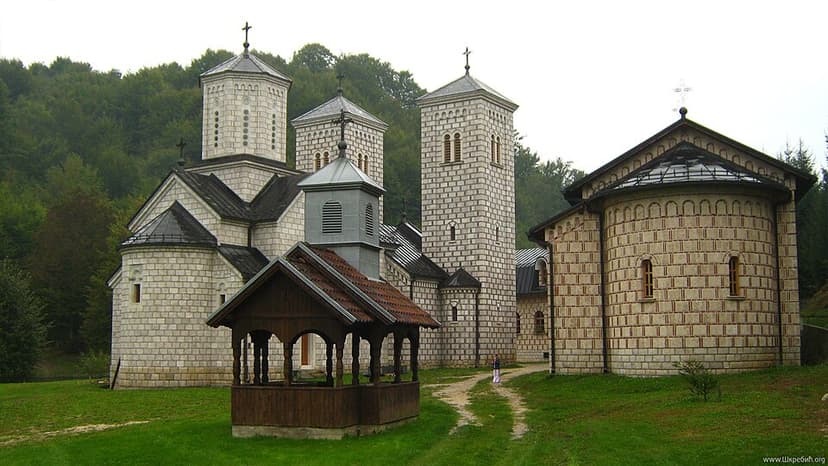
Stuplje Monastery
Stuplje Monastery is a Serbian Orthodox monastery dedicated to Archangel Michael, located in Gornji Vijačani, Bosnia and Herzegovina. While folk tradition links its founding to King Dragutin, historical records suggest its earliest mention dates to the late 15th century. After being destroyed by the Ottomans, its location was lost until archaeological discoveries in the 1990s led to its reconstruction and consecration in 2008.

Rmanj Monastery
Rmanj Monastery is a Serbian Orthodox monastery located in Martin Brod, Bosnia and Herzegovina, dedicated to Saint Nicholas. Its history is marked by frequent destruction and rebuilding, with the original construction dating to the late 15th or early 16th century. It served as a significant religious and administrative center, particularly as the seat of the Metropolitanate of Dabro Bosnia for over a century, and has been declared a National Monument of Bosnia and Herzegovina.

Čajniče Monastery
Čajniče Monastery, located in Bosnia and Herzegovina, is a Serbian Orthodox monastery renowned for its Church of the Assumption of the Blessed Mother of God. The monastery houses two churches: an older one dating from the late 16th or early 17th century and a newer one built in 1857. It is particularly famous for the miraculous icon of the Holy Virgin, a 14th-century Byzantine artwork, and the Čajniče Gospel, the oldest gospel written in Bosnia.