
Stuplje Monastery
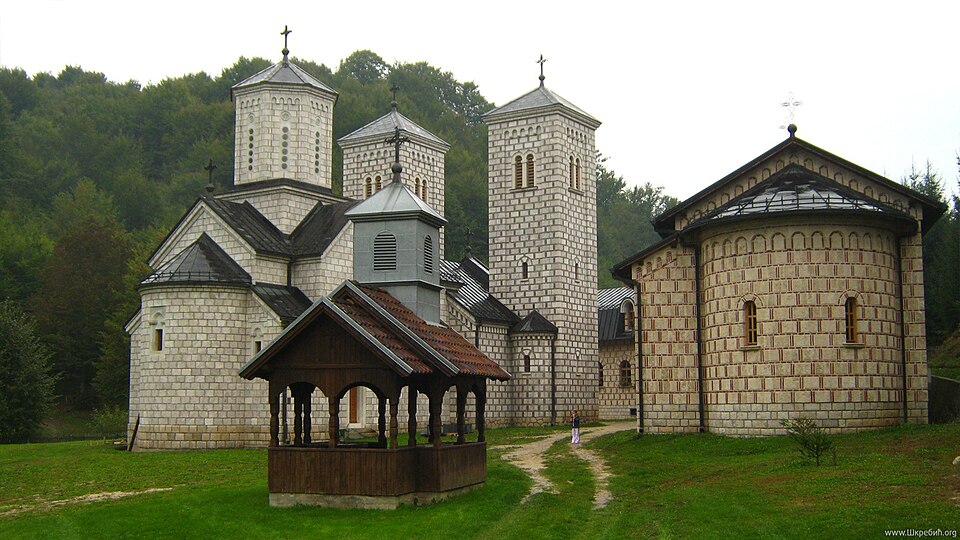
Stuplje Monastery is a Serbian Orthodox monastery dedicated to Archangel Michael, located in Gornji Vijačani, Bosnia and Herzegovina. While folk tradition links its founding to King Dragutin, historical records suggest its earliest mention dates to the late 15th century. After being destroyed by the Ottomans, its location was lost until archaeological discoveries in the 1990s led to its reconstruction and consecration in 2008.
Key Facts
- ›Dedicated to Archangel Michael.
- ›Located in Gornji Vijačani, near Čelinac, Bosnia and Herzegovina.
- ›Folk tradition attributes its founding to King Dragutin.
- ›Earliest mention in a chronicle dated to the end of the 15th century.
- ›Destroyed by the Ottomans during the Great Turkish War (1683–1699).
- ›Rebuilt and consecrated in 2008 based on archaeological finds.
Foundation of A Basilica-Shaped Church, Foundation of A Monastic Building, Toponyms Indicating Its Historical Use
Manastir Stuplje
King Dragutin
- Ottoman Conquest of the Kingdom of Bosnia
- Ottoman Conquest of North-Western Bosnia
- Great Turkish War
- Destruction By Ottomans During the Great Turkish War
- Reconstruction and Consecration
About Stuplje Monastery
The Stuplje Monastery is a Serbian Orthodox monastic complex dedicated to Archangel Michael, situated in the village of Gornji Vijačani, near the town of Čelinac, within the region of Republika Srpska in Bosnia and Herzegovina. While local tradition attributes its founding to King Dragutin of the Nemanjić dynasty, historical evidence points to its earliest mention in a chronicle dating from the close of the 15th century. The monastery faced destruction by the Ottoman Empire during the Great Turkish War (1683–1699), leading to the displacement of its monks and the loss of its physical presence for centuries.
Rediscovery and Reconstruction
Following its destruction, the exact location of Stuplje Monastery became obscure for a prolonged period, with historical references placing it in various vicinities. A significant breakthrough occurred in March 1994 when two local individuals, guided by suggestive toponyms like Crkvište (meaning 'church site'), Manastirica ('monastery stream'), and Kaluđersko Brdo ('monk's hill'), discovered the foundation of a basilica-style church. Archaeological investigations in 1997 further revealed the remains of a monastic building, confirming the site's identity as the lost Stuplje Monastery. On the initiative of the Eparchy of Banja Luka, the monastery was subsequently rebuilt on the discovered foundations and was consecrated in late 2008, restoring its presence as an active religious center.
Source: Wikipedia ↗
Frequently Asked Questions
When was Stuplje Monastery founded?
Folk tradition credits King Dragutin with its establishment. However, the earliest written mention of Stuplje appears in a chronicle from the end of the 15th century. The exact founding date remains uncertain due to the loss of historical documents.
What happened to Stuplje Monastery?
During the Great Turkish War (1683–1699), the monastery was burned down by the Ottomans. The surviving monks fled to Orahovica Monastery in Slavonia, taking many of their manuscript books with them. For a long time, the location of Stuplje was unknown.
How was the location of Stuplje Monastery rediscovered?
In March 1994, two locals searched for the monastery in the village of Gornji Vijačani at a site called Crkvište. They found the foundation of a basilica-shaped church, and subsequent archaeological excavations in 1997 uncovered the foundation of a monastic building, leading scholars to conclude these were the remains of Stuplje Monastery.
Is Stuplje Monastery still active?
The Stuplje Monastery was rebuilt on the site of the archaeological finds and was consecrated at the end of 2008. It is now an active religious site.
What is the religious tradition of Stuplje Monastery?
Stuplje Monastery is a Serbian Orthodox monastery.
Related Monasteries

Tvrdoš Monastery
Tvrdoš Monastery is a Serbian Orthodox monastery located near Trebinje in Bosnia and Herzegovina, with its origins dating back to the late 15th or early 16th century. It historically served as the seat of the archbishops of Herzegovina until its destruction by Venetian forces in 1694. While the current structure was rebuilt in 1924, the monastery is renowned today for its wine production and 15th-century wine cellars, which are a significant tourist draw.

Rmanj Monastery
Rmanj Monastery is a Serbian Orthodox monastery located in Martin Brod, Bosnia and Herzegovina, dedicated to Saint Nicholas. Its history is marked by frequent destruction and rebuilding, with the original construction dating to the late 15th or early 16th century. It served as a significant religious and administrative center, particularly as the seat of the Metropolitanate of Dabro Bosnia for over a century, and has been declared a National Monument of Bosnia and Herzegovina.

Čajniče Monastery
Čajniče Monastery, located in Bosnia and Herzegovina, is a Serbian Orthodox monastery renowned for its Church of the Assumption of the Blessed Mother of God. The monastery houses two churches: an older one dating from the late 16th or early 17th century and a newer one built in 1857. It is particularly famous for the miraculous icon of the Holy Virgin, a 14th-century Byzantine artwork, and the Čajniče Gospel, the oldest gospel written in Bosnia.