
Tsakhats Kar Monastery
Tsakhats Kar Monastery is an Armenian monastic complex located in the Vayots Dzor Province of Armenia, overlooking the Yeghegis River. Founded in the 10th century during the Bagratid kingdom, it served as a significant medieval educational institution, particularly for painting. The monastery is divided into two groups of structures, with the western section now largely in ruins, and features several churches, including Surb Hovhannes and Surb Karapet, along with numerous khachkars.
Key Facts
- ›Located in the Vayots Dzor Province of Armenia, near the villages of Yeghegis and Horbategh.
- ›Founded in the 10th century during the Bagratid kingdom.
- ›Served as a medieval educational institution, with a focus on painting.
- ›Comprises two main groups of structures separated by 200 meters.
- ›Features ruins of Surb Hovhannes church (built 989) and Surb Karapet church (10th century).
- ›Numerous khachkars are present around the monastery.

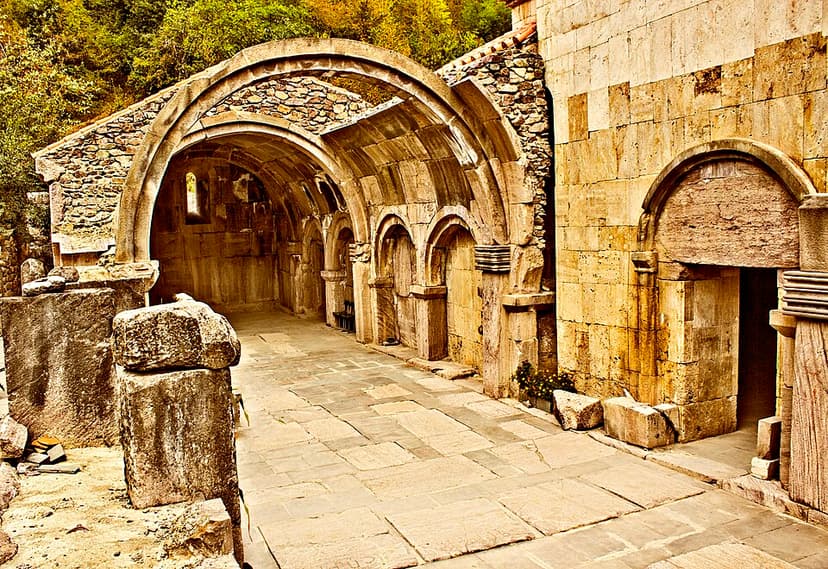
Cupola Hall
Surb Hovhannes Church, Surb Karapet Church, Khachkars, Medieval Educational Institution
Tsaghats Kar Monastery
About Tsakhats Kar Monastery
Tsakhats Kar Monastery is an Armenian monastic complex situated in the Vayots Dzor Province of Armenia. Perched along the mountain foothills, it overlooks the Yeghegis River and is located between the villages of Yeghegis and Horbategh. The monastery is also found within walking distance of the fortress of Smbataberd.
Historical Context and Significance
Historical records indicate that the church at Tsakhats Kar was constructed in the 10th century, during the era of the Bagratid kingdom. The historian Asoghik documented information pertaining to its construction. Beyond its religious function, Tsakhats Kar served as a vital medieval educational institution, notably for the study of painting. One hypothesis suggests that the monastery's name, possibly derived from the Armenian for "flowered stone" (Ծաղկած Քար or Ցաղաց Քար), relates to this distinctive stone.
Structures and Features
The monastery site is characterized by two distinct groups of structures, separated by approximately 200 meters (656 feet). The western grouping, which is now largely half-ruined, was originally built from rough-hewn basalt. Within the complex, notable structures include Surb Hovhannes church, completed in 989, and the 10th-century Surb Karapet church. Surb Karapet is architecturally described as a cupola hall type structure, with sacristies located in each of its four corners. The monastery grounds are also adorned with numerous khachkars, a distinctive type of Armenian carved stone cross.
A natural spring, referred to as a pipe-spring, is located on the right side shortly after crossing the river in the vicinity of the monastery.
Source: Wikipedia ↗
Frequently Asked Questions
When was Tsakhats Kar Monastery founded?
Tsakhats Kar Monastery was founded in the 10th century, during the period of the Bagratid kingdom in Armenia. Historical records mention its construction during this era.
What was the significance of Tsakhats Kar Monastery in the Middle Ages?
In the Middle Ages, Tsakhats Kar Monastery was an important educational institution. It was a place where subjects such as painting were studied, contributing to its historical and cultural importance.
What are the main structures within Tsakhats Kar Monastery?
The monastery complex includes Surb Hovhannes church, built in 989, and the 10th-century Surb Karapet church. Many other structures are present but are now in ruins.
What is the architectural style of the churches at Tsakhats Kar Monastery?
The Surb Karapet church is described as a cupola hall type structure. It features a sacristy located in each of its four corners.
Where is Tsakhats Kar Monastery located?
Tsakhats Kar Monastery is situated in the Vayots Dzor Province of Armenia. It is located along the mountain foothills overlooking the Yeghegis River, between the villages of Yeghegis and Horbategh.
Related Monasteries

Marmashen Monastery
Marmashen Monastery is a 10th-century Armenian monastic complex located in the Shirak Province of Armenia, near the village of Marmashen. The complex comprises five churches and exhibits architectural styles similar to those of Khtzkonk Monastery. It was constructed by Vahram Pahlavouni, a significant figure in Armenian history.
Vahanavank
Vahanavank is a 10th-11th century Armenian Apostolic cathedral located in the Syunik Province of Armenia, west of Kapan. Founded by Prince Vahan Nakhashinogh, it served as a religious and educational center for the kings of Syunik and housed a spiritual school. The monastery complex includes the oldest church, Surb Grigor Lusavorich, built in 911, and later additions like the Surb Astvatsatsin church.

Vanevan Monastery
Vanevan Monastery is an Armenian Apostolic monastery located in the Gegharkunik Province of Armenia, southeast of Lake Sevan. Its main church, Saint Grigor, was constructed in 903 by Prince Shapuh Bagratuni and his sister Mariam. The monastery holds historical significance as the burial site of King Smbat I of Armenia and is noted for its distinct architectural features, particularly in the design of its churches.