
Trisulti Charterhouse
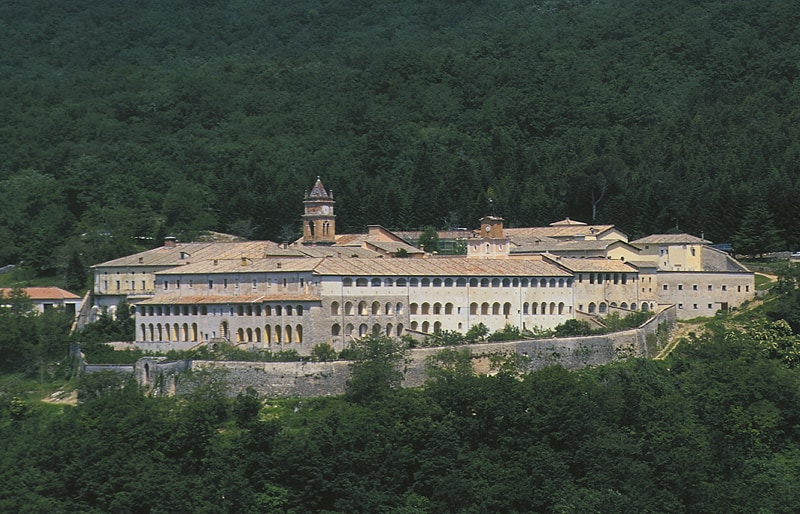
Trisulti Charterhouse is a historic monastery located in Collepardo, Italy, with a complex history dating back to a Benedictine abbey founded in 996. It was later assigned to the Carthusians by Pope Innocent III in 1204, with its church consecrated in 1211. The monastery has undergone significant renovations, particularly in the Baroque style, and is now owned by the Cistercians. It gained notoriety in 2018 when plans were announced to establish a "gladiator school" for right-wing politicians, a venture that led to legal disputes.
Key Facts
- ›Founded as a Benedictine abbey in 996 by Saint Dominic Abbot.
- ›Rebuilt and assigned to the Carthusians by Pope Innocent III starting in 1204.
- ›The abbey church was consecrated in 1211.
- ›Underwent significant Baroque restoration, giving it its current appearance.
- ›Currently operated by the Cistercian Congregation of Casamari Abbey since 1947.
- ›Features a Romanesque-Gothic guesthouse known as the "Palace of Innocent III" with a library of 36,000 volumes.
Romanesque-Gothic, Baroque
- Library of 36,000 Volumes
- Palace of Innocent Iii
- 18th-Century Pharmacy
- Bust of Saint Bartholomew By Jacopo Lo Duca
- Two Wooden Choirs Dating From 1564 and 1688
- Frescoed Ceiling Depicting the Glory of Paradise
Certosa Di Trisulti
Saint Dominic Abbot, Pope Innocent Iii, Jacopo Lo Duca, Paolo Posi, Giuseppe Kofler, Giuseppe Caci, Vincenzo Manenti, Filippo Balbi, Giacomo Manco, Steve Bannon, Benjamin Harnwell
- Consecrated In 1211.
- Became A National Monument In 1873.
- Taken Over By the Cistercian Congregation of Casamari Abbey In 1947.
- Announced Plans For A "Gladiator School" In 2018.
- Eviction and Subsequent Legal Dispute Regarding Lease In 2018-2024.
About Trisulti Charterhouse
Trisulti Charterhouse, or Certosa di Trisulti, is a historically significant monastery situated in Collepardo, within the province of Frosinone in central Italy. Nestled on the slopes of Monte Rotonaria at an elevation of 825 meters, its origins trace back to a Benedictine abbey founded in 996 by Saint Dominic Abbot. The current complex, however, was substantially erected starting in 1204 under the directive of Pope Innocent III, who entrusted it to the Carthusian order. The abbey church, dedicated to Saint Bartholomew, received its consecration in 1211.
The name "Trisulti" is thought to originate from the Latin "tres saltibus," signifying "at the three jumps," likely referencing a castle belonging to the Colonna family that controlled three vital mountain passes. Over the centuries, the charterhouse underwent numerous enlargements and modifications, with its present appearance largely reflecting a Baroque restoration.
In 1947, the monastery transitioned to the Cistercian Congregation of Casamari Abbey, where it continues to function as an active Cistercian community. The charterhouse is enclosed by imposing walls and features a Romanesque-Gothic guesthouse, commonly referred to as the "Palace of Innocent III." This guesthouse includes a portico, a terrace, and a notable library housing 36,000 volumes. The church of San Bartolomeo, originally Gothic, was extensively rebuilt in the Baroque style, featuring a façade designed by Paolo Posi in 1798. The interior contains finely carved wooden choirs, frescoes by Giuseppe Caci, and altarpieces by Vincenzo Manenti and others. The complex also boasts an 18th-century pharmacy adorned with trompe-l'œil frescoes.
Trisulti Charterhouse gained international attention in 2018 when plans were announced by Steve Bannon to establish a "gladiator school" for aspiring right-wing politicians within its walls. This initiative led to a legal dispute involving the Dignitatis Humanae Institute and the Italian government, concerning allegations of unpaid rent and fraudulent lease acquisition, though an Italian court later ruled in favor of the lease being obtained correctly.
Source: Wikipedia ↗
Frequently Asked Questions
When was Trisulti Charterhouse founded?
A Benedictine abbey was first founded on the site in 996 by Saint Dominic Abbot. The current Carthusian monastery began construction in 1204.
What is the religious tradition of Trisulti Charterhouse?
Trisulti Charterhouse was originally a Carthusian monastery. Since 1947, it has been operated by the Cistercian Congregation of Casamari Abbey.
What are some notable architectural features of Trisulti Charterhouse?
The complex features a Romanesque-Gothic guesthouse, often called the "Palace of Innocent III," which includes a portico, terrace, and a substantial library. The church of San Bartolomeo, though originally Gothic, was largely rebuilt in the Baroque style, with an 18th-century pharmacy also part of the complex.
What is the significance of the name Trisulti?
The name Trisulti is believed to derive from the Latin "tres saltibus," meaning "at the three jumps." This likely refers to a castle of the Colonna family that controlled three mountain passes.
Has Trisulti Charterhouse been involved in any recent controversies?
Yes, in 2018, plans were announced by Steve Bannon to establish a "gladiator school" for right-wing politicians at the charterhouse. This led to a legal dispute over the lease of the property.
Related Monasteries

Brixen
Brixen, also known as Bressanone, is a historic town and municipality in South Tyrol, northern Italy, situated at the confluence of the Eisack and Rienz rivers. It is the third-largest city and oldest town in the province, known for its German-speaking majority and rich history dating back to the Upper Paleolithic. The town boasts significant religious and secular architecture, including its cathedral and the Renaissance Bishop's Palace, and is a center for culture and tourism, particularly for its nearby ski resort, Plose.

Santa Maria Casanova
The Abbey of Santa Maria Casanova was a significant Cistercian monastery established in 1191 and completed in 1208, marking the first Cistercian foundation in Abruzzo, Italy. Although nearly all of its structures were demolished after its suppression in 1807, a lone tower, recently restored, remains as a testament to its former presence. It played a role in the Cistercian network, serving as a mother abbey to several other foundations.

Marienberg Abbey
Marienberg Abbey is a Benedictine monastery located in Mals, South Tyrol, northern Italy, founded in 1149 or 1150. It is notable for being Europe's highest-standing abbey at 1,340 meters and for its long tradition of education. The abbey retains a Baroque architectural style with Romanesque elements and features well-maintained frescos, having undergone periods of destruction and restoration throughout its history.