
Tiger Cave Temple
Tiger Cave Temple, also known as Wat Tham Suea, is a significant Buddhist temple located north-northeast of Krabi, Thailand. Founded in 1975 by Vipassana monk Jumnean Seelasettho, the temple is renowned for its sacred tiger paw prints within the cave, impressive Buddha statues, and the challenging ascent via a long flight of stairs to its summit. The site holds archaeological and historical importance, with artifacts and natural features contributing to its unique spiritual and geographical character.
Key Facts
- ›The temple's foundation dates to 1975 (B.E. 2518).
- ›It is named after legends of tigers in the cave and discovered tiger paw prints.
- ›A strenuous staircase of 1,260 steps leads to the summit.
- ›A large golden Buddha statue is situated at the mountain's peak.
- ›The temple serves as a Thai Buddhist meditation center.
- ›Ancient artifacts and human remains are found within the temple grounds.

Tiger Paw Prints In the Cave, Tall Buddha Statues, Strenuous Flight of Stairs To the Summit, Tropical Rainforest Surroundings, Ancient Artifacts, Human Skeletons and Decorated Skulls
Wat Tham Suea
Jumnean Seelasettho
About Tiger Cave Temple
Tiger Cave Temple (Wat Tham Suea)
Tiger Cave Temple, known locally as Wat Tham Suea, is a notable Buddhist site situated to the north-northeast of Krabi, Thailand. Its origins trace back to 1975 (B.E. 2518) when the Vipassana monk Jumnean Seelasettho established it as a meditation center within a cave. The temple's name is derived from local legends of tigers inhabiting the cave, supported by the discovery of tiger paw prints on the cave walls and the cave's natural contours resembling a tiger's paw.
Geography and Archaeology
The temple is nestled within a tropical rainforest environment, part of the Kiriwong Valley, and is surrounded by mountains. The area features several caves accessible to visitors, such as Tum Khon Than, Tum Lod, Tum Chang Kaeo, and Tum Luk. Significant archaeological discoveries have been made in the vicinity, including stone tools, pottery shards, and molded Buddha footprints, alongside human skeletons and decorated skulls found within the temple grounds, highlighting its long history.
Ascent and Summit
A prominent feature of Tiger Cave Temple is the challenging staircase leading to its summit. Originally comprising 1,237 steps, it has been updated to include 1,260 steps, many with risers exceeding a foot in height. This strenuous ascent culminates at an elevation of 278 meters, offering visitors a rewarding view. At the apex, a large golden Buddha statue stands, providing a focal point for reflection and offering expansive vistas of the surrounding landscape, including much of Krabi town.
Monastic Life and Features
Tiger Cave Temple functions as a Thai Buddhist meditation center. The monks reside in caves located in the foothills area, accessed by a separate set of 184 steps. Monkeys are a common sight on the lower stairs and grounds, coexisting with the temple's visitors and residents. The temple's unique blend of natural beauty, spiritual significance, and historical artifacts makes it a significant pilgrimage and tourist destination.
Source: Wikipedia ↗
Frequently Asked Questions
When was Tiger Cave Temple founded?
The foundation of Tiger Cave Temple dates back to 1975 (B.E. 2518). It was established when a Vipassana monk named Jumnean Seelasettho chose to meditate in the cave.
What is the significance of the name 'Tiger Cave Temple'?
The temple derives its name from legends of tigers that once roamed the cave. Further reinforcing this, tiger paw prints have been discovered on the cave walls, and the cave's natural bulge resembles a tiger's paw.
How many steps are there to the summit of Tiger Cave Temple?
The main staircase leading to the summit of Tiger Cave Temple has been recently updated and now consists of 1,260 steps. The elevation at the top of these stairs is 278 meters.
What can be seen from the summit of Tiger Cave Temple?
From the shrine at the top of the stairs, visitors can see a large golden Buddha statue, other temple buildings, and much of Krabi town. The panoramic view offers a significant vantage point.
Are there any archaeological findings at Tiger Cave Temple?
Yes, the temple grounds and surrounding caves have yielded ancient artifacts. These include stone tools, pottery shards, molded Buddha footprints, and human skeletons and decorated skulls have been observed in various parts of the temple.
Related Monasteries

Thailand
Thailand, officially the Kingdom of Thailand and formerly known as Siam, is a country in Mainland Southeast Asia with a rich history dating back to at least 40,000 years of human habitation. Its recorded history is marked by the rise and fall of powerful kingdoms, including Sukhothai, Lan Na, and Ayutthaya, with the latter being a significant regional power before its destruction in 1767. The nation adopted its current name and transitioned to a constitutional monarchy in 1932, navigating periods of both democracy and military rule, and establishing itself as a key geopolitical player in Southeast Asia.
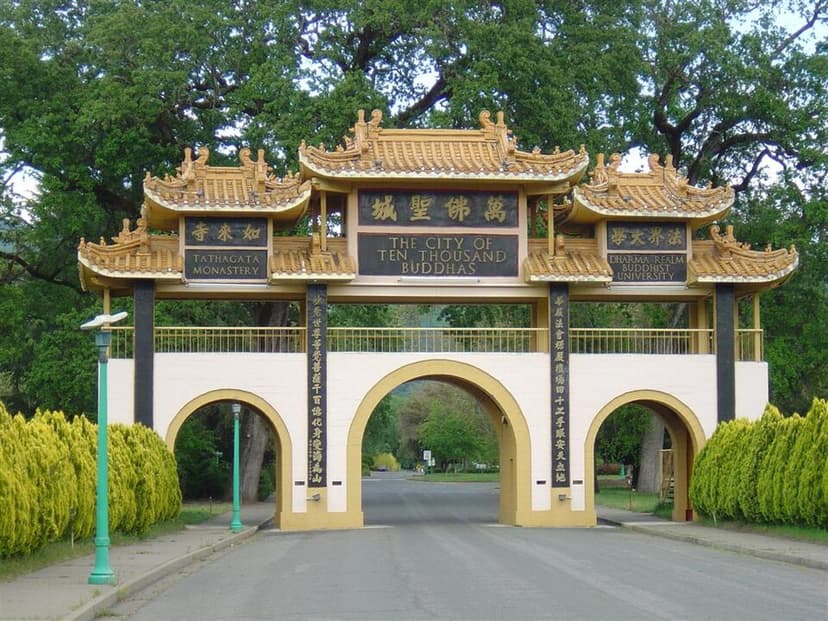
City of Ten Thousand Buddhas
The City of Ten Thousand Buddhas is a significant international Buddhist community and monastery in Talmage, California, founded by the influential figure Hsuan Hua. It was established as one of the first Chan Buddhist temples in the United States and is recognized for its strict adherence to traditional Buddhist monastic codes, including the vinaya. The community encompasses educational institutions, residential facilities, and an organic farm, serving as a major center for propagating Buddhist teachings in the Western Hemisphere.
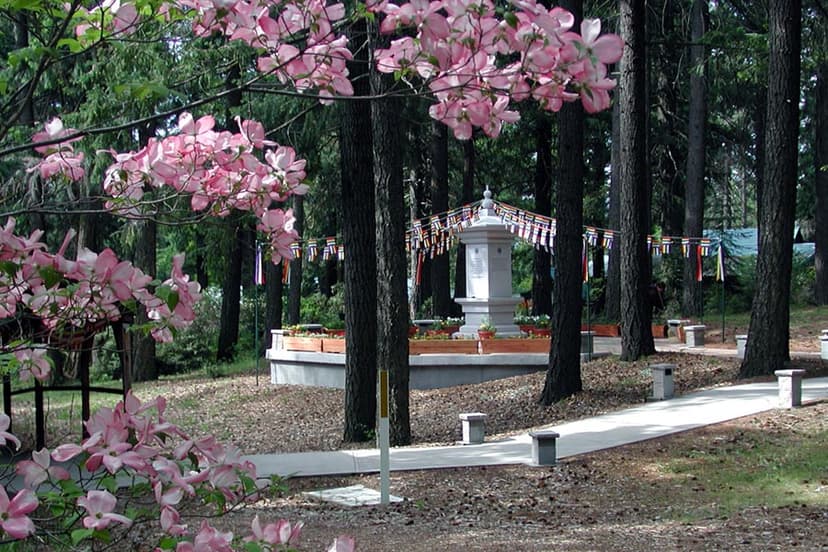
Shasta Abbey
Shasta Abbey is a training monastery for Buddhist monks and a practice center for lay Buddhists and visitors, located on sixteen forested acres near Mount Shasta in northern California. Established in 1970 by Reverend Master P.T.N.H. Jiyu-Kennett, it is part of the Order of Buddhist Contemplatives (OBC). The monastery emphasizes the practice of Serene Reflection Meditation (Sōtō Zen) and the keeping of Buddhist Precepts, offering a refuge for spiritual practice and publishing Buddhist texts.