
Svensky Monastery
Svensky Monastery is a historic Russian Orthodox monastery situated near Bryansk, Russia, at the confluence of the Desna and Sven Rivers. Traditionally founded by Prince Roman of Bryansk following a miraculous icon appearance, it became a significant religious and economic center, known for its lively fair. Despite periods of destruction and closure, the monastery has seen restoration and the return of its monastic community.
Key Facts
- ›Traditionally founded by Prince Roman of Bryansk, who was reportedly buried there.
- ›Associated with a miraculous icon of the Theotokos Panachrantos, attributed by some to St. Alypius.
- ›Suffered repeated raids by Crimean Tatars in the 16th century.
- ›Transformed into a branch of the Kiev Pechersk Lavra in 1682, known as New Pechersk monastery.
- ›Buildings were extensively rebuilt in Cossack Baroque and Baroque styles during the 17th and 18th centuries.
- ›Closed by the Bolsheviks in 1926 and reopened for monks in 1992.

Cossack Baroque, Baroque
Miraculous Icon of the Theotokos Panachrantos, Site of A Historically Lively Fair
Svinsky Monastery, New Pechersk Monastery
Prince Roman of Bryansk, St. Mikhail of Chernigov, St. Alypius, Ivan the Terrible, Prince Ivan Mstislavsky, Peter the Great, Ivan Fyodorovich Michurin
- Repeatedly Sacked By Crimean Tatars In the 16th Century
- Transformed Into A Branch of the Kiev Pechersk Lavra In 1682
- Closed By the Bolsheviks In 1926
- Reopened For Monks In 1992
About Svensky Monastery
Svensky Monastery is a historic Russian Orthodox monastery situated at the confluence of the Desna and Sven Rivers, approximately three miles from the city of Bryansk, Russia. Originally known as Svinsky Monastery, named after the Svin River, its spelling was later altered to Svensky to avoid the Russian word for "swine."
Legendary Foundation and Early History
Church legends attribute the monastery's founding to Prince Roman of Bryansk, who is also reportedly buried there. The tradition holds that the monastery was established at the location where a miraculous icon of the Theotokos appeared to Roman, the second son of St. Mikhail of Chernigov, and cured him of blindness. The tree from which this icon was found was reputedly chopped down for icon painting. The miraculous icon itself is believed to represent the Theotokos Panachrantos with Saints Anthony and Theodosius and is popularly attributed to St. Alypius, a celebrated icon-painter of Kievan Rus'. Scholar Nikodim Kondakov suggested the icon might have been modeled on a mosaic from the Assumption Cathedral in the Kiev Pechersk Monastery.
16th Century and Royal Patronage
During the 16th century, Svensky Monastery faced repeated raids by the Crimean Tatars. Following one such raid, Ivan the Terrible provided funds for the construction of a five-domed cathedral, a refectory church, and a belltower. The doors of the cathedral, noted for their rare craftsmanship, were a donation from Prince Ivan Mstislavsky. The church of Saints Anthony and Theodosius commenced construction on May 19, 1566, and despite a vault collapse a year later, it was restored.
Transformation and Baroque Period
After Russia acquired Left-bank Ukraine through the Treaty of Andrusovo, the monastery became the site of the region's most vibrant annual fair. Its close ties with the Kiev Pechersk Lavra led to its transformation in 1682 into a branch of the lavra, and its name was changed from Svensky to New Pechersk monastery. During this period of Ukrainian influence, Cossack Baroque architectural elements were widely incorporated into its buildings. The Presentation Church, featuring three towers above the main entrance, was erected in the simplified Ukrainian Baroque style in the late 1680s. The main cathedral was rebuilt in the Baroque style in 1715, and the ancient clocktower was extended to a height of 42 meters. The Saviour Church, built over the fair gates, was constructed in five levels with a surrounding gallery in 1742. The monastery's defensive walls were erected between 1749 and 1769.
18th Century Cathedral and Decline
Construction began on a new cathedral on July 30, 1749, intended to be modeled after the New Cathedral of the Donskoi Monastery in Moscow. The design is believed to have been commissioned from Ivan Fyodorovich Michurin, who had overseen the construction of St. Andrew's Church in Kiev. The new cathedral bore a resemblance to St. Clement's Church in Zamoskvorechye, also ascribed to Michurin. A seven-tier Baroque iconostasis from the old cathedral was carefully preserved and installed in the new structure before its consecration in 1758. No further new construction occurred after this period.
19th Century Decline and Soviet Era Closure
The monastery experienced a decline in the 19th century, particularly after the fair was relocated to Bryansk in 1864. A garden was planted on its historical site, featuring cedars, chestnuts, and cherry trees. In 1926, the Bolsheviks closed the monastery, expropriated its valuables, and transferred the miraculous icon to the Tretyakov Gallery. Michurin's cathedral was demolished, the Church of Saints Anthony and Theodosius was reduced to rubble, and the house where Peter the Great stayed before the Battle of Poltava was torn down. Conservation efforts on the remaining structures began only in the late 1980s, and the monastic community was readmitted in 1992.
Source: Wikipedia ↗
Frequently Asked Questions
When was Svensky Monastery founded?
Church legends attribute the monastery's foundation to Prince Roman of Bryansk. While an exact date is not specified in historical records, it is believed to have been founded in connection with a miraculous icon appearing to him.
What is the significance of the miraculous icon associated with Svensky Monastery?
The monastery is associated with a miraculous icon of the Theotokos Panachrantos, which reportedly appeared to Prince Roman of Bryansk and cured him of blindness. This icon is considered central to the monastery's legendary founding.
What historical events impacted Svensky Monastery?
The monastery was repeatedly sacked by Crimean Tatars in the 16th century. It was closed by the Bolsheviks in 1926, leading to the expropriation of valuables and destruction of some buildings, before being reopened in 1992.
What architectural styles are present at Svensky Monastery?
The monastery features elements of Cossack Baroque and Baroque styles, particularly evident in reconstructions and additions made during the 17th and 18th centuries. The main cathedral was rebuilt in the Baroque style in 1715.
Is Svensky Monastery still an active religious site?
Yes, Svensky Monastery was reopened for monks in 1992, indicating that it currently houses an active monastic community.
Related Monasteries

Antonievo-Siysky Monastery
The Antonievo-Siysky Monastery is a historic Russian Orthodox monastery located in the Arkhangelsk Oblast of Russia. Founded in 1520 by Saint Antonius of Siya, it grew significantly, becoming a prominent spiritual and economic center in the Russian North, particularly known for its salt trade and rich library. The monastery played a role in Russian history, notably as a place of exile for Feodor Romanov, who later became Patriarch of Moscow and whose son founded the Romanov dynasty.
Bogoyavlensky Monastery (Kostroma)
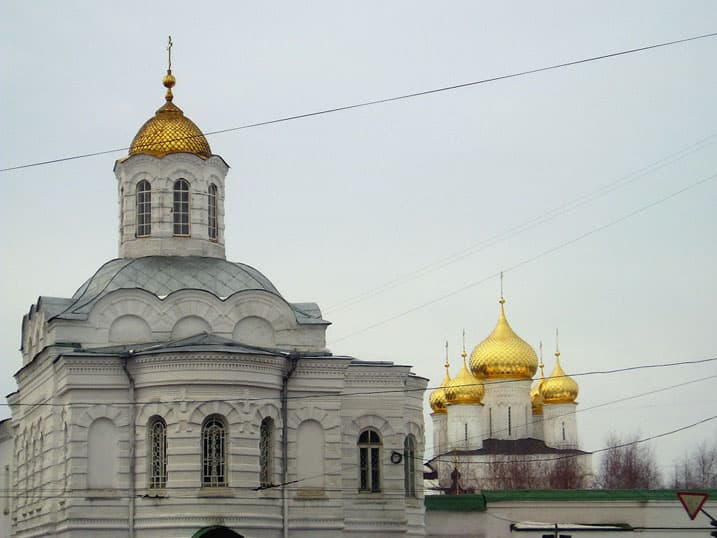
Bogoyavlensky Convent, located in Kostroma, is a prominent Russian Orthodox convent renowned for housing the ancient Feodorovskaya Icon of the Mother of God. Originally founded as a monastery in the 15th century, it underwent significant construction and stylistic changes throughout its history, including a major rebuilding in the Russian Revival style in the late 19th century, after which it became a convent. Despite abolishment after the October Revolution, it was revived in the 1990s.
Conception Convent
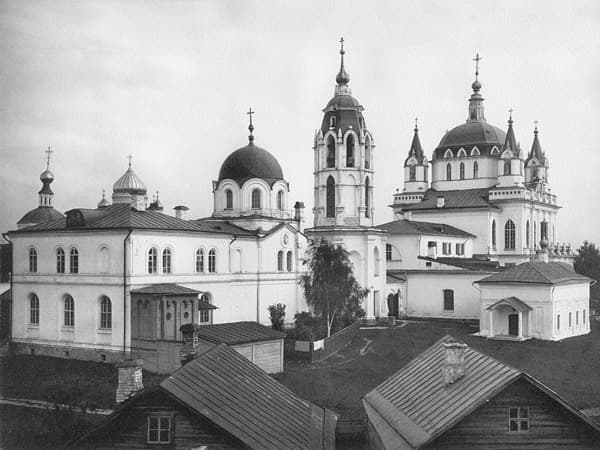
The Conception Convent, also known as the Zachatyevsky Monastery, is a Russian Orthodox convent located on the Moskva River in Moscow. Originally believed to occupy the site of the oldest nunnery in Moscow, it was reestablished in 1995 after being closed by the Bolsheviks in 1918 and undergoing significant damage and repurposing during the Soviet era. Its reconstruction has seen the rebuilding of its katholikon in a Russian Revival style.