
Sukovo Monastery
Sukovo Monastery is an important cultural monument located near Pirot, Serbia, dedicated to the Assumption of the Blessed Virgin Mary. While its exact founding date and founder are unknown, historical records suggest it has been demolished and rebuilt multiple times, with the current church constructed between 1857 and 1859. The monastery is known for its rare iconography, including a depiction of St. Christopher with an animal head.
Key Facts
- ›Located near the village of Sukovo, 18 km east of Pirot, Serbia.
- ›The monastery church is dedicated to the Assumption of the Blessed Virgin Mary.
- ›The current church was built between 1857 and 1859.
- ›Features rare frescoes, including a depiction of St. Christopher with an animal head.
- ›Designated as a cultural monument of great importance in Serbia.
- ›The monastery was looted during World War I and Father Justin Popović was arrested there in 1946 by communist authorities.

Byzantine
- Rare Fresco of St. Christopher With An Animal Head
- Depiction of the Virgin Mary With Wings
- Iconostasis With Carved Woodcarving
- Joint Tomb of Pope Jovan and Monk Benjamin
Father Justin Popović, Pope Jovan, Monk Benjamin, Cherubima
- Demolished and Rebuilt Multiple Times
- Painted In 1606
- Document From 1019 Mentions It As Part of the Bulgarian Diocese of Sredets Eparchy
- Demolished By Ottomans
- Rebuilt During the 17th Century
- Current Church Built Between 1857 and 1859
- Painting Done In 1869
- Looted By Bulgarians During World War I
- Father Justin Popović Arrested In 1946
- Narthex Rebuilt In 1947
- Church Reconstructed In 1974
- Under State Protection Since 1968
About Sukovo Monastery
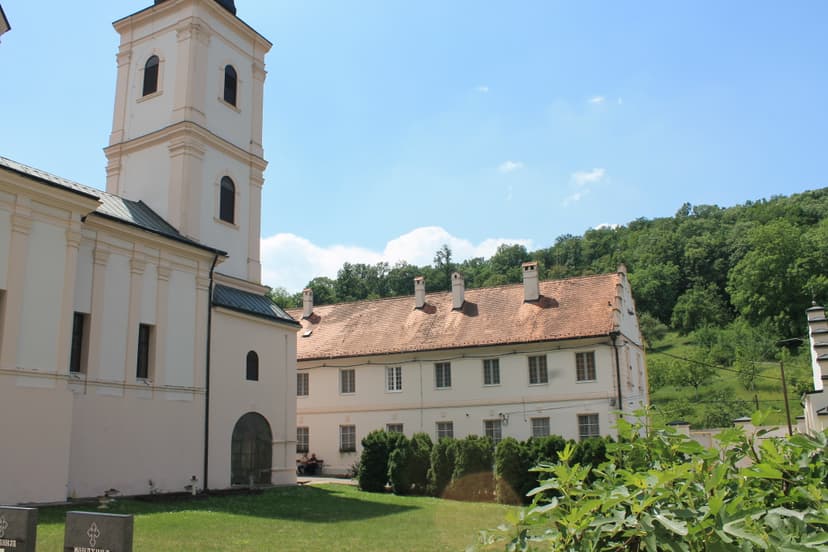
Sukovo Monastery is a significant cultural monument situated near the village of Sukovo, on the right bank of the Jerma River, approximately 18 kilometers east of Pirot, Serbia. It is part of the Eparchy of Niš of the Serbian Orthodox Church and is recognized as an immovable cultural asset, designated a cultural monument of great importance.
History and Significance
While the precise founding date and the identity of its founder remain unknown, historical records indicate that Sukovo Monastery has faced destruction and subsequent rebuilding on several occasions. A document from 1019 suggests its existence as part of the Bulgarian diocese of the Sredets Eparchy under the Ohrid Archdiocese. It is known to have been demolished by the Ottomans and later rebuilt, with significant reconstruction occurring during the 17th century. The present monastery church was constructed between 1857 and 1859, traditionally attributed to Sali-beg from Pirot, who built it as an act of gratitude for his son's recovery. The monastery's artistic treasures include frescoes painted in 1869. During World War I, the monastery was looted by Bulgarian forces. In 1946, Father Justin Popović was arrested at Sukovo Monastery by the communist authorities in Yugoslavia. The monastery has been under state protection since 1968.
Architecture and Notable Features
The monastery church is characterized by its trikonchos (trefoil) plan, featuring three semicircular apses. The eastern apse serves as the altar space, while the northern and southern ones are designated for choir stalls. Constructed from hewn stone with hot lime and covered with ordinary tiles, the church is topped by a low, circular cube with a cross. The masonry work involved local craftsmen. A notable feature is the spacious vestibule, rebuilt in 1947, which houses the joint tomb of Pope Jovan and monk Benjamin. The church's interior contains frescoes, including a rare depiction of St. Christopher with a halo and an animal head, identified as Reprovos, a martyr from the dog-headed tribe, a highly unusual iconographic representation in Eastern Christianity. Another striking fresco is a depiction of the Virgin Mary with wings. The iconostasis showcases intricate woodcarving, considered a significant artistic value, with scenes from the Old Testament in its lower section.
Current Status
Sukovo Monastery continues to function as an active monastic community and is open to the public. Its narthex was rebuilt in 1947, and the entire church underwent reconstruction in 1974, during which a substantial number of objects were discovered and are now housed in the Ponišavlje museum in Pirot.
Source: Wikipedia ↗
Frequently Asked Questions
When was Sukovo Monastery founded?
The exact time of construction and the founder of Sukovo Monastery are unknown. However, historical documents suggest it existed as early as 1019 as part of the Bulgarian diocese of the Sredets Eparchy.
What is the main church of Sukovo Monastery dedicated to?
The main church of Sukovo Monastery is dedicated to the Assumption of the Blessed Virgin Mary.
What is significant about the frescoes in Sukovo Monastery?
Sukovo Monastery is notable for its rare frescoes. Among these is a depiction of St. Christopher with a halo and an animal head, identified as Reprovos, a martyr from the dog-headed (kinocephalon) tribe, which is a very unusual iconography in Eastern Christianity.
Has the monastery undergone significant destruction and rebuilding?
Yes, preserved data indicates that Sukovo Monastery has been demolished several times throughout its history. It was rebuilt during the 17th century after being destroyed by the Ottomans, and the current church was constructed between 1857 and 1859.
What is the architectural style of the church?
The church at Sukovo Monastery has a trikonchos (trefoil) base with three semicircular apses. It is constructed of hewn stone with hot lime and covered with ordinary tiles, topped with a low cube and a cross.
What historical events have impacted Sukovo Monastery?
The monastery was looted by Bulgarians during World War I. In 1946, communist authorities in Yugoslavia arrested Father Justin Popović at Sukovo Monastery.
Related Monasteries
Beočin Monastery
Beočin Monastery is a Serbian Orthodox monastery situated on Fruška Gora mountain in Vojvodina, Serbia. While its exact founding date is unknown, it was first documented in 1566/1567. The monastery has undergone significant reconstruction, particularly between 1732 and 1740 for its church and in 1762 for its bell tower, and was declared a Monument of Culture of Exceptional Importance in 1990.

Berkasovo Monastery
The Berkasovo Monastery, dedicated to Saint Petka Trnovska, is a Serbian Orthodox monastery situated near the village of Berkasovo in Serbia's Srem region. Established as a monastery on August 8, 2008, its current church was founded in the latter half of the 19th century, built around a sacred spring believed to possess healing properties. Historically, the area was significant, with mentions of a fortified town in the possession of notable figures like Vuk Grgurević and Jovan Branković.

Bođani Monastery
Bođani Monastery is the oldest Serbian Orthodox monastery in the Bačka region of Vojvodina, Serbia, founded in 1478. According to tradition, it was established by a merchant named Bogdan who regained his sight after washing in a local spring. The monastery has undergone numerous reconstructions due to damage from wars, fires, and floods, with the current church dating to 1722. It is renowned for its Baroque architecture and extensive frescoes by Hristofor Žefarović, which are considered a significant contribution to Serbian art.