
Berkasovo Monastery
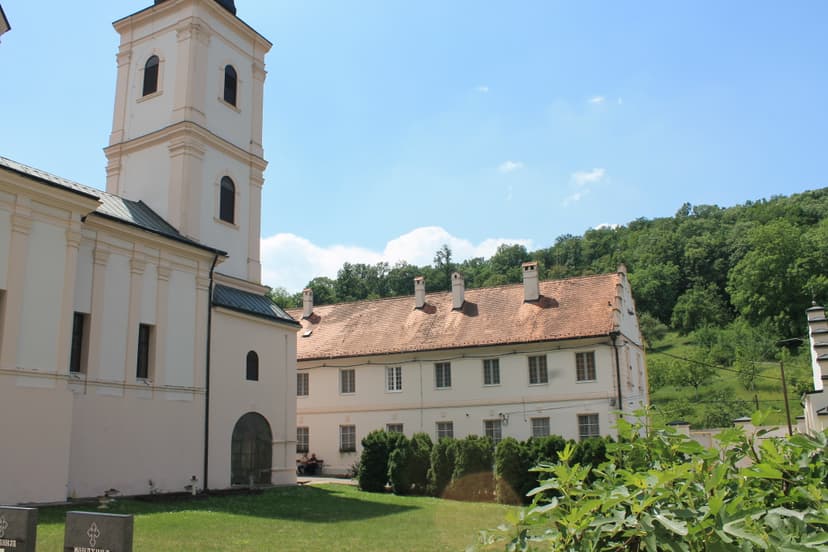
The Berkasovo Monastery, dedicated to Saint Petka Trnovska, is a Serbian Orthodox monastery situated near the village of Berkasovo in Serbia's Srem region. Established as a monastery on August 8, 2008, its current church was founded in the latter half of the 19th century, built around a sacred spring believed to possess healing properties. Historically, the area was significant, with mentions of a fortified town in the possession of notable figures like Vuk Grgurević and Jovan Branković.
Key Facts
- ›Located near the village of Berkasovo, municipality of Sid, Serbia.
- ›Dedicated to Saint Petka Trnovska.
- ›Officially declared a monastery on August 8, 2008.
- ›The current church was founded in the second half of the 19th century.
- ›Features a spring with water considered by locals to be healing and miraculous.
- ›The westernmost monastery in the Fruska Gora region.

Healing Spring, Forest and Vineyards Surrounding the Church
Manastir Berkasovo
Vuk Grgurević, Jovan Branković
- Founding of the Fortified Town of Berkasovo
- Declaration of the Church of St. Petka As A Monastery In 2008
About Berkasovo Monastery
The Berkasovo Monastery, known in Serbian as Manastir Berkasovo, is a significant Serbian Orthodox monastery belonging to the Diocese of Srem. It is located in the municipality of Sid, near the village of Berkasovo, and holds the distinction of being the westernmost monastery in the Fruska Gora region. The monastery's primary dedication is to Saint Petka Trnovska.
History and Significance
The current Church of St. Petka, which serves as the monastery's center, was established in the second half of the 19th century. The monastery was officially declared on August 8, 2008, on the feast day of the church. A key feature of the monastery complex is a spring located on the east side of the church, whose waters are widely believed by the local populace to possess healing and miraculous properties. Historical records indicate that in 1863, a wooden church, known as a 'vodica,' stood near this spring, attracting people from various regions until it was destroyed by fire. Gratitude inscriptions on marble slabs, including one from a citizen of Dubrovnik cured of a serious illness, attest to the perceived efficacy of the spring water.
The area surrounding Berkasovo has historical roots extending further back. The fortified town of Berkasovo was once under the control of Vuk Grgurević. Later, in 1496, it came into the possession of despot Jovan Branković, who is also recognized as one of the founders of the nearby Privina Glava monastery. The monastery is situated in a picturesque bay known as Ashman, surrounded by a forest and vineyards, contributing to its serene atmosphere.
Source: Wikipedia ↗
Frequently Asked Questions
When was the current church of Berkasovo Monastery built?
The present-day Church of St. Petka, which forms the core of the monastery, was founded in the second half of the 19th century. This structure was later declared a monastery in 2008.
What is special about the spring at Berkasovo Monastery?
Beneath the church, on the east side, there is an arranged spring whose water is believed by the local people to be healing and miraculous. Inscriptions of gratitude from individuals cured of illnesses testify to these water's reputed properties.
What is the historical significance of the Berkasovo area?
Historically, the fortified town of Berkasovo was a significant possession. It was held by Vuk Grgurević and later by despot Jovan Branković in 1496, who was also a founder of the nearby Privina Glava.
When did Berkasovo Monastery officially become a monastery?
The Church of St. Petka was officially declared a monastery on August 8, 2008. This event took place on the day of the church's glory.
Related Monasteries
Beočin Monastery
Beočin Monastery is a Serbian Orthodox monastery situated on Fruška Gora mountain in Vojvodina, Serbia. While its exact founding date is unknown, it was first documented in 1566/1567. The monastery has undergone significant reconstruction, particularly between 1732 and 1740 for its church and in 1762 for its bell tower, and was declared a Monument of Culture of Exceptional Importance in 1990.

Bođani Monastery
Bođani Monastery is the oldest Serbian Orthodox monastery in the Bačka region of Vojvodina, Serbia, founded in 1478. According to tradition, it was established by a merchant named Bogdan who regained his sight after washing in a local spring. The monastery has undergone numerous reconstructions due to damage from wars, fires, and floods, with the current church dating to 1722. It is renowned for its Baroque architecture and extensive frescoes by Hristofor Žefarović, which are considered a significant contribution to Serbian art.

Bogovađa Monastery
Bogovađa Monastery is a Serbian Orthodox monastery situated in Bogovađa, near Lajkovac, central Serbia. It holds a historical significance as a center of learning and has undergone numerous renovations throughout its existence. The monastery's origins trace back to the 15th century, with its current structures reflecting reconstructions and additions from the late 18th and mid-19th centuries.