
St Serf's Inch Priory
St Serf's Inch Priory, also known as Portmoak Priory, was an Augustinian monastic community initially located on St Serf's Inch in Loch Leven, Scotland. Its origins trace back to at least 838 AD with a church dedication, evolving into an Augustinian priory in 1150 under King David I. The priory is recognized as one of Scotland's oldest Christian sites and was home to notable figures like the chronicler Andrew de Wyntoun before its eventual dissolution and conversion into a fishing hut.
Key Facts
- ›One of the oldest Christian sites in Scotland, with a church dedicated in 838 AD.
- ›Converted to an Augustinian Priory in 1150 by King David I.
- ›Allegedly founded on an earlier Scottish CéLI Dé establishment.
- ›Notable former prior was the chronicler Andrew de Wyntoun.
- ›Later referred to as 'Portmoak Priory', possibly due to relocation.
- ›Site protected as a scheduled monument.

- Twelfth-Century Church Foundations
- Large Adjacent Structure Foundations
- Concentric Oval Enclosures
- Remnants of Turf-Built Cellular Buildings
- Remnants of Corn-Drying Kilns
- Fish Pond Suggested By Organic Material Deposits
Portmoak Priory
Bruide, Son of Dargart, Andrew De Wyntoun, Patrick Graham
- Church Dedication In 838 Ad
- Conversion To Augustinian Priory In 1150
- Absorption of Scottish Monks Into Augustinian Order
- Grant To St Leonard's College, St Andrews By James Vi
About St Serf's Inch Priory
St Serf's Inch Priory, also referred to as Portmoak Priory, stands as one of Scotland's most historically significant Christian sites, with origins tracing back to a church dedication in 838 AD. Initially, it was associated with a Scottish Céli Dé establishment, allegedly founded by Bruide, son of Dargart, King of the Picts. The site's transformation into an Augustinian Priory occurred in 1150, instigated by King David I of Scotland and linked to St Andrews Cathedral Priory. This transition saw the integration of the existing Scottish monks, with those unwilling to join facing expulsion.
Historical Context and Development
The priory is believed to have been dedicated to St Serb, also known as Servanus. Historical indications suggest the earlier Scottish establishment possessed a substantial collection of writings, though much of this collection is now lost or exists only in Latin translations. The Augustinian priory flourished for over four centuries. Among its most distinguished figures was the chronicler Andrew de Wyntoun, who likely composed his "Orygynale Cronykil of Scotland" while residing at Loch Leven. By the 15th century, the priory began to be known as "Portmoak," possibly signifying a partial relocation of the canons from the island location. Following the resignation of its last prior, the priory was granted by the Protestant King James VI of Scotland to St Leonard's College in St Andrews. Eventually, the priory's structures were repurposed, with evidence suggesting it was later converted into a fishing hut or bothy.
Archaeological Discoveries
Archaeological excavations at the site, conducted in various phases since 1877, have yielded significant insights into the priory's past. In 2011, 2012, and 2017, excavations revealed the foundations of a twelfth-century church measuring approximately 27 by 9.25 feet with walls 2.5 feet thick, featuring archways on its east and west ends. West of the church, the remains of a larger structure, measuring 83 by 22 feet with walls over 5 feet thick, were discovered, along with burials within the area. The site also showed evidence of a series of large concentric oval enclosures, with the largest, measuring 200 by 110 meters, thought to be the sanctuary of the eighth-century monastery. Further findings included remnants of roads, areas of light industry or occupation, medieval pottery sherds, iron artifacts, copper-alloy fragments, and a Neolithic flint arrowhead. Evidence of an outer ditch, dating to the twelfth century, and compacted organic material suggest the presence of a fish pond. Small earthworks to the south and east are believed to be the remnants of turf-built cellular buildings and corn-drying kilns. The site is currently protected as a scheduled monument.
Source: Wikipedia ↗
Frequently Asked Questions
When was St Serf's Inch Priory founded?
A church was dedicated at the site in 838 AD, making it one of Scotland's oldest Christian sites. The Augustinian Priory was officially established in 1150.
What religious order was St Serf's Inch Priory a part of?
The priory was a community of Augustinian canons. Before that, it is believed to have been a Scottish Céli Dé (or Culdee) establishment.
What is the significance of St Serf's Inch Priory?
It is recognized as one of Scotland's oldest Christian sites and was home to the chronicler Andrew de Wyntoun, who likely wrote his 'Orygynale Cronykil of Scotland' there. Archaeological excavations have revealed extensive remains of its historical structures.
What happened to St Serf's Inch Priory after its monastic use?
After centuries of Augustinian life, the priory was granted to St Leonard's College, St Andrews, by King James VI. At some point, the structure was converted into a fishing hut or bothy.
What have archaeological excavations revealed about the site?
Excavations have uncovered the foundations of a twelfth-century church, a large adjacent structure, and burials. Evidence suggests a series of large concentric oval enclosures, a ditch created in the twelfth century, and remnants of possible turf-built cellular buildings and corn-drying kilns.
Related Monasteries
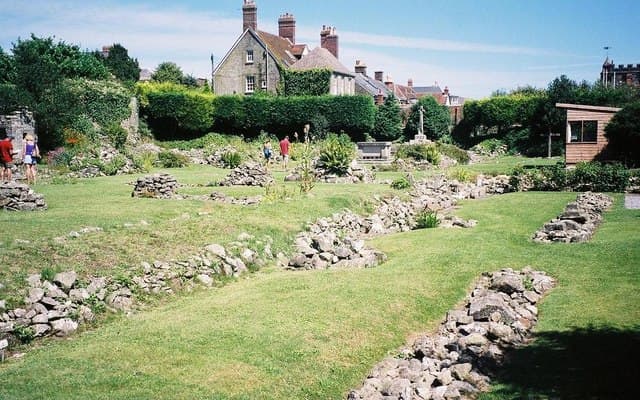
Shaftesbury Abbey
Shaftesbury Abbey was a prominent Benedictine nunnery in Shaftesbury, Dorset, founded around 888 by Alfred the Great. It became a significant pilgrimage site, particularly after the translation of the relics of St. Edward the Martyr. The abbey was dissolved in 1539 during the English Reformation, having been one of the wealthiest nunneries in England.

Charlieu Abbey
Charlieu Abbey, also known as St. Fortunatus' Abbey, was a significant Benedictine monastery founded in 872 in the Forez region of Burgundy, France. It later became an early and important priory within the Cluniac movement. The abbey faced suppression during the French Revolution, leading to the destruction of most of its structures, with only a portion of its narthex and western bay remaining as ruins.

St Oswald's Priory, Gloucester
St Oswald's Priory in Gloucester was founded in the late 9th or early 10th century by Æthelflæd, daughter of Alfred the Great, and her husband Æthelred. Initially dedicated to St Peter, it was renamed in honour of St Oswald after his relics were translated there. The priory enjoyed royal favour and was a significant pilgrimage site before declining in importance from the 11th century and being suppressed in 1536.