
St Oswald's Priory, Gloucester
St Oswald's Priory in Gloucester was founded in the late 9th or early 10th century by Æthelflæd, daughter of Alfred the Great, and her husband Æthelred. Initially dedicated to St Peter, it was renamed in honour of St Oswald after his relics were translated there. The priory enjoyed royal favour and was a significant pilgrimage site before declining in importance from the 11th century and being suppressed in 1536.
Key Facts
- ›Founded by ÆthelflæD and Æthelred in the late 880s or 890s.
- ›Renamed St Oswald's after the translation of St Oswald's relics in 909.
- ›ÆthelflæD and Æthelred were buried at the priory.
- ›King Æthelstan was a major benefactor.
- ›Became a minor house of Augustinian canons before its suppression.
- ›Ruins are a Grade I listed building.

Grade I Listed Building, Burial Place of æThelflæD and æThelred
New Minster, St Peter's Abbey
æThelflæD, æThelred, Lord of the Mercians, King æThelstan, St Oswald
Foundation By æThelflæD and æThelred, Translation of St Oswald's Relics, Burial of æThelflæD and æThelred, Suppression In 1536, Damage During the English Civil War
About St Oswald's Priory, Gloucester
St Oswald's Priory, located in Gloucester, was a significant monastic institution founded in the late 880s or 890s by Æthelflæd, daughter of Alfred the Great, and her husband Æthelred, ealdorman of Mercia. Initially established as a minster dedicated to St Peter, it was later renamed in honour of St Oswald following the translation of some of his relics to the site in 909. The priory served as the burial place for its founders, Æthelflæd and Æthelred, and enjoyed considerable royal favour, particularly from Æthelstan, Æthelflæd's nephew, who became a major benefactor and may have commissioned grave covers for them.
History and Development
During its early years, St Oswald's Priory was an important part of the 'Burh' of Gloucester and a prominent pilgrimage destination. However, its importance began to wane from the 11th century. By the reign of King Cnut, its estates were being used to endow a royal clerk. In 1089, when the Norman abbot Serlo began constructing a new church for the older St Peter's Abbey (which would evolve into Gloucester Cathedral), St Oswald's became a more minor establishment, housing Augustinian canons with significantly reduced emoluments. The priory met its end during the Dissolution of the Monasteries, being suppressed in 1536. Subsequently, the building served as the parish church of St Catherine, but this structure was largely demolished in 1643 during the English Civil War.
Legacy
Today, the surviving ruins of St Oswald's Priory are recognised as a Grade I listed building, attesting to its historical and architectural significance. Items recovered from the priory are preserved in the Gloucester City Museum & Art Gallery. The priory's history is intertwined with the ruling families of Anglo-Saxon England, making it a site of considerable historical interest.
Source: Wikipedia ↗
Frequently Asked Questions
When was St Oswald's Priory founded?
St Oswald's Priory was founded in the late 880s or the 890s by Æthelflæd and Æthelred. It was later renamed in honour of St Oswald following the translation of his relics in 909.
Who founded St Oswald's Priory?
The priory was founded by Æthelflæd, daughter of Alfred the Great, and her husband Æthelred, ealdorman of Mercia. They were both buried at the priory.
What was the significance of St Oswald's Priory?
Initially, St Oswald's Priory was a significant religious site and a major destination for pilgrims journeying to Gloucester. It enjoyed royal favour, particularly from King Æthelstan, who was a major benefactor.
What happened to St Oswald's Priory?
The priory's importance declined from the 11th century, and it became a minor house of Augustinian canons. It was suppressed in 1536 and later served as the parish church of St Catherine, which was destroyed during the English Civil War in 1643. Today, its ruins are a Grade I listed building.
Are there any royal connections to St Oswald's Priory?
Yes, the priory was founded by Æthelflæd, daughter of King Alfred the Great, and her husband Æthelred. Æthelflæd and Æthelred were buried there, and Æthelstan, Æthelflæd's nephew, was also a significant benefactor.
Related Monasteries
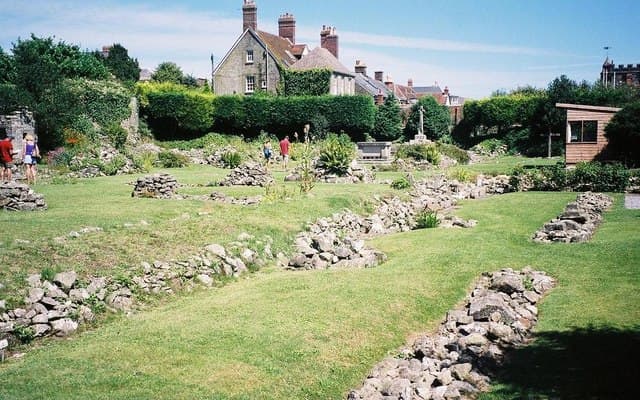
Shaftesbury Abbey
Shaftesbury Abbey was a prominent Benedictine nunnery in Shaftesbury, Dorset, founded around 888 by Alfred the Great. It became a significant pilgrimage site, particularly after the translation of the relics of St. Edward the Martyr. The abbey was dissolved in 1539 during the English Reformation, having been one of the wealthiest nunneries in England.

Charlieu Abbey
Charlieu Abbey, also known as St. Fortunatus' Abbey, was a significant Benedictine monastery founded in 872 in the Forez region of Burgundy, France. It later became an early and important priory within the Cluniac movement. The abbey faced suppression during the French Revolution, leading to the destruction of most of its structures, with only a portion of its narthex and western bay remaining as ruins.

St Serf's Inch Priory
St Serf's Inch Priory, also known as Portmoak Priory, was an Augustinian monastic community initially located on St Serf's Inch in Loch Leven, Scotland. Its origins trace back to at least 838 AD with a church dedication, evolving into an Augustinian priory in 1150 under King David I. The priory is recognized as one of Scotland's oldest Christian sites and was home to notable figures like the chronicler Andrew de Wyntoun before its eventual dissolution and conversion into a fishing hut.