
St. Mary's Church
Eastern Orthodox·Albania·Cultural Monument of Albania·14th century
St. Mary's Church, also known as Virgin Mary's Church, is an Eastern Orthodox cave church situated on Maligrad Island in the Albanian part of Lake Prespa. Constructed in 1369 by Serbian nobleman Kesar Novak, it features frescoes and Greek inscriptions from its founding year, notably depicting Kesar Novak and his wife Kalia.
Key Facts
- ›Eastern Orthodox cave church on Maligrad Island.
- ›Dedicated to Saint Mary (Virgin Mary).
- ›Built in the year 1369 by Serbian nobleman Kesar Novak.
- ›Features frescoes and Greek inscriptions dated to 1369.
- ›Includes depictions of Kesar Novak and his wife Kalia within its frescoes.

Cave Church, Frescoes Depicting Kesar Novak and His Family, Greek Inscriptions From 1369
Virgin Mary's Church, Shpella E Maligradit, рождество на пресвета богородица
Kesar Novak, Kalia
About St. Mary's Church
St. Mary's Church, also referred to as Virgin Mary's Church (Albanian: Shpella e Maligradit, Macedonian: Рождество на Пресвета Богородица), is a significant Eastern Orthodox cave church located on Maligrad Island, within the Albanian portion of Lake Prespa. Recognized as a Cultural Monument of Albania, the church holds historical and artistic importance.
Foundation and Construction
The church was commissioned and built in the year 1369 by Kesar Novak, a Serbian nobleman. The construction of a cave church on Maligrad Island reflects the religious and architectural practices of the period. Its dedication is to Saint Mary, a central figure in Orthodox Christianity.
Artistic and Epigraphic Significance
St. Mary's Church is distinguished by its well-preserved frescoes and Greek inscriptions, both dating from its founding year of 1369. These artworks provide valuable insights into the period and the individuals associated with the church. Notably, the frescoes include depictions of the family of Kesar Novak, featuring himself alongside his Greek wife, Kalia. These portrayals offer a personal glimpse into the patrons of the church and their lineage.
Source: Wikipedia ↗
Frequently Asked Questions
Where is St. Mary's Church located?
St. Mary's Church is located on the island of Maligrad, within the Albanian part of Lake Prespa.
When was St. Mary's Church built?
The church was constructed in the year 1369.
Who built St. Mary's Church?
It was built by Serbian nobleman Kesar Novak, who was also known as Qesar Novaku.
What notable features does St. Mary's Church have?
The church is known for its frescoes and Greek inscriptions, which date back to its founding year of 1369. These frescoes include portraits of Kesar Novak and his Greek wife, Kalia.
What religious tradition does St. Mary's Church belong to?
St. Mary's Church is an Eastern Orthodox church.
Related Monasteries

Albania
Albania is a country located in Southeast Europe, on the Adriatic and Ionian Seas. Historically inhabited by Illyrian and Epirote tribes, its territory was later integrated into the Roman and Byzantine Empires. During the Middle Ages, various Albanian principalities emerged, most notably the Principality of Arbanon, and later the Kingdom of Albania. The nation became a focal point of resistance against Ottoman expansion under Skanderbeg in the 15th century, and despite centuries of Ottoman rule, it maintained distinct cultural identities, leading to the Albanian Renaissance and eventual independence in 1912.

Meteora
Meteora is a rock formation in northwestern Greece famous for its complex of Eastern Orthodox monasteries built atop towering natural pillars. Established primarily from the 14th century onwards, these monasteries offered refuge and spiritual centers, with 24 originally built and six still extant today. Recognized for their unique architecture, beauty, and religious significance, Meteora is a UNESCO World Heritage site visited by many for its history, culture, and natural splendor.
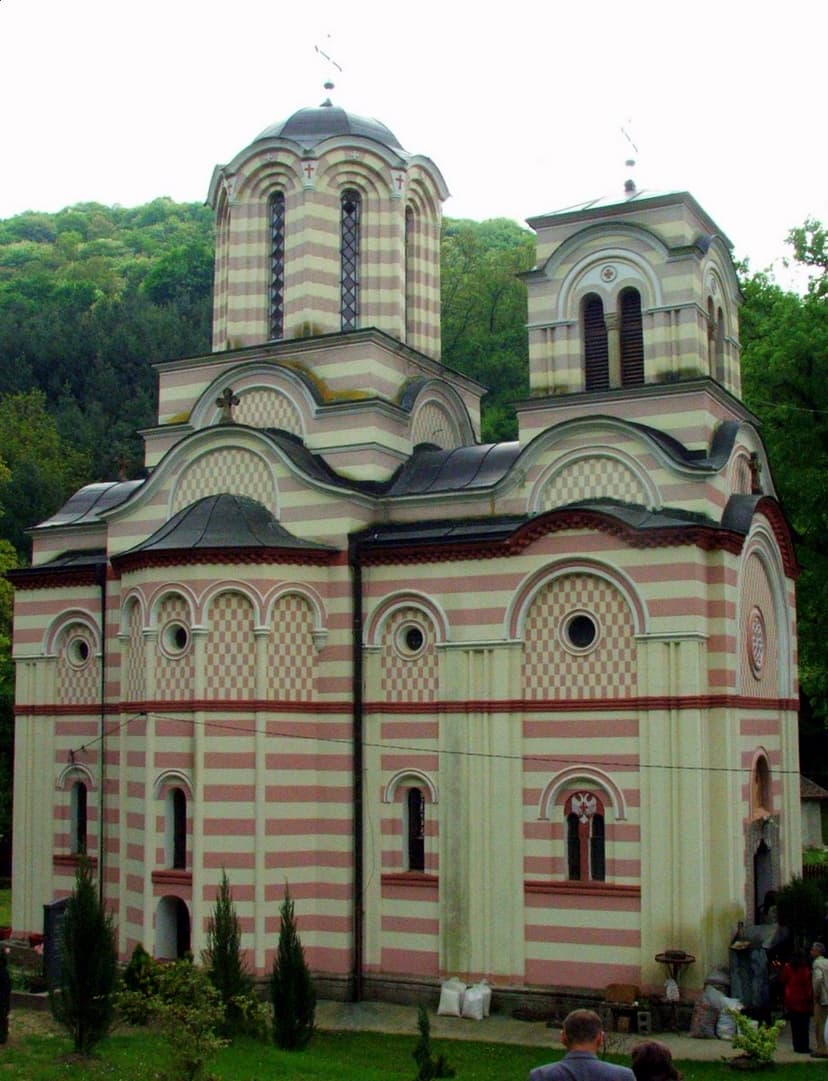
Tuman Monastery
The Tuman Monastery, also known as Tumane Monastery, is a 14th-century Eastern Orthodox monastery situated in Serbia, near the town of Golubac. Renowned as the "Ostrog of the Đerdap" due to its historical healers, it is the second most visited pilgrimage site in the Serbian Orthodox Church. The principal church is dedicated to the Archangel Gabriel, and the monastery's origins are intertwined with local legends involving Miloš Obilić and Saint Zosimus.