
St. Mark Serbian Orthodox Monastery
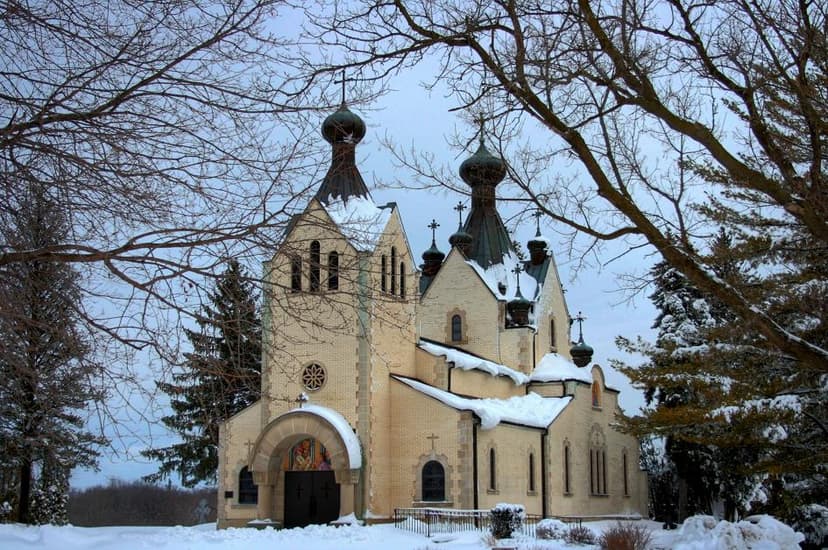
St. Mark Serbian Orthodox Monastery is an Eastern Orthodox Christian monastery located in Sheffield, Ohio. It is part of the Serbian Orthodox Eparchy of Eastern America and its church architecture was initially inspired by the medieval Marko's Monastery in North Macedonia. The monastery is recognized as an important American Orthodox institution and hosts a youth camp that continues to operate with year-round activities.
Key Facts
- ›Located in Sheffield, Ohio.
- ›Part of the Serbian Orthodox Eparchy of Eastern America.
- ›Church architecture modeled after Marko's Monastery in Skopje.
- ›Features the Saint Mark Church Cemetery to its west.
- ›Its patronal feast day is May 8th (Julian calendar).
- ›Hosts a youth camp with ongoing summer and winter activities.

Medieval-Inspired
Saint Mark Church Cemetery, Youth Camp
Srpski Pravoslavni Manastir Svetog Marka
About St. Mark Serbian Orthodox Monastery
St. Mark Serbian Orthodox Monastery is an Eastern Orthodox Christian monastery situated in Sheffield, Ohio. It operates under the spiritual guidance of Bishop Irinej of the Serbian Orthodox Eparchy of Eastern America, a diocese within the Serbian Orthodox Church. The monastery's church architecture draws inspiration from the medieval Marko's Monastery located in Skopje, North Macedonia, reflecting a connection to historical Orthodox monastic traditions.
Historical Context and Significance
The monastery is recognized as one of the notable American Orthodox monasteries. A significant development in its history was the establishment of a youth camp in 1985, which has continued to be an active program offering both summer and winter activities. The patronal feast day of the monastery is observed on May 8th, following the Julian calendar. Adjacent to the monastery church, to its west, lies the Saint Mark Church Cemetery.
Source: Wikipedia ↗
Frequently Asked Questions
Where is St. Mark Serbian Orthodox Monastery located?
St. Mark Serbian Orthodox Monastery is situated in Sheffield, Ohio. It is an Eastern Orthodox Christian monastery under the jurisdiction of the Serbian Orthodox Eparchy of Eastern America.
What is the architectural inspiration for the monastery church?
The church at St. Mark Serbian Orthodox Monastery was initially designed to resemble the medieval Marko's Monastery located in Skopje, North Macedonia. This connection highlights its historical and spiritual influences.
Does the monastery have a cemetery?
Yes, the Saint Mark Church Cemetery is located just west of the monastery church. It serves as a burial ground associated with the monastery.
What is the patronal feast day of the monastery?
The patronal feast day of St. Mark Serbian Orthodox Monastery is celebrated on May 8th, according to the Julian calendar. This date marks a significant observance for the monastic community.
Are there any special programs or activities at the monastery?
St. Mark Serbian Orthodox Monastery is known for its youth camp, which was established in 1985. This camp continues to offer summer and winter activities for young people.
Related Monasteries

Monastery of Saint Herman of Alaska
The Saint Herman of Alaska Monastery is an Eastern Orthodox Christian monastery located in Platina, California, under the jurisdiction of the Serbian Orthodox Eparchy of Western America. Founded in 1968 by Seraphim Rose and Herman Podmoshensky, it is known for its monastics' ascetic lives and its significant role in publishing Orthodox Christian literature in English. The monastery also publishes a bimonthly periodical, "The Orthodox Word," and an annual church calendar through its publishing house, Saint Herman Press.

Monastery of Saint Mark
Saint Mark Serbian Orthodox Monastery is an Eastern Orthodox Christian monastery situated in Sheffield, Ohio. Its church architecture was initially inspired by the medieval Marko's Monastery in Skopje, North Macedonia. The monastery is an important center for the Serbian Orthodox Eparchy of Eastern America and hosts an active youth camp.
Monastery of Saint Sava
The Saint Sava Serbian Orthodox Monastery and Seminary in Libertyville, Illinois, was established in 1923 by Bishop Saint Mardarije as an educational institution for Serbian Orthodox theology. It later served as a refuge for Serbs during World War II and became a focal point for a significant schism within the Serbian Orthodox Church in North America. The monastery is also known as the final resting place, until 2013, of Peter II of Yugoslavia, the last king of Yugoslavia.