
St. John's Abbey in the Thurtal
Benedictine·Switzerland·Parts remain as a parish church and educational center; dissolved as a monastery·12th century
St. John's Abbey in the Thurtal was a Benedictine monastery founded in the mid-12th century in what is now Switzerland. It reached its zenith in the 14th century, maintaining independence through the Reformation before becoming a priory of St. Gall's Abbey in 1555. After suffering fire damage and relocating in the 17th century, the priory was dissolved in 1805, with its former buildings now serving as an educational center.
Key Facts
- ›Founded in the MID-12th century, with the oldest written record dating to 1152.
- ›Originally established in Alt St. Johann, Canton of St. Gallen, Switzerland.
- ›Owned extensive estates in Toggenburg, the Rhine valley, and parts of modern-day Liechtenstein.
- ›Survived the Reformation but lost its independence in 1555, becoming a priory of St. Gall's Abbey.
- ›Relocated to Sidwald near Nesslau (Neu St. Johann) in 1626 due to fire and illness.
- ›Dissolved in 1805; its former church is now a Roman Catholic parish church.

Rococo
- Red House In Vaduz
- Rococo-Style Monastic Church Buildings Completed By 1680
Kloster St. Johann Im Thurtal
Pope Eugene Iii, Pope Alexander Iii, Emperor Frederick Ii
- Placed Under Papal Protection By Pope Eugene Iii In 1152
- Confirmed By Pope Alexander Iii In 1178
- King Became Vogt In 1227/1228
- Emperor Frederick Ii Issued A Golden Bull Confirming Vogt Obligations In 1231
- High Point In the 14th Century
- Survived the Reformation
- Lost Independence and Became A Priory of St. Gall's Abbey In 1555
- Buildings Severely Damaged By Fire In 1626
- Community Relocated To Sidwald Near Nesslau In 1626
- Priory Dissolved In 1805
About St. John's Abbey in the Thurtal
St. John's Abbey in the Thurtal (German: Kloster St. Johann im Thurtal) was a significant Benedictine monastery with a history spanning several centuries in what is now Switzerland. Its origins trace back to the mid-12th century, with the earliest documented mention appearing in a papal bull from Pope Eugene III in 1152, placing the monastery under his protection and confirming its possessions and the free election of its abbot.
History and Development
The abbey flourished, with its possessions confirmed and expanded by subsequent papal bulls, including one from Pope Alexander III in 1178. Royal and imperial involvement is noted with the king becoming the Vogt (protector) of the abbey in 1227/1228, a role later confirmed by Emperor Frederick II in 1231. During the 14th century, the monastery reached its peak influence and prosperity. It managed to navigate the religious upheaval of the Reformation, but its independent status ended in 1555 when it was incorporated as a priory under the larger St. Gall's Abbey.
A significant turning point occurred in 1626 when a fire caused severe damage to the existing buildings. Compounded by an unexplained illness affecting the community, the monks relocated to a new site further down the valley, which became known as Neu St. Johann. The construction of new monastic buildings at this site was completed by 1680, showcasing a magnificent Rococo architectural style. The priory played a role in the Counter-Reformation efforts within the religiously mixed region of Toggenburg.
Dissolution and Legacy
St. John's Abbey in the Thurtal was ultimately dissolved in 1805. The former monastic church was subsequently repurposed as the Roman Catholic parish church for the community of Neu St. Johann. The remaining structures of the former priory now serve a different purpose, housing the Johanneum, an educational center focused on remedial education. The abbey's historical estates were spread across regions including Toggenburg, the Rhine valley, and even parts of modern-day Liechtenstein, demonstrating its considerable historical landholdings.
Source: Wikipedia ↗
Frequently Asked Questions
When was St. John's Abbey in the Thurtal founded?
St. John's Abbey in the Thurtal was founded in the mid-12th century. The oldest surviving written record of the monastery is dated October 4, 1152, when Pope Eugene III placed it under papal protection.
Where was St. John's Abbey in the Thurtal originally located?
The monastery was originally established in Alt St. Johann, located in the Canton of St. Gallen, Switzerland. It later relocated to a new site known as Neu St. Johann near Nesslau.
What happened to St. John's Abbey in the Thurtal after it lost its independence?
After losing its independence in 1555, St. John's Abbey in the Thurtal became a priory of St. Gall's Abbey. The priory served as an instrument of the Counter-Reformation in the mixed-denomination region of Toggenburg.
What is the current status of the former St. John's Abbey buildings?
The former monastic church of St. John's Abbey in the Thurtal now functions as the Roman Catholic parish church of Neu St. Johann. The remaining buildings house an educational center known as the Johanneum.
Did St. John's Abbey in the Thurtal own property outside of Switzerland?
Yes, the abbey owned numerous estates in Toggenburg and the Rhine valley, as well as in Vorarlberg, Austria. It also frequently purchased land in the territory of modern-day Liechtenstein, notably acquiring the Red House in Vaduz in 1525.
Related Monasteries

Engelberg Abbey
Engelberg Abbey is a historic Benedictine monastery located in Engelberg, Switzerland, founded in 1120. It was established by Count Conrad of Sellenbüren and initially populated by monks from Muri Abbey, eventually becoming a double monastery housing both monks and nuns. Over centuries, it held significant spiritual and temporal jurisdiction, though many rights were lost during the French Revolution. Despite fires and political disturbances, the abbey has been rebuilt and continues its monastic traditions, also operating educational institutions.

Fahr Priory
Fahr Convent is a Benedictine convent with a unique history, established in 1130 in an exclave of Aargau within the canton of Zürich. Historically overseen by the Abbot of Einsiedeln, it has functioned as a double monastery and is one of the few surviving examples of such an arrangement. The convent has preserved its religious and agricultural traditions, including viticulture, and houses a museum dedicated to the writer Silja Walter.
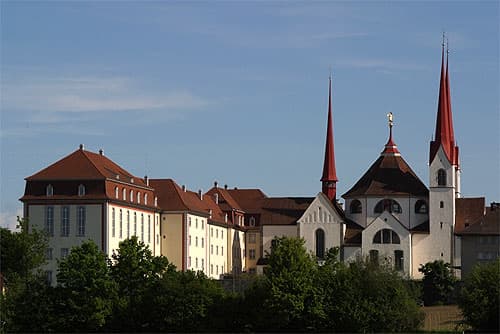
Muri Abbey
Muri Abbey, a Benedictine monastery dedicated to Saint Martin of Tours, was founded in 1027 by Radbot, Count of Habsburg, and flourished for over eight centuries in Muri, Canton of Aargau, Switzerland. It served as a significant religious and cultural center, housing the burial place of the House of Habsburg and educating many distinguished figures. Though the monastic community was dissolved in 1841 and relocated, the former abbey now functions as a museum and heritage site of national significance.