
St. Hallvard's Church and Monastery
Catholic·Norway·Active (Church/Parish Offices), Converting (Monastery)·20th century
St. Hallvard's Church and Monastery, located in Oslo, Norway, is a significant Catholic parish church and the site of the largest Catholic parish in Norway. Designed by Lund & Slaatto and completed in 1966, the complex features a unique architectural design with a circular nave enclosed within a square, stern exterior. It was formerly administered by the Franciscans and is currently being adapted for use by Catholic priests.
Key Facts
- ›Designed by architects Lund & Slaatto and completed in 1966.
- ›Features a circular central nave enclosed within a square monastery building.
- ›Constructed with exposed brick and concrete.
- ›Was run by the Franciscans until September 1, 2008.
- ›The monastery section is being converted into apartments for Catholic priests.
- ›Houses the largest current parish of the Catholic Church in Norway.

Modernist
- Circular Central Nave Within A Square Structure
- Exposed Brick and Concrete Construction
- Santa Maria Chapel For Sacraments
St. Hallvard Kirke Og Kloster
About St. Hallvard's Church and Monastery
St. Hallvard's Church and Monastery, situated on Enerhaugen in Oslo, Norway, is a prominent site for the Catholic Church in the region. It serves as the Catholic parish church for eastern Oslo and houses the largest current parish of the Catholic Church in Norway. The complex, designed by architects Lund & Slaatto, was completed in 1966 and has been recognized for its distinctive architectural design.
Architecture and Design
The monastery and church complex is characterized by its striking modernist architecture. The exterior presents a square, stern, and introspective facade, constructed from exposed brick and concrete. In contrast, the interior of the church features a circular nave, ingeniously enclosed within the square structure of the monastery building. The roof of the church room is designed to hang down, creating a lower ceiling height where it is traditionally highest. Adjacent to the main church is the rectangular Santa Maria chapel, where the sacraments are preserved.
Function and Current Status
Originally, the St. Hallvard's Church and Monastery complex included the monastery, parish offices, and the church. The monastery itself contains a chancery, living rooms, and cells. It was run by the Franciscans until September 1, 2008. Currently, the monastery section is being converted into apartments for Catholic priests. The parish office section houses a vestry, offices for Fransiskushjelpen, a reading room, and a meeting room, indicating its ongoing role in parish life and community services.
Source: Wikipedia ↗
Frequently Asked Questions
Where is St. Hallvard's Church and Monastery located?
St. Hallvard's Church and Monastery is situated on Enerhaugen in Oslo, Norway. It is located near the site of the former medieval St. Hallvard's Cathedral.
What is the architectural style of St. Hallvard's Church and Monastery?
The monastery and church were designed by Lund & Slaatto, featuring a distinctive modernist style. The building's exterior is square and stern, while the central church nave is circular and enclosed within the monastery structure, built with exposed brick and concrete.
Who previously administered St. Hallvard's Church and Monastery?
The Catholic parish church was administered by the Franciscans. This arrangement concluded on September 1, 2008.
What is the current status of the monastery section?
The monastery section is currently undergoing conversion into apartments intended for Catholic priests. The complex also includes parish offices and the church itself.
What is the significance of St. Hallvard's Church and Monastery?
It serves as the Catholic parish church for eastern Oslo and is the location of the largest current parish of the Catholic Church in Norway. The building itself garnered attention for its innovative architecture upon its completion.
Related Monasteries

Nidarholm Abbey
Nidarholm Abbey was a Benedictine monastery situated on Munkholmen island, serving as a significant religious and economic center on the sea approach to Trondheim, Norway. Founded by either King Canute the Great in 1028 or Sigurd Ullstreng around 1100, it was dedicated to Saints Benedict and Laurence. Despite facing several destructive fires and playing a role as a final Catholic stronghold during the Reformation, the monastery was eventually abandoned and its structures repurposed after 1537, leaving no visible remains today.
Halsnøy Abbey
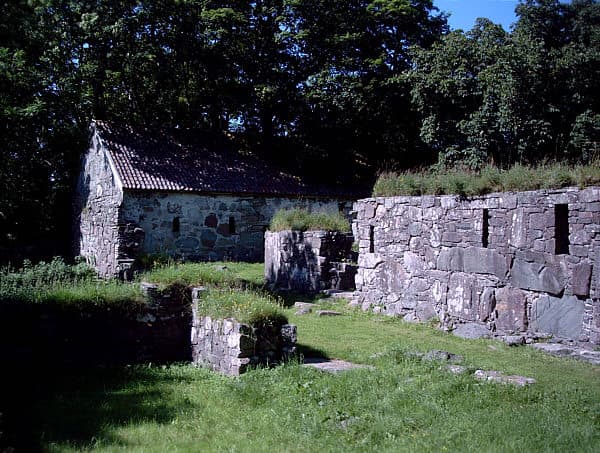
Halsnøy Abbey was a prominent Augustinian priory in medieval Norway, founded around 1163-1164 by Jarl Erling Skakke to support his son's claim to the throne. It became one of the wealthiest monasteries in the country before being dissolved in 1536 during the Reformation. While most monastic buildings were demolished in the 19th century, significant remnants of ancillary structures have been preserved as ruins.

Hovedøya Abbey
Hovedøya Abbey was a significant medieval Cistercian monastery located on the island of Hovedøya in the Oslofjord, Norway. Founded in 1147 by monks from England, it quickly became one of the wealthiest institutions in Norway during the medieval period. The abbey's existence was brought to an end by political turmoil and the Reformation, with its buildings later quarried for stone, leaving behind some of the most complete monastic ruins in Norway.