
Scheut
Catholic·Belgium·district·15th century
Scheut is a district within the municipality of Anderlecht in Brussels, Belgium, historically significant for a pivotal battle and the founding of a monastery. While the Carthusian Monastery of Our Lady of Grace was established here in the 15th century and later abandoned, the area later became the foundation for the Scheut Missionaries in the 19th century, an order that played a crucial role in evangelizing missions abroad. Today, Scheut is a modern district served by metro stations and featuring sights like the Museum of China – Scheut.
Key Facts
- ›Site of the 1356 Battle of Scheut between the Count of Flanders and the Duchess of Brabant.
- ›Carthusian Monastery of our Lady of Grace founded in 1454, later moved to Brussels.
- ›The Scheut Missionaries were founded here in 1863 by Theophile Verbist.
- ›The Scheut Missionaries evangelized in China, Mongolia, the Philippines, and the Congo Free State.
- ›Features the Museum of China – Scheut, showcasing artifacts from missionary work.
- ›The Church of St. Vincent de Paul, an Art Deco structure, is located in the district.

Art Deco
Museum of China – Scheut, Church of St. Vincent De Paul, Parc Forestier/Bospark, Scheutbos
Theophile Verbist, Louis Ii of Flanders, Joanna, Duchess of Brabant, General Dumouriez
- Battle of Scheut
- Bombardment of Brussels From Scheut's High Ground
- French Revolutionary Army Routing Austrians
About Scheut
Scheut is a district located in the northern part of Anderlecht, a municipality within Brussels, Belgium. Historically, it is recognized for significant events and the establishment of religious institutions that shaped its identity.
Historical Significance
The territory of Scheut played a role in medieval conflicts, most notably as the site of the Battle of Scheut in 1356. Later, in 1454, the Carthusian Monastery of Our Lady of Grace was founded here, though it was abandoned by 1578 due to religious wars and eventually transferred to Brussels. The district also served as a strategic point during later military engagements, including the bombardment of Brussels in 1695 and a confrontation involving the French Revolutionary army in 1792.
19th Century and Modern Era
A pivotal development in the 19th century was the founding of the Scheutveld College on April 28, 1863, by Catholic priest Theophile Verbist. This marked the beginning of the Congregation of Scheut Missionaries, an order that dedicated itself to evangelizing efforts in regions such as China, Mongolia, the Philippines, and the Congo Free State. The old chapel associated with the site was integrated into the Scheutists' church but was later demolished to make way for modern development.
Contemporary Scheut
Today, Scheut is a functioning district of Brussels, accessible via metro stations like Aumale and Jacques Brel. It features sights such as the Church of St. Vincent de Paul, an Art Deco structure built in the 1930s, and the Museum of China – Scheut, which displays artifacts from the missionary congregation's global endeavors, including a 15th-century bronze Buddha. The district also includes the Parc Forestier/Bospark and is bordered by the semi-natural site of the Scheutbos.
Source: Wikipedia ↗
Frequently Asked Questions
What significant historical event took place in Scheut in the 14th century?
In 1356, the territory of Scheut was the site of the Battle of Scheut. This conflict was fought between Louis II, Count of Flanders, and Joanna, the Duchess of Brabant, reportedly over a monetary dispute.
Was there a monastery in Scheut?
Yes, the Carthusian Monastery of Our Lady of Grace was founded in Scheut in 1454. However, due to the wars of religion, it was abandoned by 1578 and eventually transferred to Brussels.
What is the connection between Scheut and missionary work?
Scheut is the historic origin of the Scheut Missionaries, also known as the Congregation of the Immaculate Heart of Mary. This congregation was founded on the site in 1863 by Theophile Verbist with the goal of evangelizing in Asia and Africa.
What can be seen at the Museum of China – Scheut?
The Museum of China – Scheut houses a collection of documents and artifacts brought back to Europe by the congregation of Scheut Missionaries. Notable items include a 15th-century bronze Buddha.
What architectural styles are represented in Scheut?
The Church of St. Vincent de Paul, built between 1935 and 1937, is a notable example of Art Deco style. While the original Carthusian monastery is gone, its site has seen later constructions.
Related Monasteries

Bois-Seigneur-Isaac Abbey
Bois-Seigneur-Isaac Abbey, located in Belgium, has a rich and varied history, transitioning from an Augustinian abbey to a Premonstratensian priory before its current occupation by the Lebanese Maronite Order. It is particularly renowned for a eucharistic miracle in 1405, which led to it becoming a significant pilgrimage site. Despite periods of suppression and ruin, the abbey's chapel has continuously survived and remains a center for devotion.
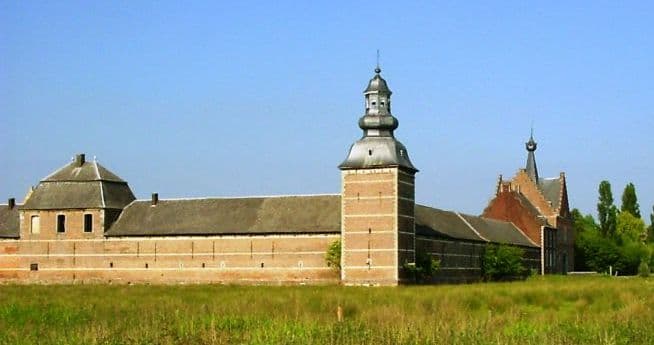
Herkenrode Abbey
Herkenrode Abbey was a significant Cistercian nunnery founded around 1182 in Kuringen, Belgium, becoming the wealthiest women's monastery of its order in the Low Countries. Though it faced decline in the 15th century, it experienced a revival and underwent reconstruction in the 18th century. The abbey was dissolved by the French Revolutionary Army in 1795, leading to its dispersal and eventual ruin, though much of its 16th-century stained glass has survived and is considered globally significant.

La Cambre Abbey
La Cambre Abbey, also known as Ter Kameren Abbey, is a former Cistercian monastery located in Brussels, Belgium. Founded around 1196, it was a significant religious site that reached its peak in the 13th century. Though suppressed during the French Revolution and largely rebuilt in the 18th century, parts of the medieval structure remain, and today the site houses a Catholic parish, a community of Norbertine canons, the Belgian National Geographic Institute, and a prestigious visual arts school.