
Rukumija Monastery
Rukumija Monastery is a Serbian Orthodox monastery situated near Požarevac, in the village of Bradarac. While its exact founding date is uncertain, it is believed to originate from the 14th century. The monastery has endured destruction and restoration throughout its history, with significant work undertaken by Prince Miloš Obrenović in 1825 and later by monk Naum Andrić and Russian Alexander Ruble in the late 20th century.
Key Facts
- ›Located near Požarevac, Serbia, in the village of Bradarac.
- ›Believed to have been founded in the 14th century.
- ›The original church was dedicated to St. Ascension of the Lord.
- ›Restored in 1825 by Prince Miloš Obrenović.
- ›Features murals by painter Janja (1829) and later by monk Naum Andrić (1971).
- ›Houses relics of Venerable Martyr Sinaita.

Relics of Venerable Martyr Sinaita, Murals By Janja, Murals By Naum Andrić
Manastir Rukumija
Miloš Obrenović, Maksim Ratković, Janja, Naum Andrić, Alexander Ruble, Martyr Sinaita
Demolished During the First Serbian Uprising, Restored In 1825, Church Painted In 1829, Church Painted In 1971, Suffered Fire Damage In 1978, Restored and Retouched In 1994
About Rukumija Monastery
Rukumija Monastery is a Serbian Orthodox religious site located in the village of Bradarac, near Požarevac, within the Braničevo District of Serbia. While its precise construction date remains unconfirmed, historical conjecture places its founding in the 14th century. The monastery has a history marked by destruction and subsequent restoration, with a significant renewal undertaken in 1825 by Prince Miloš Obrenović, and further artistic contributions and repairs occurring in the late 20th century.
Historical Context and Construction
The earliest detailed description of Rukumija Monastery comes from Maksim Ratković in 1733. At that time, the church was dedicated to St. Ascension of the Lord, constructed from stone with a vaulted stone ceiling and a tiled roof. It featured a wooden narthex, which also served as the burial place for Martyr Sinaita. The church was described as small and was unfortunately demolished by Ottoman forces during the suppression of the First Serbian Uprising.
The current church at Rukumija Monastery exhibits a straightforward architectural design, characterized by a single nave and a narthex to the west, with a semicircular apse on the eastern side. Inscriptions indicate that the church was adorned with paintings by the artist Janja in 1829. More recently, in 1971, monk Naum Andrić created the present-day murals using the "secco" technique, adhering to classic Orthodox iconography. These murals sustained considerable damage in a 1978 fire, with some frescoes becoming too degraded to discern figures. A restoration and retouching effort was carried out in 1994 by the Russian artist Alexander Ruble. Rukumija Monastery is also noted for housing the relics of Venerable Martyr Sinaita.
Source: Wikipedia ↗
Frequently Asked Questions
When was Rukumija Monastery founded?
The exact founding date of Rukumija Monastery is not known for certain. However, historical accounts suggest it was likely built in the 14th century.
What is the significance of the church at Rukumija Monastery?
The original church was dedicated to St. Ascension of the Lord and was built of stone with a vaulted ceiling. The present church, a simpler one-nave structure, features murals from different periods, most recently by monk Naum Andrić in 1971.
Has Rukumija Monastery been damaged or destroyed?
Yes, Rukumija Monastery has been destroyed on several occasions. Notably, it was demolished by the Turks during the suppression of the First Serbian Uprising. The church also suffered damage in a fire in 1978.
What notable figures are associated with Rukumija Monastery?
Prince Miloš Obrenović played a key role in its restoration in 1825. Later, monk Naum Andrić painted the murals in 1971, and Russian Alexander Ruble restored them in 1994. The monastery also holds relics of Venerable Martyr Sinaita.
Related Monasteries

Ježevica Monastery
Ježevica Monastery is a Serbian Orthodox monastery situated near the village of Ježevica, south of Čačak, Serbia, dedicated to St. Nicholas. While tradition attributes its founding to King Stefan Milutin, historical records suggest a nobleman in service to King Stefan Dušan founded it in 1337. The monastery's interior was adorned with paintings in the early 17th century, and a Baroque bell tower was added in the 19th century, making it a significant cultural heritage site.
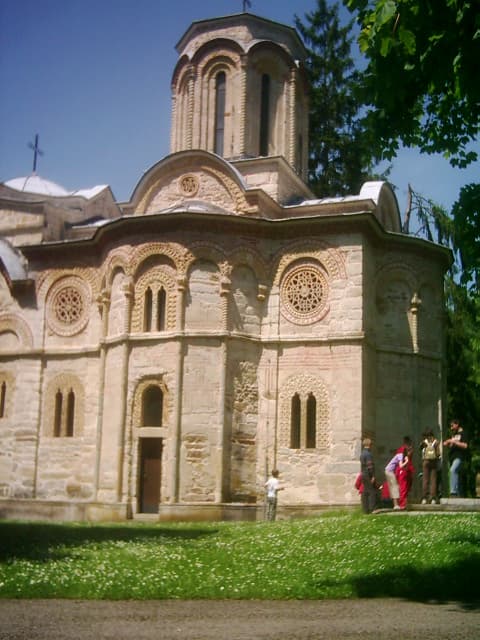
Ljubostinja Monastery
Ljubostinja Monastery is a Serbian Orthodox monastery near Trstenik, Serbia, built between 1388 and 1405 by Princess Milica. Dedicated to the Holy Virgin, its name signifies a "place of love," purportedly built on the site where Prince Lazar and Princess Milica first met. The monastery served as Princess Milica's endowment and later became a refuge for widows of fallen noblemen, eventually housing about fifty nuns and being declared a Monument of Culture of Exceptional Importance.
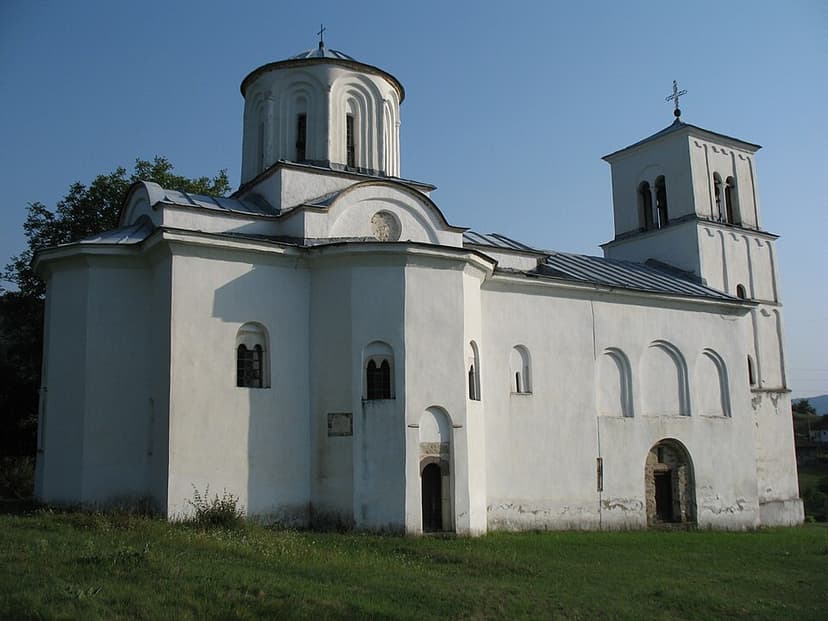
Nova Pavlica Monastery
Nova Pavlica Monastery is a 14th-century Serbian Orthodox monastery situated in Pavlica, Raška, southwestern Serbia. Founded by Stefan and Lazar Musić, it is dedicated to the Presentation of Mary and exemplifies the Morava architectural school. The monastery holds historical significance, having hosted the relics of Prince Lazar on their journey to Ravanica.