
Rouge-Cloître Abbey
Rouge-Cloître Abbey, originally a hermitage founded in 1367, became an Augustinian priory in the Sonian Forest near Brussels, Belgium. It was once a prestigious center known for its library and illumination workshop, attracting notable figures. After periods of pillaging and suppression, particularly during the French Revolution, the abbey was definitively abolished in 1796 and its church destroyed.
Key Facts
- ›Founded as a hermitage in 1366 and established as an Augustinian priory in 1367.
- ›Located in the Sonian Forest, south-eastern Brussels, Belgium.
- ›Known for its fine library and a notable illumination workshop in its early centuries.
- ›Was a prestigious priory in the Spanish Netherlands, visited by Emperor Charles V.
- ›Suffered pillaging during the Dutch Revolt and a fire in 1693.
- ›Abolished in 1796 and its buildings sold as national property; the church was destroyed by fire in 1805.

Sonian Forest Location, Proximity To Lakes and Rouge-CloîTre Stream, Fine Library, Illumination Workshop, Enclosure Created In 1400
Abbaye Du Rouge-CloîTre, Roodklooster Abbey, Abdij Van Het Roodklooster, Roode Cluse, Roode Kluis, Saint-Paul En Soignes
Gilles Olivier, Walter Van Der Molen, William Daniel, Joanna, Duchess of Brabant, Charles V, Holy Roman Emperor, Albert Vii, Archduke of Austria, Isabella of Spain, Joseph Ii, Holy Roman Emperor
- Foundation of Hermitage
- Founding Charter Witnessed
- Adoption of the Rule of Saint Augustine
- Confirmation By Bishop of Cambrai
- Affiliation To the Order of Canons Regular of Saint Augustine
- Formation of A Congregation With Groenendael
- Joining the Windesheim Congregation
- Pillaged During the Dutch Revolt
- Fire Ravaged Buildings
- Suppressed By Edict of Emperor Joseph Ii
- Valuables Removed
- Reinstatement and Return of Sixteen Canons
- Bought By the States of Brabant
- Occupied and Plundered By French Revolutionary Troops
- Definitive Suppression By the French Directory
- Buildings Sold As National Property
- Church Destroyed By Fire
About Rouge-Cloître Abbey
Rouge-Cloître Abbey, known in French as Abbaye du Rouge-Cloître and in Dutch as Abdij van het Roodklooster, is a former Augustinian priory situated in the picturesque Sonian Forest, in the southeastern part of Brussels, Belgium. Its origins trace back to a hermitage established in 1366 by Gilles Olivier and Walter van der Molen. The following year, on March 1, 1367, the founding charter for the priory was witnessed by Joanna, Duchess of Brabant, marking its formal establishment. Shortly thereafter, the community embraced the Rule of Saint Augustine, aligning with the nearby Groenendael Priory.
History and Development
The priory quickly grew in stature. By 1374, it was affiliated with the Order of Canons Regular of Saint Augustine. The early centuries were characterized by strong devotion and significant development. Rouge-Cloître possessed a fine library and fostered a notable illumination workshop, contributing to its reputation. The monastery's advantageous location provided access to essential resources, including sandstone for construction, wood from the forest, plentiful springs, fish from the surrounding ponds, and a water mill. An enclosure, parts of which still exist, was created around the monastery in 1400. During the 16th century, the priory reached its zenith, becoming one of the most prestigious in the Spanish Netherlands, partly due to its proximity to Brussels. It hosted esteemed visitors such as Emperor Charles V, Archduke Albert VII, and Isabella of Spain.
Decline and Closure
The abbey's fortunes began to wane in the late 16th century during the Dutch Revolt, when it was pillaged, forcing the canons to seek refuge in Brussels. A fire in 1693 damaged a portion of the buildings, though its valuable library was spared. A more significant blow came in 1783 with Emperor Joseph II's edict that abolished convents deemed "useless." The valuables were removed in 1784, and many books were subsequently deposited in Vienna. Although sixteen canons returned in 1790 following the reinstatement of old institutions, the abbey was again occupied and plundered by French revolutionary troops in 1792. Its definitive suppression occurred in 1796 with the abolition of monasteries decreed by the French Directory, and its buildings were sold as national property. The church itself was completely destroyed by fire in 1805.
Legacy
Today, Rouge-Cloître Abbey is administered by the municipality of Auderghem. The area, known as the Rouge-Cloître estate since the 16th century, remains a tranquil spot surrounded by lakes and the Rouge-Cloître stream, popular with nature enthusiasts and ramblers. While the monastic community and most of its structures are gone, the historical significance of Rouge-Cloître Abbey endures as a testament to its past as a center of religious life and culture.
Source: Wikipedia ↗
Frequently Asked Questions
When was Rouge-Cloître Abbey founded?
Rouge-Cloître Abbey began as a hermitage built in 1366. The founding charter for the priory was witnessed on March 1, 1367, and shortly after, the community adopted the Rule of Saint Augustine, solidifying its establishment as an Augustinian priory.
What does the name "Rouge-Cloître" mean?
The name "Rouge-Cloître" (French for Red Cloister), also known as Roodklooster or Rooklooster in Dutch, is believed by some historians to derive from "Roode Cluse" or "Roode Kluis," meaning 'Red Hermitage.' This theory suggests the original hermitage's walls were coated with a red mixture to waterproof them. Another explanation points to its location in a forest clearing, a "ro" or "rode."
What led to the decline and closure of Rouge-Cloître Abbey?
The abbey faced decline due to pillaging during the Dutch Revolt in the late 16th century. A significant blow came in 1783 when Emperor Joseph II abolished certain convents. Although briefly reinstated after the Brabant Revolution, it was again occupied and plundered by French revolutionary troops in 1792, leading to its definitive suppression in 1796.
What significant historical figures or events are associated with Rouge-Cloître Abbey?
Joanna, Duchess of Brabant, witnessed the founding charter in 1367 and provided gifts of land and privileges. Emperor Charles V, Archduke Albert VII, and Isabella of Spain were among the notable personages who stayed at the monastery in the 16th century, highlighting its prestige at the time.
What happened to the buildings and collections of Rouge-Cloître Abbey after its closure?
After its suppression in 1796, the buildings were sold as national property. The church was completely destroyed by fire in 1805. Many valuable books and illuminated manuscripts from its library were transferred to the Imperial Library in Vienna, where they remain, though some were lost or sold.
Related Monasteries

Eekhout Abbey
Eekhout Abbey was a medieval Augustinian canonry located in Bruges, Belgium, traditionally linked to a hermit's cell around 1050. It officially joined the Arrouaisian Order in 1146, adopting the Rule of St. Augustine and establishing separate communities for men and women. After centuries of decline, the abbey was dissolved during the French Revolution and subsequently demolished, with only a single doorway remaining.
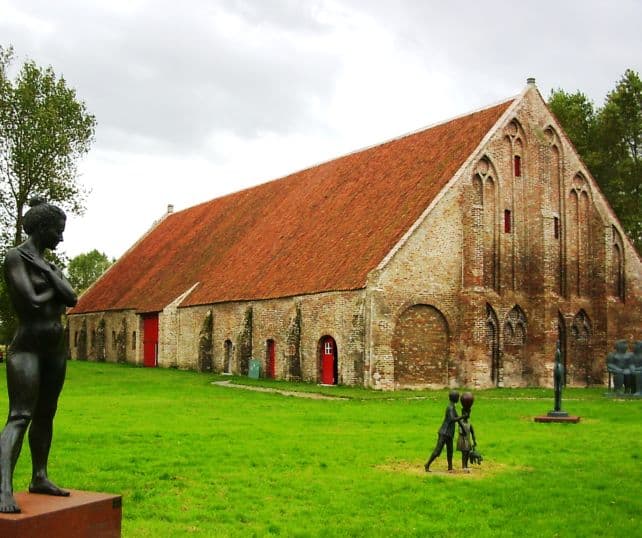
Ter Doest Abbey
Ter Doest Abbey was a significant Cistercian monastery located in Lissewege, Belgium, which played a crucial role in land reclamation and the wool trade. Founded in 1106 and later affiliating with the Cistercian order, it housed notable figures and was dissolved during the French Revolution. Today, its most prominent surviving structure is the massive tithe barn.

Villers Abbey
Villers Abbey, a former Cistercian monastery located in Belgium, was founded in 1146 and abandoned in 1796. Once a significant religious and economic center, the abbey's extensive ruins are now classified as part of Wallonia's Major Heritage. The site has undergone considerable restoration and is a popular tourist destination, hosting cultural events.