
Porta coeli Convent
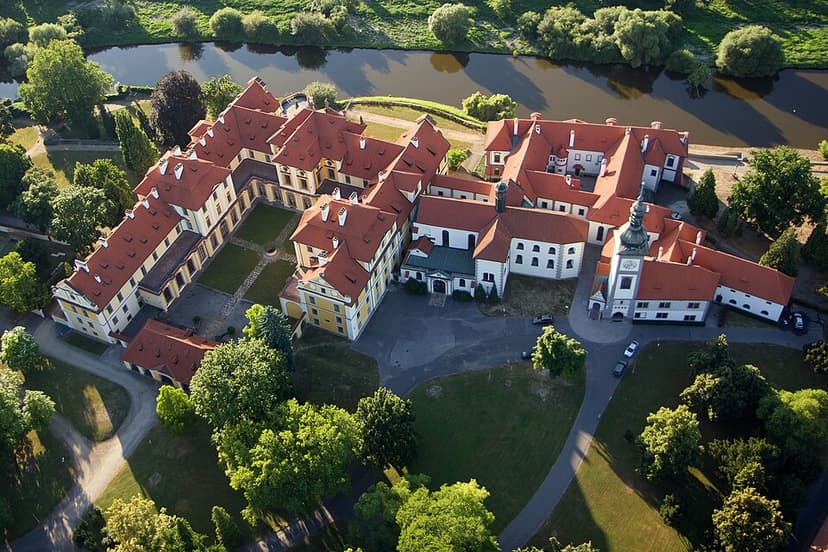
Porta coeli Convent, meaning "Heaven's Gate" in Latin, is a 13th-century Cistercian convent located in Předklášteří, Czech Republic. Founded in 1233 by Queen Constance of Hungary, it features a unique Western façade with a portal reminiscent of French cathedrals. The convent houses valuable Baroque furnishings and notable early Gothic vaulting in its cloister walk.
Key Facts
- ›Founded in 1233 by Queen Constance of Hungary.
- ›Located in Předklášteří, near Tišnov, Czech Republic.
- ›Features a Western façade portal unique in Europe east of the Rhine.
- ›Contains Baroque furnishings from after 1764 and early Gothic vaulting in the cloister.
- ›The asteroid 3276 Porta Coeli is named in its honor.
- ›A brewery named "Vorkloster" operates on its premises.

Gothic, Baroque
- Western FaçAde Portal Reminiscent of French Cathedrals
- Early Gothic Vaulting In the Cloister Walk
- Figurative and Decorative Carvings In the Chapter House
- Baroque Furnishings Including Paintings and Sculptures
- Brewery "Vorkloster"
Heaven's Gate
Queen Constance of Hungary, Bernhard, Bishop of Prague, Robert the Englishman, Bishop of Olomouc, F. A. Maulbertsch, Andreas Schweigl, IgnáC Raab
- Founded In 1233.
- Church Consecrated In 1239.
- Queen Constance of Hungary Buried At the Convent.
- Saved Twice By the Efforts of the Marienstern Monastery.
- Brewery Opened In 2019.
About Porta coeli Convent
Porta coeli Convent, whose name translates from Latin to "Heaven's Gate," is a significant 13th-century Cistercian monastery located in Předklášteří, near Tišnov, in the South Moravian Region of the Czech Republic. The convent was established in 1233 by Queen Constance of Hungary, who was also interred within its grounds. Its strategic location is in the picturesque valley of the Svratka River.
Architecture and Furnishings
The church at Porta coeli is characterized by its three aisles, a transept, and a long sanctuary culminating in a five-sided apse. Despite the typical Cistercian emphasis on austerity, the western façade presents a remarkable portal that evokes the grandeur of French cathedrals, an architectural feature that is notably unique in the geographical region east of the Rhine. The interior of the convent is enriched by valuable Baroque furnishings added after 1764. These include a painting by F. A. Maulbertsch on the high altar, a sculpture by Andreas Schweigl, and other works by the Jesuit artist Ignác Raab.
Cloister and Chapter House
The cloister walk of Porta coeli Convent is particularly noteworthy. It showcases early Gothic vaulting, intricate figurative and decorative carvings, and an adjacent chapter house constructed between 1260 and 1270. These elements highlight the convent's architectural evolution and artistic merit through the centuries.
Modern Operations and Recognition
In a continuation of its historical presence, a brewery named "Vorkloster" (the German name for the locality) was opened on the monastery's premises in 2019. The convent has also experienced moments of historical preservation, being saved from destruction in 1861 and again in 1990 through the dedicated efforts of the Lusatian Sorbs, specifically from the Marienstern Monastery. The asteroid 3276 Porta Coeli bears the name of this historic institution, further cementing its recognition.
Source: Wikipedia ↗
Frequently Asked Questions
When was Porta coeli Convent founded?
Porta coeli Convent was founded in 1233. Its church was consecrated in 1239.
Who founded Porta coeli Convent?
The convent was founded by Queen Constance of Hungary, the widow of King Ottokar I of Bohemia.
Where is Porta coeli Convent located?
It is located in Předklášteří, near Tišnov, in the South Moravian Region of the Czech Republic, situated in the valley of the Svratka River.
What is significant about the architecture of Porta coeli Convent?
The Western façade features a portal that is reminiscent of French cathedrals and is considered unique in the area of Europe east of the Rhine. The cloister walk is also noteworthy for its early Gothic vaulting and carvings.
What is housed within the convent's church?
The church interior contains valuable Baroque furnishings from after 1764, including a painting by F. A. Maulbertsch on the high altar and sculptures by Andreas Schweigl.
Is there a brewery at Porta coeli Convent?
Yes, a brewery named "Vorkloster" is situated on the premises of the monastery and was opened in 2019. "Vorkloster" is the German name for the village where the monastery is located.
Related Monasteries
Zbraslav Monastery
The Cistercian Abbey of Zbraslav, also known as Aula Regia, was a prominent monastery in the Kingdom of Bohemia, founded by King Wenceslaus II in 1292. It served as the royal necropolis for the Přemyslid dynasty and was abolished in 1789 by Emperor Joseph II. The abbey is renowned for its abbot, Peter of Zittau, author of the Zbraslav Chronicle, and for the significant Gothic painting, the Madonna of Zbraslav.

Osek abbey
Osek Abbey is a historic Cistercian monastery located in Osek, Czech Republic, with origins dating back to the 13th century. Originally built in Romanesque-Gothic style, it was significantly transformed into its high-Baroque appearance during the early 18th century. While it experienced periods of prosperity and decline, including destruction during the Hussite Wars and later suppression under Communist rule, Osek Abbey was reestablished and designated a national cultural monument. Today, the monastery complex, featuring the Church of Assumption of Virgin Mary, a convent, and an abbot's residence, is no longer home to an active monastic community.

Vyšší Brod Monastery
Vyšší Brod Monastery, also known as Hohenfurth Abbey, is a significant Catholic Cistercian monastery located in the Czech Republic. Founded in 1259, it stands as a vital cultural monument in South Bohemia. The monastery is notable for its adherence to the Traditional Latin Mass and houses a branch of the Prague Postal Museum.