
Pernegg Abbey
Premonstratensian·Austria·Retreat and seminar centre·12th century
Pernegg Abbey was originally founded as a Premonstratensian nunnery in 1153 by Ekbert and Ulrich of Pernegg, serving as a daughter house of Seelau Abbey. It later transitioned to a community of canons in 1584 and became an abbey in 1700. However, Emperor Joseph II's reforms led to its dissolution in 1783. The premises were subsequently acquired by Geras Abbey in the mid-19th century and have been utilized as a retreat and seminar center since 1995.
Key Facts
- ›Founded in 1153 as a Premonstratensian nunnery.
- ›Became a community of canons in 1584.
- ›Elevated to the status of an abbey in 1700.
- ›Dissolved in 1783 under Emperor Joseph II's reforms.
- ›Acquired by Geras Abbey in the MID-19th century.
- ›Currently used as a retreat and seminar center for Geras Abbey since 1995.

Ekbert of Pernegg, Ulrich of Pernegg
Founding of the Nunnery, Transition To A Community of Canons, Became An Abbey, Dissolution Under Emperor Joseph Ii, Acquisition By Geras Abbey, Establishment As A Retreat and Seminar Centre
About Pernegg Abbey
Pernegg Abbey, situated in Pernegg, Lower Austria, was established in 1153 by Ekbert and Ulrich of Pernegg. Initially founded as a Premonstratensian nunnery, it functioned as a daughter house of Seelau Abbey. The institution underwent significant changes throughout its history, transitioning into a community of canons in 1584 and subsequently becoming an abbey in 1700.
History and Dissolution
The abbey's existence was significantly impacted by the reforms of Emperor Joseph II, which led to its dissolution in 1783. Following its closure, the premises of Pernegg Abbey were acquired by the nearby Geras Abbey in the mid-19th century. Since 1995, the historical site has been repurposed as a retreat and seminar center, continuing its association with the Premonstratensian community through its service to Geras Abbey.
Source: Wikipedia ↗
Frequently Asked Questions
When was Pernegg Abbey founded?
Pernegg Abbey was founded in 1153. It was established by Ekbert and Ulrich of Pernegg as a Premonstratensian nunnery.
What religious order was Pernegg Abbey a part of?
Pernegg Abbey was a Premonstratensian institution. It was a daughter house of Seelau Abbey, also associated with the Premonstratensian order.
Why was Pernegg Abbey dissolved?
Pernegg Abbey was dissolved in 1783 as part of the reforms initiated by Emperor Joseph II. These reforms led to the closure of many monasteries and religious institutions.
What is the current use of the Pernegg Abbey premises?
Since 1995, the former Pernegg Abbey premises have been used as a retreat and seminar centre. This facility serves the monastery at Geras.
What is the relationship between Pernegg Abbey and Geras Abbey?
Pernegg Abbey was founded by the same individuals who founded Geras Abbey. The premises of Pernegg Abbey were acquired by Geras Abbey in the mid-19th century and are now used as a retreat and seminar center for Geras Abbey.
Related Monasteries

Geras Abbey
Geras Abbey is a Premonstratensian monastery located in Geras, Lower Austria. Founded in 1153 as a daughter house of Seelau Abbey, it has continuously operated to the present day, having survived the monastic reforms and closures of Emperor Joseph II in 1783. The abbey is known for its Romanesque basilica, which was significantly reworked in the Baroque style and later designated a minor basilica.

Averbode Abbey
Averbode Abbey is a Premonstratensian monastery in Belgium with a history dating back to its founding around 1134. Throughout its existence, it has experienced periods of growth, suppression, and reestablishment, notably serving as a leading children's publisher in Belgium during the 20th century. The abbey church is a distinct blend of Baroque and Gothic architectural styles, constructed with local sandstone.
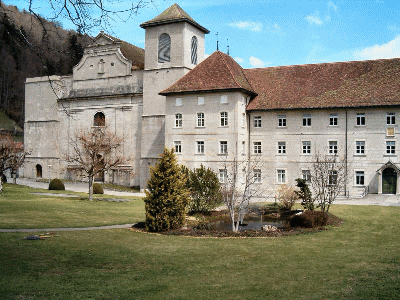
Bellelay Abbey
Bellelay Abbey, a former Premonstratensian monastery in the Bernese Jura, Switzerland, was legendarily founded in 1136 and confirmed by Pope Innocent II in 1142. Known for its 18th-century Baroque architecture and as the origin of the Tête de Moine cheese, the abbey reached a golden age as an educational institution for nobility. Secularized in 1797, its buildings have since housed a psychiatric clinic and served as a venue for cultural events.