
Öved Abbey
Premonstratensian·Sweden·Manor house (private residence)·12th century
Öved Abbey, originally a Premonstratensian abbey founded in the 12th century, was confiscated by the Danish Crown during the Reformation and fell into disrepair. In the 18th century, it was transformed into the palatial Övedskloster Manor by Hans Ramel, resulting in a significant 18th-century architectural ensemble.
Key Facts
- ›Founded in the 12th century by Archbishop Eskil of Lund.
- ›Originally a Premonstratensian abbey.
- ›Confiscated by the Danish Crown during the Reformation.
- ›Reconstructed into a palatial manor house starting in 1753.
- ›Architectural ensemble designed by Carl Hårleman and Jean Eric Rehn.
- ›Remains the private property of the Ramel family.

Rococo, Neoclassical
Palatial Manor House Ensemble, Rococo Parish Church, Grand Roads With Stone Causeways, 18th-Century Interior Design and Furnishings, Collection of Objets D'Art
öVedskloster Manor, öVedskloster Slott
Eskil of Lund, Hans Ramel, Amalia Beata Lewenhaupt, Carl HåRleman, Jean Eric Rehn
Founding of the Abbey, Confiscation By the Danish Crown, Reconstruction Into A Manor House
About Öved Abbey
Öved Abbey, known today as Övedskloster Manor, has a history stretching back to the 12th century when it was founded as a Premonstratensian abbey by Archbishop Eskil of Lund. Little is known about the original abbey, and no visible remains survive. The province of Scania was part of Denmark at the time of its founding.
Early History and Reformation
During the Reformation, the abbey was confiscated by the Danish Crown and subsequently transformed into a profitable estate. The 16th century saw the estate change owners multiple times, and a fire after 1594 likely destroyed most of the monastic buildings, with others converted into farm structures. The continuous wars between Sweden and Denmark throughout the 17th century further contributed to the neglect and disrepair of the monastic site. Despite this, drawings from the 1680s indicate that the walls of the former church were still standing to a significant height, and some monastic buildings remained intact.
Reconstruction and Manor House
In 1753, Hans Ramel acquired the estate and initiated a comprehensive reconstruction, transforming it into the palatial manor house visible today. Plans by architect Carl Hårleman for a new manor, park, parish church, and outbuildings were largely implemented. The reconstruction began in 1759 with the construction of a new Rococo church. New roads, many raised on substantial stone causeways, were also created, significantly shaping the surrounding landscape. The manor house and its wings were erected between 1769 and 1776, with Hårleman's external plans being respected. The interior layout was reworked by Jean Eric Rehn, reflecting the transition from Rococo to the Neoclassical ideals of the Gustavian era.
Architectural Ensemble and Legacy
The combined efforts of Hårleman and Rehn resulted in what is considered one of Sweden's most accomplished 18th-century architectural ensembles. The manor house features a distinctive north façade with pilasters and a mansard roof, while the wings are designed as rusticated pavilions. The garden side, facing a lower garden, has three storeys with large French windows. The interiors are sumptuously decorated with original furniture by master cabinet maker Georg Haupt, sculptures, and paintings by renowned artists. The manor house and its surroundings have remained largely unchanged since their construction and continue to be the private property of the Ramel family.
Source: Wikipedia ↗
Frequently Asked Questions
When was Öved Abbey founded?
Öved Abbey was founded in the 12th century. It was established by the archbishop of Lund, Eskil of Lund, on the site where the present manor now stands.
What happened to Öved Abbey after the Reformation?
Following the Reformation, the abbey was confiscated by the Danish Crown. It was subsequently transformed into a profitable estate and suffered significant disrepair due to fires and neglect.
Who was responsible for the reconstruction of Övedskloster?
The complete reconstruction into the palatial manor house was carried out by Hans Ramel, who purchased the estate in 1753. He followed plans largely developed by architect Carl Hårleman and interior designs were reworked by Jean Eric Rehn.
Is Övedskloster Manor still privately owned?
Yes, Övedskloster Manor remains in private ownership. It is still the property of the Ramel family, with the current owner being the tenth in line and also named Hans Ramel.
What architectural styles are present at Övedskloster?
The manor ensemble showcases Rococo architecture with the parish church built between 1759–1761, and Neoclassical ideals of the Gustavian era influencing the interior layout of the manor house, which was built between 1769–1776.
Related Monasteries

Averbode Abbey
Averbode Abbey is a Premonstratensian monastery in Belgium with a history dating back to its founding around 1134. Throughout its existence, it has experienced periods of growth, suppression, and reestablishment, notably serving as a leading children's publisher in Belgium during the 20th century. The abbey church is a distinct blend of Baroque and Gothic architectural styles, constructed with local sandstone.
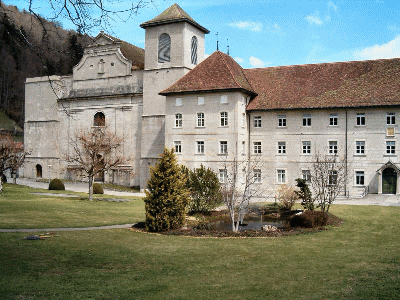
Bellelay Abbey
Bellelay Abbey, a former Premonstratensian monastery in the Bernese Jura, Switzerland, was legendarily founded in 1136 and confirmed by Pope Innocent II in 1142. Known for its 18th-century Baroque architecture and as the origin of the Tête de Moine cheese, the abbey reached a golden age as an educational institution for nobility. Secularized in 1797, its buildings have since housed a psychiatric clinic and served as a venue for cultural events.

Bonne-Espérance Abbey
Bonne-Espérance Abbey was a Premonstratensian monastery founded in 1130 and existing until the late 18th century in Vellereille-les-Brayeux, Belgium. Its foundation stemmed from the conversion of William of Croix, whose parents donated land for the abbey. The abbey was known for its veneration of Our Lady of Good Hope and housed the relics of Saint Frederick of Hallum before its suppression by the French Revolutionary Army.