
Nysted Friary
Nysted Friary, founded in 1286 in Nysted, Denmark, was a significant Franciscan establishment and the last one to operate in Denmark after the Reformation. It played a role in regional Franciscan governance and housed a hospital for notable individuals. Though its buildings were demolished after its dissolution in 1538, archaeological finds and historical records, such as the Nysted Martyrology, offer insights into its past.
Key Facts
- ›Founded in 1286, it was one of the earliest Franciscan friaries in Denmark.
- ›Served as the location for the annual chapter meeting of Franciscans in Scandinavia six times between 1283 and 1415.
- ›Included a hospital that accommodated important members of the Danish court and noble families.
- ›Experienced internal conflict between Observant and Conventual Franciscans in the late 15th century.
- ›The Nysted Martyrology, a rare surviving medieval Danish document, originated from this friary.
- ›Was the last occupied Franciscan friary in Denmark, closing in 1538.
Nysted Martyrology, Hospital For Notable Individuals
Nysted Franciskanerkloster
Valdemar Podebusk, Lutke Naamensen
- Internal Conflict Between Observants and Conventuals
- Dissolution Due To the Reformation
About Nysted Friary
Nysted Friary, known in Danish as Nysted franciskanerkloster, was a significant Franciscan monastery located in the coastal town of Nysted on the island of Lolland in southern Denmark. Founded in 1286, it was among the earlier Franciscan establishments in Denmark and fell under the jurisdiction of the Custody of Odense within the Franciscan Province of Dacia. The friary's importance was highlighted by its hosting of the annual chapter meeting for Franciscans across Scandinavia on six occasions between 1283 and 1415, suggesting its prominence in the order's regional affairs.
History and Significance
The friary was constructed in a typical quadrilateral layout, featuring four wings surrounding a central cloister with a chapel forming one side. Beyond its religious functions, Nysted Friary also operated a hospital that served as a place of care for important members of the Danish court and noble families, as evidenced by references to a mortality book that recorded deaths among its patients. This institution cared for figures such as Bishop Valdemar Podebusk and Lyder Colbaltus Kabel.
During the late 15th century, the friary was internally divided by a conflict within the Franciscan order regarding the strict interpretation of their Rule of Saint Francis, particularly concerning the vow of poverty. This dispute between the Observants, who advocated for strict adherence and avoidance of property, and the Conventuals, who favored a more liberal interpretation, led to significant unrest, including physical altercations between the factions in 1477 and 1479. Despite these internal struggles, the friary continued to function, though it began selling off properties in 1483 and 1484.
A highly valuable artifact associated with Nysted Friary is the Nysted Martyrology, a comprehensive list of saints' days for the entire year. This document, one of only four surviving from the medieval period in Denmark, was lost during the friary's dissolution and was only rediscovered in a library in The Hague in 1959.
Dissolution and Aftermath
The Reformation brought an end to Nysted Friary. Following royal decrees beginning in 1527 to close Franciscan houses, Nysted Friary became the last one remaining in Denmark, ceasing operations in 1538. The expulsion of the Franciscans was a contentious period, often marked by public anger directed at monastic houses. Historical accounts detail the confiscation of valuables from Nysted Friary by local officials. The last recorded monk at Nysted was Lutke Naamensen.
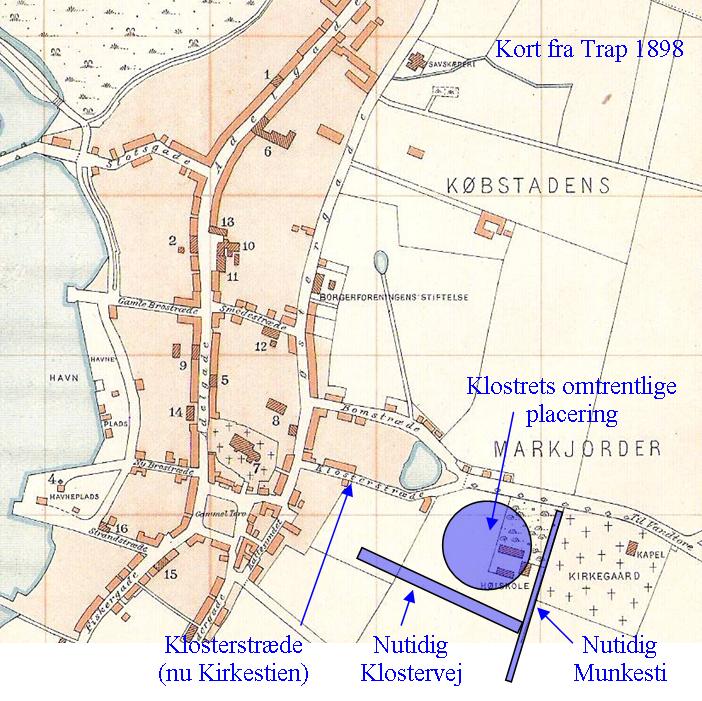
After its closure, the buildings were ordered to be demolished in 1551, with two of the chapel bells being transferred to Nysted parish church. By 1577, only ruins remained, and over the following centuries, the stone and bricks were extensively removed for the construction of local buildings, so much so that even foundation stones have vanished. Archaeological excavations in the 1920s by the National Museum of Denmark identified the site and uncovered several burials, including the seal of Chancellor Valdemar Podebusk, who had become a Franciscan before his death and burial there. The site has since been redeveloped for modern construction purposes.
Source: Wikipedia ↗
Frequently Asked Questions
When was Nysted Friary founded?
Nysted Friary was founded in 1286. It was established on land donated by the lords of Kærstrup and Kjeldstrup farms in the coastal town of Nysted.
What was the significance of Nysted Friary in Scandinavia?
The friary was prominent enough to host the annual chapter meeting of Franciscans from all of Scandinavia six times between 1283 and 1415. After this period, it hosted these meetings fewer times.
Did Nysted Friary have any special facilities?
Yes, the friary had a hospital that was significant enough to accommodate important members of the Danish court and noble families who were ill.
What happened to Nysted Friary after the Reformation?
The Reformation led to the closure of Franciscan houses, and Nysted Friary was the last one remaining, closing in 1538. Its buildings were ordered to be demolished in 1551, and its materials were reused for local construction.
What is the Nysted Martyrology?
The Nysted Martyrology is a list of saints' days for the entire year that was created at Nysted Friary. It is one of only four such documents surviving from the medieval period in Denmark and was rediscovered in 1959.
Related Monasteries

Alling Abbey
Alling Abbey was one of the last Benedictine monasteries built in Denmark, established north of Silkeborg before 1250. It followed a typical monastic architectural pattern, with ranges surrounding St. Hans Church to isolate the monks. Following the Danish Reformation, the abbey was secularized and subsequently demolished in the late 16th century, with its site now preserved and partially excavated.

Dominican Priory, Viborg
The Dominican Priory, Viborg, also known as Blackfriars (Sortebrødrekloster), was a significant medieval monastery in Viborg, Denmark, founded by Bishop Gunnar of Viborg around 1227. It served as a center for Dominican friars engaged in teaching and prayer, notable for its preaching in Danish from 1254. The priory was dissolved in 1529 during the Reformation, and while the church continued as a parish church, the priory buildings were later demolished and rebuilt.
Franciscan Friary, Copenhagen
The Franciscan Friary in Copenhagen, also known as Greyfriars, was established in 1238 by Countess Ingerd of Revenstein and became the most significant Franciscan house in Denmark. At its peak, it included a church, refectory, and a great hall used for state meetings, alongside a guesthouse, hospital, and gardens. The friary was dissolved in the 1530s due to the spread of Lutheran doctrines and local opposition to monastic begging, with its properties eventually being repurposed for public use, including a hospital and later a prison.