
Franciscan Friary, Copenhagen
Christian·Denmark·Ruins/Rebuilt Structures·13th century
The Franciscan Friary in Copenhagen, also known as Greyfriars, was established in 1238 by Countess Ingerd of Revenstein and became the most significant Franciscan house in Denmark. At its peak, it included a church, refectory, and a great hall used for state meetings, alongside a guesthouse, hospital, and gardens. The friary was dissolved in the 1530s due to the spread of Lutheran doctrines and local opposition to monastic begging, with its properties eventually being repurposed for public use, including a hospital and later a prison.
Key Facts
- ›Founded in 1238 by Countess Ingerd of Revenstein.
- ›Served as the most important Franciscan friary in Denmark.
- ›Included a church, refectory, great hall, guesthouse, and hospital.
- ›Renowned for housing numerous relics of saints.
- ›Dissolved in the early 1530s following the spread of Lutheranism.
- ›Later repurposed for a hospital, prison, and orphanage.
Church With Numerous Relics, Great Hall Used For State Meetings, Hospital For the Sick and Poor, Guesthouse, Large Garden and Apple Orchard, Cellars Used As Town Jail
Greyfriars, GråBrøDrene
Countess Ingerd of Revenstein, Jacob Sunesen, Bishop Peder Sunesen
Founded In 1238, Dissolved In the Early 1530s, Church Converted To A Prison, Buildings Affected By Fires of 1728 and 1807
About Franciscan Friary, Copenhagen
The Franciscan Friary in Copenhagen, also known by its Danish name Gråbrødrene (Greyfriars), was a significant religious institution in medieval Denmark. Founded in 1238 by Countess Ingerd of Revenstein, a prominent noblewoman, it quickly became the most important Franciscan house in the country.
Establishment and Early Years
Countess Ingerd, a member of the influential Hvide family, established the friary on a farm located outside the town of Copenhagen at the time of its founding. She had encountered the Franciscans, a relatively new religious order, while living in Germany with her husband and proceeded to found several Franciscan houses in Denmark. The friary in Copenhagen was managed by a Guardian and several brothers, each with specific duties related to the hospital, guest house, and other communal needs.
Over time, the friary accumulated various properties throughout Copenhagen, generating income through rents. Although officially forbidden to accept money, the friars, nicknamed "beggar monks" for their practice of soliciting food gifts, found ways to ease their financial constraints. They also received payments for praying for the souls of the deceased.
The Friary at its Height
At its zenith, the Franciscan Friary comprised a church, a refectory, and a large hall that frequently hosted important state gatherings and meetings for the provincial governing Franciscan monasteries in Denmark. Within its walls were also a guesthouse, a hospital for the sick and poor, living quarters for lay brothers, an extensive garden, a brewery, and an apple orchard. The friary also maintained a house in Dragør.
The church was particularly renowned for its extensive collection of relics, including those of prominent saints such as Saint Olav, Saint Erik, Saint Canute, Saint Eskil, Abbot Vilhelm, Saint Bridget, and Saint Willehad.
Dissolution and Later History
By the 1520s, the spread of Lutheran doctrines in Copenhagen led to growing dissent against religious houses and their financial demands. The "beggar monks" became an early target for anti-Catholic sentiment. In 1530, the mayor and town council prohibited monks and friars from begging in the streets. Faced with this restriction and the general populace's unwillingness to permit their presence, the guardian and vice-guardian conveyed the friary and its possessions away from the Franciscan order on April 25, 1530.
The brothers departed shortly thereafter. Eight brothers who had learned a craft removed their habits, married, and settled in Copenhagen with the aid of the magistrate and citizens. Subsequently, crown administrators decided the church, conventual buildings, and burial ground would be transferred to the University of Copenhagen to generate income. New streets were laid out through the former garden and orchard, and rents from former friary properties were allocated to support the hospital.
A royal decree on August 6, 1532, altered this arrangement, dedicating the monastery, church, and income-producing houses to fund the hospital for the benefit of the poor and sick. The church tower remained a visible landmark until at least 1596. The friary's extensive cellars were converted into the town jail, and the church itself was eventually transformed into a prison. In 1621, Christian IV added an orphanage and recommissioned the church as a place of worship, known as the "Prison Church."
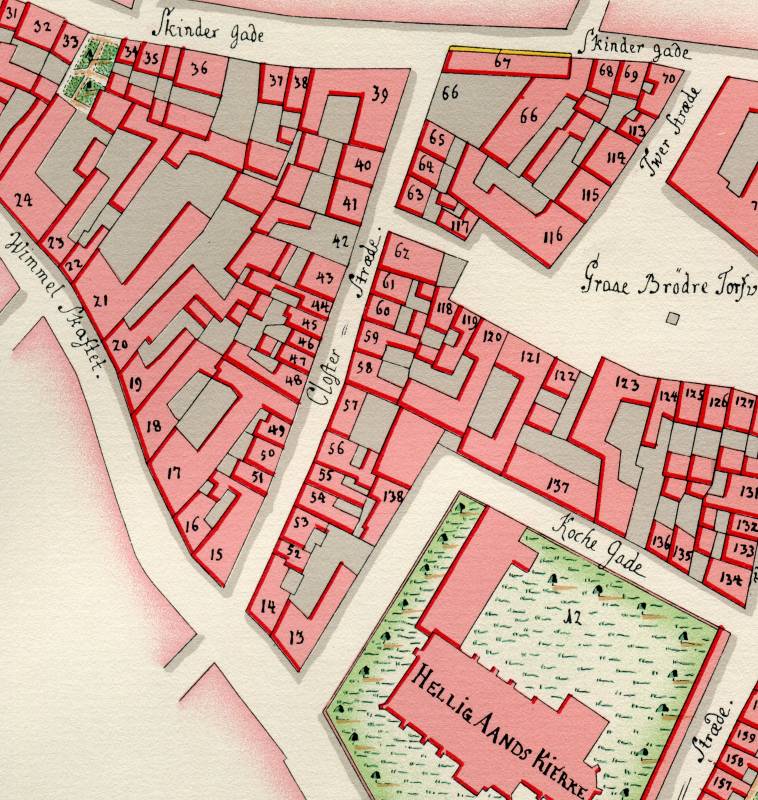
The majority of the friary buildings were lost in the fires of 1728 and 1807, while others were demolished to make way for private residences and businesses. Although parts of the thick outer walls and conventual structures were incorporated into new buildings near Grayfriars Market Square in Copenhagen, little tangible evidence remains today of the centuries of Franciscan occupation.
Source: Wikipedia ↗
Frequently Asked Questions
When was the Franciscan Friary in Copenhagen founded?
The Franciscan Friary in Copenhagen was founded in 1238. It was established by Countess Ingerd of Revenstein, a prominent figure from one of Denmark's wealthy families.
Who founded the Franciscan Friary in Copenhagen?
The friary was founded by Countess Ingerd of Revenstein. She was a wealthy noblewoman who had connections with the Franciscan order and established several houses in Denmark.
Why was the Franciscan Friary dissolved?
The friary was dissolved in the early 1530s due to the growing influence of Lutheran doctrines in Copenhagen and local opposition to the friars begging for alms. The town authorities made it illegal for them to beg, leading to the abandonment of the friary.
What happened to the Franciscan Friary after its dissolution?
After the friars left, the church, conventual buildings, and burial ground were intended for the University of Copenhagen. However, a royal decree in 1532 redirected these assets to fund a hospital for the poor and sick. The church was later converted into a prison and eventually a 'Prison Church'.
What notable relics were housed at the Franciscan Friary?
The Franciscan church was known for its collection of relics, which included those of Saint Olav, Saint Erik, Saint Canute, Saint Eskil, Abbot Vilhelm, Saint Bridget, and Saint Willehad, among others.
What was the nickname of the Franciscan friars?
The Franciscan friars were nicknamed the "beggar monks." This was because, despite rules against receiving money, they were often seen on the streets asking for gifts of food.
Related Monasteries

Alling Abbey
Alling Abbey was one of the last Benedictine monasteries built in Denmark, established north of Silkeborg before 1250. It followed a typical monastic architectural pattern, with ranges surrounding St. Hans Church to isolate the monks. Following the Danish Reformation, the abbey was secularized and subsequently demolished in the late 16th century, with its site now preserved and partially excavated.

Dominican Priory, Viborg
The Dominican Priory, Viborg, also known as Blackfriars (Sortebrødrekloster), was a significant medieval monastery in Viborg, Denmark, founded by Bishop Gunnar of Viborg around 1227. It served as a center for Dominican friars engaged in teaching and prayer, notable for its preaching in Danish from 1254. The priory was dissolved in 1529 during the Reformation, and while the church continued as a parish church, the priory buildings were later demolished and rebuilt.

Hospital of the Holy Ghost, Copenhagen
The Hospital of the Holy Ghost in Copenhagen, Denmark, was founded in 1296 as one of the oldest hospitals in the city, initially dedicated to caring for the poor and sick. Over time, it evolved, becoming an Augustinian priory in 1497 under King Christian I. Following the Reformation, it transitioned into a secular city institution and its church became a parish church, with parts of the original complex repurposed or demolished.