
Novo-Diveevo Convent
Novo-Diveevo Convent, also known as the Stavropighial Convent of the Holy Dormition, is a female monastic community established in Nanuet, New York, in 1949. It operates under the Russian Orthodox Church Outside Russia and is locally referred to as Diveevo. The convent is notable for housing one of the largest Russian Orthodox Christian cemeteries in the United States, with over 8,000 graves across five sections.
Key Facts
- ›Founded in 1949.
- ›Operates under the Russian Orthodox Church Outside Russia.
- ›Known locally as Diveevo.
- ›Home to one of the largest Russian Orthodox Christian cemeteries in the United States.
- ›The cemetery contains over 8,000 graves divided into 5 areas.
- ›Features a monument in remembrance of the Russian Liberation Army.

- One of the Largest Russian Orthodox Christian Cemeteries In the United States
- Monument For the Russian Liberation Army
Novo-Diveyevo Convent, Novo-Diveievo, Novodiveevo, Stavropighial Convent of the Holy Dormition, Diveevo
Prince Georgy Konstantinovich of Russia, Princess Vera Constantinovna of Russia, Pavel Bermondt-Avalov, Alexander Bogolepov, Tetos Demetriades, Andrey Dikiy, Roman Gul, Vsevolod K. Gurevich, Michael Karpovich, Margarita Khitrovo, Vasily Konovalenko, Boris Koverda, Maria Kurenko, Plato Malozemoff, Gregory V. Mesniayev, Sofia Panina, Igor Pantuhoff, Alexander Rodzyanko, Anatoly Rogozhin, Alexander Siloti, Seraphim Slobodskoy, Olga Spessivtseva, Nicholas Teliatnikow, Alexandra Tolstaya, Ilya Andreyevich Tolstoy, Michael Alexandrovich Verbov, Elena Wrangel, Vladimir Yourkevitch, Irina Lomasney, Abbess Makaria
World War Ii
About Novo-Diveevo Convent
Novo-Diveevo Convent, also known by variants such as Novo-Diveyevo and Novodiveevo, is a female monastic community located in Nanuet, Rockland County, New York. Founded in 1949, it operates under the jurisdiction of the Russian Orthodox Church Outside Russia. The community is also referred to as the Stavropighial Convent of the Holy Dormition, and is commonly known locally as Diveevo.
Cemetery and Notable Burials
A significant feature of Novo-Diveevo Convent is its expansive cemetery, recognized as one of the largest Russian Orthodox Christian cemeteries in the United States. This burial ground encompasses over 8,000 graves, organized into five distinct sections. Among the interred are numerous figures from Russian émigré communities, including members of the Russian imperial family, military leaders, artists, historians, theologians, and political figures. Notably, the cemetery includes a monument commemorating the Russian Liberation Army, which fought against the Soviet Union during World War II.
Leadership
The head of the Novo-Diveevo Convent is Abbess Makaria.
Source: Wikipedia ↗
Frequently Asked Questions
When was Novo-Diveevo Convent founded?
Novo-Diveevo Convent was founded in 1949. It is a female monastic community located in Nanuet, Rockland County, New York.
What religious denomination is Novo-Diveevo Convent associated with?
Novo-Diveevo Convent is under the auspices of the Russian Orthodox Church Outside Russia. It is also known as the Stavropighial Convent of the Holy Dormition.
What is significant about the cemetery at Novo-Diveevo Convent?
The convent is home to one of the largest Russian Orthodox Christian Cemeteries in the United States. It has over 8,000 graves spread across five distinct areas.
Are there any notable monuments at the cemetery?
Yes, a monument is placed in remembrance of the Russian Liberation Army, which fought in World War II against the Soviet Union. The cemetery also contains the graves of many notable figures from Russian émigré communities.
Who is the head of Novo-Diveevo Convent?
The head of Novo-Diveevo Convent is Abbess Makaria.
Related Monasteries

Antonievo-Siysky Monastery
The Antonievo-Siysky Monastery is a historic Russian Orthodox monastery located in the Arkhangelsk Oblast of Russia. Founded in 1520 by Saint Antonius of Siya, it grew significantly, becoming a prominent spiritual and economic center in the Russian North, particularly known for its salt trade and rich library. The monastery played a role in Russian history, notably as a place of exile for Feodor Romanov, who later became Patriarch of Moscow and whose son founded the Romanov dynasty.
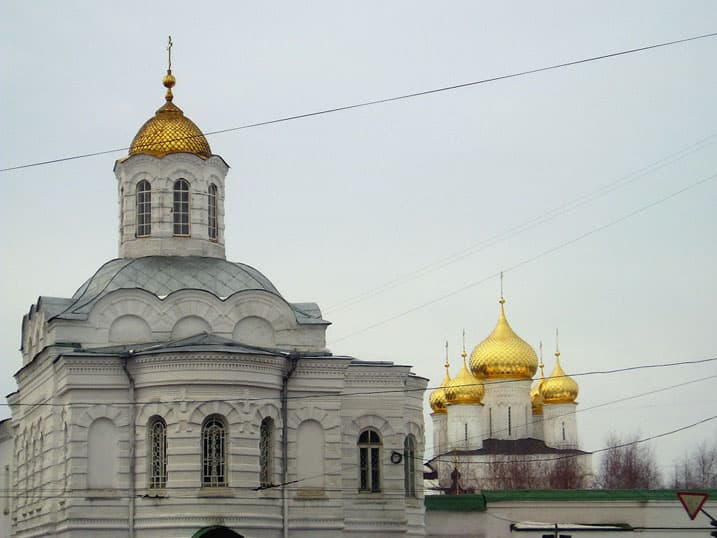
Bogoyavlensky Monastery (Kostroma)
Bogoyavlensky Convent, located in Kostroma, is a prominent Russian Orthodox convent renowned for housing the ancient Feodorovskaya Icon of the Mother of God. Originally founded as a monastery in the 15th century, it underwent significant construction and stylistic changes throughout its history, including a major rebuilding in the Russian Revival style in the late 19th century, after which it became a convent. Despite abolishment after the October Revolution, it was revived in the 1990s.
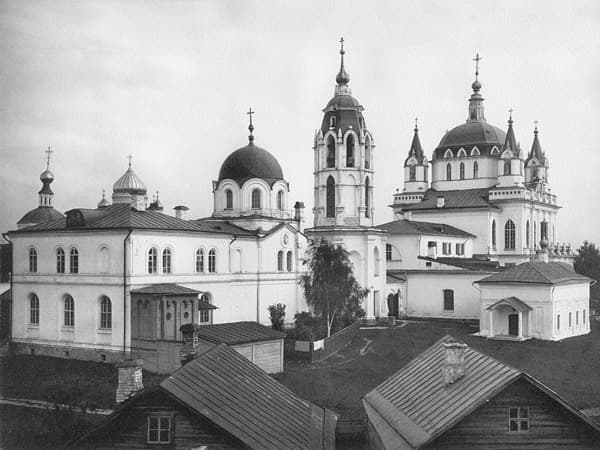
Conception Convent
The Conception Convent, also known as the Zachatyevsky Monastery, is a Russian Orthodox convent located on the Moskva River in Moscow. Originally believed to occupy the site of the oldest nunnery in Moscow, it was reestablished in 1995 after being closed by the Bolsheviks in 1918 and undergoing significant damage and repurposing during the Soviet era. Its reconstruction has seen the rebuilding of its katholikon in a Russian Revival style.