
Nieuwenbosch Abbey
Christian·Belgium·Ruins (original site) / Dissolved·13th century
Nieuwenbosch Abbey was a Cistercian nunnery, originally established in 1215 in Lokeren, Belgium. After relocating to Heusden in 1257 and adopting the name Nieuwenbosch, the abbey was significantly damaged by Iconoclasts in 1579. The community subsequently moved to Ghent for safety, where it was eventually dissolved during the French Revolution in 1796.
Key Facts
- ›Founded in 1215 near Lokeren as a Cistercian nunnery.
- ›Relocated to Heusden in 1257, becoming known as Nieuwenbosch Abbey.
- ›Suffered significant destruction during the Iconoclast riots in 1579.
- ›Re-established in Ghent after the 1579 destruction.
- ›Dissolved in 1796 during the French Revolution.
- ›The former abbey farm, Bosseveerhoeve, is the only remaining structure at the Heusden site.

Bosseveerhoeve, Monumental Effigy of Hugo Ii
Nieuwenbos Abbey, Abdij Nieuwenbosch, Nieuwenbos
Hugo Ii, Castellan of Ghent
Iconoclast Riots, French Revolution
About Nieuwenbosch Abbey
Nieuwenbosch Abbey, also known as Nieuwenbos Abbey, was a Cistercian nunnery with a history spanning several centuries in what is now Belgium. Its establishment in 1215 marked the beginning of a community that would face significant upheaval and relocation throughout its existence.
History and Development
The Cistercian community was first established in 1215 near Lokeren, initially named the abbey of Onze Lieve Vrouwe ten Bosse at Bosse. By 1259, it was known as Oudenbos. The original site proved unsuitable due to poor water supply, prompting a move in 1257 to a new location in Heusden. It was at this point that the abbey adopted the name "Nieuwenbosch," signifying its new beginnings.
Tragedy struck the abbey in 1579 when it was stormed and largely ruined by Iconoclasts. Seeking greater security, the nuns relocated within the city of Ghent. They constructed new premises in what is now the Lange Violettenstraat, repurposing stone from the destroyed Heusden buildings. The original Heusden site and its remaining structures were eventually leased to farmers.
The community's existence came to an end in 1796 with its dissolution during the French Revolution.
Legacy and Present Day
Today, the original site in Heusden is marked by the former abbey farm, known as the Bosseveerhoeve. Little remains of the abbey itself, but the historical significance of the site is acknowledged. In 1948, a significant discovery was made on the grounds of the former abbey church: a monumental effigy of Hugo II, a castellan of Ghent and a benefactor of Nieuwenbosch Abbey. This effigy is now housed in the Ghent City Museum, serving as a tangible link to the abbey's past and its prominent supporters.
Source: Wikipedia ↗
Frequently Asked Questions
When was Nieuwenbosch Abbey founded?
Nieuwenbosch Abbey was established in 1215 as a Cistercian community. It later relocated to Heusden in 1257, at which point it became known as Nieuwenbosch.
What happened to Nieuwenbosch Abbey during the Iconoclast period?
The abbey was stormed and largely ruined in 1579 by the Iconoclasts. This event led the nuns to seek greater security within the city of Ghent.
Where is Nieuwenbosch Abbey located today?
The original site in Heusden now only retains the former abbey farm, known as Bosseveerhoeve. The community later relocated and was dissolved in Ghent.
What remains of Nieuwenbosch Abbey today?
On the original Heusden site, the former abbey farm, Bosseveerhoeve, is the sole visible structure. A monumental effigy of Hugo II, a benefactor, was discovered in 1948 on the former abbey church site in Heusden and is now in the Ghent City Museum.
What religious order was Nieuwenbosch Abbey part of?
Nieuwenbosch Abbey was a Cistercian nunnery.
Related Monasteries

Boneffe Abbey
Boneffe Abbey was a Cistercian monastery located on the banks of the Mehaigne in present-day Belgium, existing from the early 13th century until its suppression by French revolutionaries at the end of the 18th century. Initially a convent for nuns, it was later designated as a monastery for monks. The abbey and its church suffered damage from conflict during the Dutch Revolt and the War of the Spanish Succession, with periods of rebuilding and reconsecration.

Clairefontaine Abbey
Clairefontaine Abbey, also known as the Abbey of Notre-Dame de Clairefontaine, was a Cistercian nunnery established in the mid-13th century and suppressed in 1796. While legend attributes its founding to a Marian apparition in 1214, historical evidence points to its completion by Henry V, Count of Luxembourg, after his mother Ermesinde's death. The abbey served as a significant dynastic burial site for the House of Luxembourg before its destruction during the French Revolutionary Wars, with its remains now serving as a tourist site and place of pilgrimage.
Oost-Eekloo Abbey
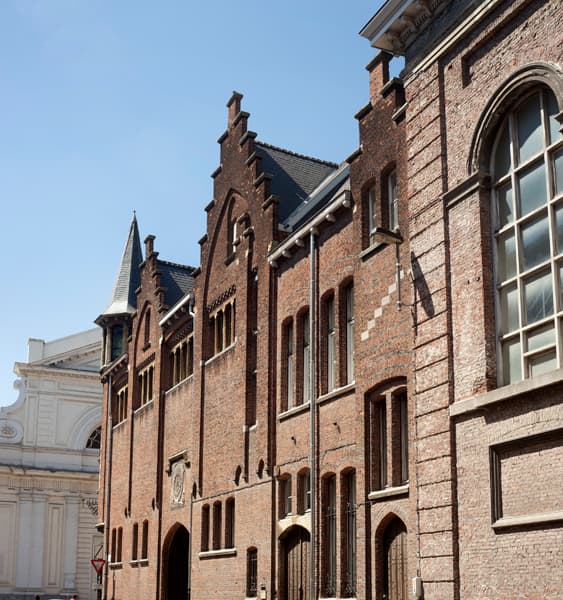
Oost-Eekloo Abbey was a Cistercian nunnery founded in Oosteeklo in 1217, later relocating to Ghent after being plundered during the Dutch Revolt. The abbey played a role in the agricultural development of its original locale and, after its move to Ghent, saw the construction of its church, refectory, chapter house, and infirmary. Though suppressed in 1796, the community continued clandestinely until officially recognized again in 1814, eventually dying out by the mid-19th century.