
Marrick Priory
Christian·England·Ruins and Outdoor Education Centre·12th century
Marrick Priory was a Benedictine nunnery established between 1140 and 1160 in Richmondshire, North Yorkshire. It included the parish church and 400 acres of land, flourishing until its dissolution in 1539. Following its surrender, the site passed through various private owners before the church, a Grade II* listed building, was converted into an outdoor education center in 1970.
Key Facts
- ›Established between 1140 and 1160 by Roger de Aske.
- ›Owned the Church of the Virgin Mary and St. Andrew and 400 acres of local land.
- ›Surrendered to commissioners during the Dissolution of the Monasteries on 15 September 1539.
- ›The church was used as a farm building after 1948 and is a Grade II* listed building.
- ›The church was converted into an outdoor education and residential center in 1970.
Perpendicular Gothic
Nuns' Steps Or Nuns' Causey, Grade Ii* Listed Church Building
Roger De Aske, Christabel Cowper
Dissolution of the Monasteries
About Marrick Priory
Marrick Priory: A Benedictine Nunnery in North Yorkshire
Marrick Priory was a Benedictine nunnery located in Richmondshire, North Yorkshire, England. Its establishment is dated between 1140 and 1160, with Roger de Aske credited as its founder. The priory's holdings were substantial, encompassing the parish Church of the Virgin Mary and St. Andrew, along with approximately 400 acres of local land. Despite facing raids from marauding Scots, the nunnery experienced a period of prosperity that lasted until the 16th century.
Dissolution and Later History
The priory's monastic life concluded on 15 September 1539, when Prioress Christabel Cowper surrendered the site to commissioners John Uvedale and Leonard Bekwith during the Dissolution of the Monasteries. The sixteen resident nuns were displaced, with the prioress receiving a pension of 100 shillings and the other nuns receiving lesser amounts. Following the dissolution, the Crown leased the site to Sir John Uvedale, who later purchased it in 1545. Ownership changed hands several times, eventually being sold to Sir Timothy Hutton in 1592 and then to the Blackburn family in 1633.
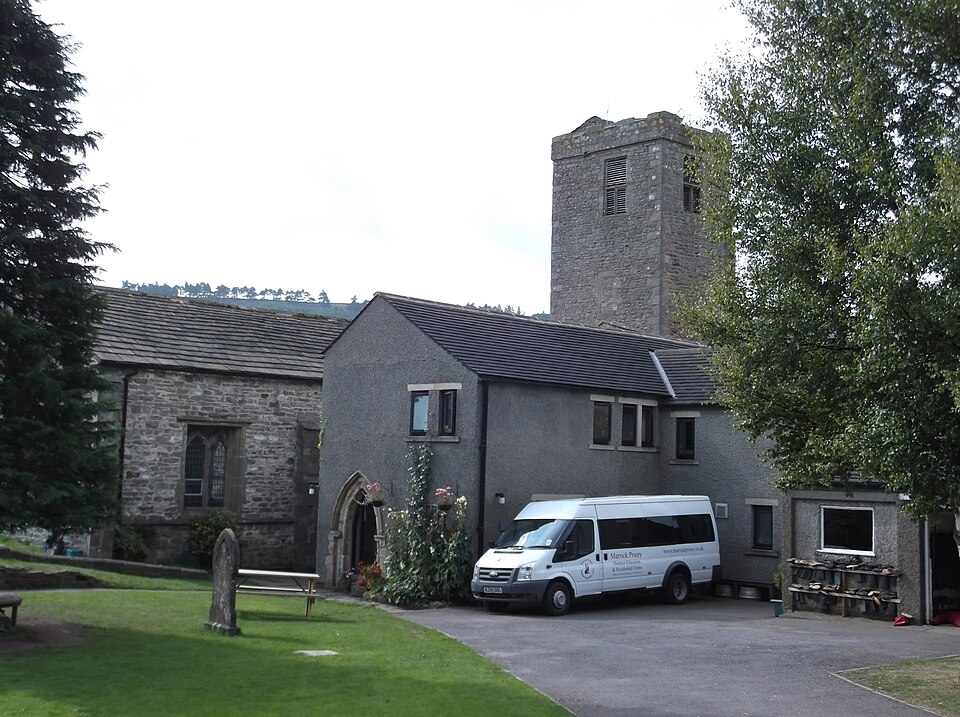
The parish church, a Grade II* listed building, continued to serve the local community for worship until 1948. After this, it was repurposed as a farm building for a period. In 1970, a significant transformation occurred when the church underwent restoration and was converted into an outdoor education and residential centre. This facility now hosts thousands of young people annually, offering a range of outdoor activities and team-building exercises.
Associated Features
Northeast of the priory site, a flagged stone path known as the Nuns' Steps or Nuns' Causey winds through Steps Wood towards the village of Marrick. This path is thought to have a historical connection to the priory, possibly serving as a link to the main Richmond road or related to the priory's historical lead-mining interests. The church itself exhibits architectural elements from the Perpendicular Gothic style, featuring a nave, a ruined chancel, and a west tower with a stair tower on its south side. The south wall of the nave is notable for a large round window containing a quatrefoil.
Source: Wikipedia ↗
Frequently Asked Questions
When was Marrick Priory founded?
Marrick Priory was established as a Benedictine nunnery between the years 1140 and 1160. It was founded by Roger de Aske.
What happened to Marrick Priory during the Dissolution of the Monasteries?
During the Dissolution of the Monasteries, the prioress Christabel Cowper surrendered Marrick Priory on 15 September 1539. The sixteen nuns residing there were evicted, and the priory site was subsequently leased and later purchased by private individuals.
What is the current use of the former Marrick Priory church?
After being used as a farm building from 1948, the church of Marrick Priory was converted into an outdoor education and residential centre for young people in 1970. It provides various outdoor activities for thousands of visitors annually.
What architectural features does the Marrick Priory church have?
The church is constructed of stone with a stone slate roof, comprising a nave, a ruined chancel, and a west tower. The tower features three stages and a south-side stair tower, while the nave has a large round window with a quatrefoil on its south wall, and most other windows are in the Perpendicular style.
Is there a notable path associated with Marrick Priory?
To the northeast of the priory, a flagged stone path known as the Nuns' Steps or Nuns' Causey leads through Steps Wood to the village of Marrick. This path is believed to have been connected to the priory, possibly serving as a route to the Richmond road or related to its lead-mining activities.
Related Monasteries

Anglesey Priory
Anglesey Abbey is a National Trust property in Lode, England, that evolved from an Augustinian priory founded in the early 12th century. After its dissolution in 1536, the site was transformed into a Jacobean-style house, and later extensively developed by Lord Fairhaven into a country house with significant art collections and landscaped gardens. The property now features a house, gardens, and a working mill, preserving the legacy of its monastic past and its later private ownership.

Ankerwycke Priory
Ankerwycke Priory was a small and relatively poor Benedictine nunnery established around 1160 in Buckinghamshire, England. Dedicated to St. Mary Magdalene, it held lands across several counties. Dissolved in 1536, its revenues were transferred to Bisham Abbey, and the priory site later saw the construction of a manor house. Today, only a small section of ruins remains, situated in Berkshire.

Appuldurcombe House
Appuldurcombe House is the shell of a substantial 18th-century English Baroque country house on the Isle of Wight, England. Originally a priory, it evolved into a convent before becoming a Leigh family home. Sir Robert Worsley began constructing the current mansion in 1702, with significant extensions and landscaping undertaken by his great-nephew, Sir Richard Worsley, in the 1770s. Despite periods as a hotel and a school, the house was damaged during World War II and is now managed by English Heritage.