
Lmbatavank
Lmbatavank, formally the Saint Stephen Church of Lmbat Monastery, is a 7th-century Armenian church situated on a hillside southwest of Artik in the Shirak Province. It is characterized by its cruciform centralized plan and octagonal drum topped by a dome. The church is notable for its 7th-century frescoes within the apse and decorative shield-type patterns on its exterior.
Key Facts
- ›Constructed in the 7th century.
- ›Dedicated to Saint Stephen.
- ›Features a cruciform centralized architectural plan.
- ›Houses 7th-century frescoes in its apse.
- ›Archaeological findings include khachkars and a Bronze Age cemetery.
- ›Partially renovated between 1955 and 1956.

Armenian Architecture
7th-Century Frescoes, Cruciform Centralized Plan, Khachkars, Bronze Age Cemetery Remnants
Saint Stephen Church of Lmbat Monastery
- Target of Attempted Cannon Fire By Turkish Forces
- Church Door Stolen and Later Returned
About Lmbatavank
The Saint Stephen Church of Lmbat Monastery, commonly known as Lmbatavank, is a significant 7th-century religious structure located on a hillside southwest of Artik in Armenia's Shirak Province. Its construction date places it firmly within the early medieval period of Armenian architectural development.
Architecture and Art
Lmbatavank is distinguished by its cruciform centralized plan, topped by an octagonal drum and a corresponding dome. The church's exterior is adorned with decorative elements, primarily circular shield-type patterns, and features bell-style arches above some windows, as well as intricate eaves and cornices. The eastern facade bears inscriptions and a low-relief cross pattée within a circle, a motif also found on other churches in the Artik region. Inside, the apse contains notable 7th-century frescoes that offer glimpses into early Christian iconography, including depictions of Jesus surrounded by celestial symbols and an image of Saint George on horseback.
Historical Context and Discoveries
Between 1955 and 1956, Saint Stephen underwent partial renovations. Subsequent excavations from 1960 onward cleared the area in front of and beneath the church, revealing khachkars and a Bronze Age cemetery. These findings underscore the ancient history of the site and its continuous use over millennia. While the church itself is a testament to 7th-century Armenian craftsmanship, the surrounding discoveries point to an even deeper historical presence.
Folklore
Lmbatavank is also associated with local folklore that highlights its perceived sanctity. One tale recounts how Turkish invaders attempting to fire a cannon at the church repeatedly misfired, ultimately abandoning the attack after realizing they were targeting a holy site. Another story involves the theft of the church door, which, according to legend, became magically stuck to the thief's back until he returned it to the church, a testament to the reverence for the site.
Source: Wikipedia ↗
Frequently Asked Questions
Where is Lmbatavank located?
Lmbatavank is located on a hillside southwest of the town of Artik, within the Shirak Province of Armenia.
What is the architectural style of Lmbatavank?
The church has a cruciform centralized plan with an octagonal drum and dome. Its exterior features decorative shield-type patterns, and the interior apse contains 7th-century frescoes.
What historical discoveries have been made at Lmbatavank?
Excavations have uncovered khachkars and a Bronze Age cemetery in the area around the church. Some of these khachkars are now incorporated into the retaining walls.
Are there any notable frescoes inside Lmbatavank?
Yes, the apse of the church contains important 7th-century frescoes. These depict scenes such as Jesus surrounded by heavenly powers and Saint George on horseback.
What is the folklore associated with Lmbatavank?
Local folklore recounts an instance where Turkish invaders attempted to fire a cannon at the church but repeatedly misfired, leading them to believe it was a holy site and cease their attack. Another tale involves a man stealing the church door, only for it to become stuck to his back until he returned it.
Related Monasteries
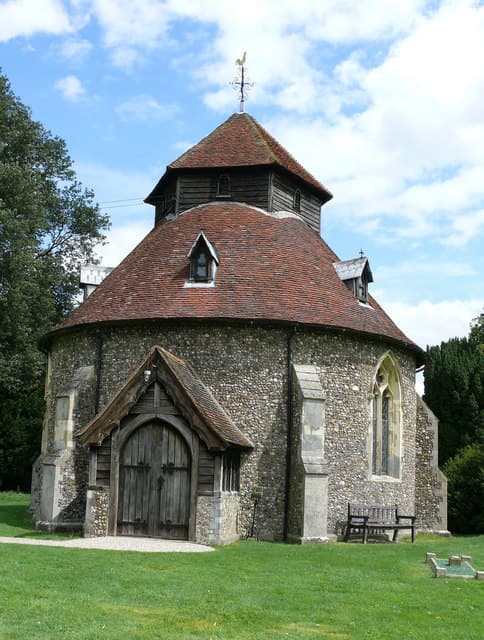
Little Maplestead Preceptory
Little Maplestead Preceptory was an establishment of the Knights Hospitaller located in the village of Little Maplestead, Essex, England. Its primary surviving structure is the parish church of St John the Baptist, a rare medieval round church built by the Knights Hospitallers. The church, dating from around 1335, retains much of its original design despite extensive rebuilding in the 19th century.

Sedlec Abbey
Sedlec Abbey, officially the Church of the Assumption of Our Lady and Saint John the Baptist, is a significant Gothic and Baroque Gothic structure located near Kutná Hora in the Czech Republic. Originally founded as the oldest Cistercian abbey in the Czech lands in 1142, it was rebuilt in the early 18th century by Johann Santini-Aichel, who infused it with his distinctive Baroque Gothic style. The church is recognized as a UNESCO World Heritage site, notable for its early Gothic architecture and later Baroque Gothic reconstruction.

Aruchavank
Aruchavank, also known as the Cathedral of Aruch or Surb Grigor, is a significant medieval Armenian church located on a plateau near Mount Aragats. Commissioned by Prince Grigor Mamikonian and his wife Heghine between 661 and 682 AD, it stands as one of the largest and most architecturally important churches of its era in Armenia. Despite damage from earthquakes and its use as a fortress, the church has undergone restoration, though its drum and cupola are now collapsed.