
Landerneau
Landerneau is a commune in the Finistère department of Brittany, France, situated at the mouth of the Elorn River. Historically, it was a significant center for the flax and linen industries in the 16th and 17th centuries. The town is also recognized for its unique "Moon of Landerneau" nickname, stemming from a silver disc atop the Saint Houardon Church, and is the birthplace of businessman Édouard Leclerc.
Key Facts
- ›Located at the mouth of the Elorn River, dividing Cornouaille and Léon.
- ›Important center for flax and linen industries in the 16th and 17th centuries.
- ›Known for the "Moon of Landerneau," a silver disc on Saint Houardon Church.
- ›Birthplace of Édouard Leclerc, founder of the E.Leclerc supermarket chain.
- ›Features the Pont de Rohan, a 16th-century house-lined bridge.
- ›Has bilingual (French and Breton) signage and promotes the Breton language.

Pont De Rohan, Saint Houardon Church
Landerne
Saint TéNéNan, Saint Arnoc, éDouard Leclerc, EugèNe Boudin
- Active Center For Flax and Linen Industries
- EugèNe Boudin Painted 'Landernau, Mouillage à L'Embouchure De La RivièRe' Circa 1870-3.
About Landerneau
Landerneau is a commune located in the Finistère department of Brittany in northwestern France. Strategically positioned at the mouth of the Elorn River, it historically served as a geographical marker between the Breton provinces of Cornouaille and Léon. The town's origins are linked to religious foundations, with its name possibly deriving from 'Lan Terneo,' signifying the "(religious) enclosure of St Ténénan." Saint Ténénan, believed to be a Welshman who moved to Brittany in the 7th century, is central to the town's early history, although some historical accounts suggest confusion with Saint Arnoc, who might be the same individual.
Economically, Landerneau flourished as an important center for the flax and linen industries during the 16th and 17th centuries. In modern times, it continues to be a vital hub for the agricultural market in northwest Brittany, hosting the headquarters of numerous agribusiness companies. The town is also renowned for its distinctive nickname, "the Moon of Landerneau," inspired by a large silver disc adorning the Saint Houardon Church, a feature that became a local point of pride and anecdote.
Landerneau boasts several notable landmarks, including the Pont de Rohan, a picturesque 16th-century bridge lined with houses that crosses the Elorn River. The town has also embraced its cultural heritage, with bilingual signage in French and Breton and initiatives to promote the Breton language. It is also the birthplace of Édouard Leclerc, the influential businessman who founded the prominent French supermarket chain E.Leclerc in 1948. The painter Eugène Boudin captured the town's maritime character in his work "Landernau, Mouillage à l'Embouchure de la Rivière" around 1870-3.
Source: Wikipedia ↗
Frequently Asked Questions
What is the origin of Landerneau's name?
The name Landerneau is believed to derive from 'Lan Terneo,' meaning "(religious) enclosure of St Ténénan." Saint Ténénan, possibly a Welshman, is thought to have established religious sites in Brittany in the 7th century. There can be confusion with Saint Arnoc, who some sources suggest is the same person.
What is the 'Moon of Landerneau'?
The 'Moon of Landerneau' refers to a large, silver metal disc located on top of the Saint Houardon Church. This feature is well-known in the surrounding area and gave rise to a nickname for the town, purportedly originating from a noble comparing it favorably to the sights at the Versailles court.
What historical industries were important in Landerneau?
In the 16th and 17th centuries, Landerneau was a significant center for the flax and linen industries. Today, it remains an important hub for the agricultural market in northwest Brittany, with several agribusiness companies headquartered there.
What is the Pont de Rohan?
The Pont de Rohan is a picturesque feature in Landerneau's town center. It is a 16th-century bridge that spans the Elorn River and is notable for having houses built along it. It served as the most downstream crossing of the Elorn until 1930.
What is the 'Fête du bruit dans Landerneau' music festival?
The 'Fête du bruit dans Landerneau' is an annual music festival held in Landerneau in August. The name translates to 'festival of noise in Landerneau' and plays on words with a French expression meaning 'that will make some noise in Landerneau,' possibly referencing historical events like escaped prisoners or theatrical dramas.
Related Monasteries
Abbey of Loc-Dieu
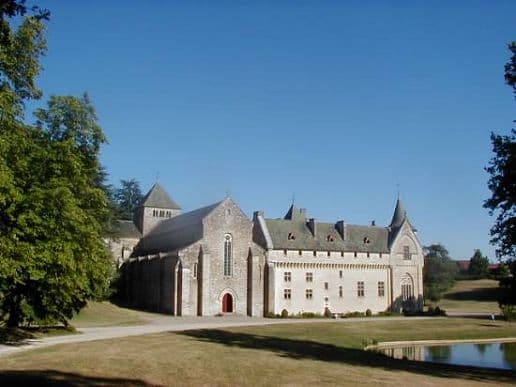
Abbey of Loc-Dieu is a Cistercian abbey situated in Aveyron, France, founded in 1123 on a site historically known as "devil's place" before being renamed "place of God" by its monastic inhabitants. Despite facing destruction and rebuilding, it became a significant Gothic architectural site and, during World War II, served as a safe haven for artworks from the Louvre, including the Mona Lisa. Today, the abbey and its park are open to the public.

Abbey of Saint-Germain-des-Prés
The Abbey of Saint-Germain-des-Prés, originally a Benedictine abbey founded in 558, is one of the oldest churches in Paris. It served as a significant center for scholarship, producing illuminated manuscripts, and was a royal necropolis. Despite destruction by Vikings and damage during the French Revolution, the church has undergone numerous rebuilds and restorations, incorporating Romanesque, Gothic, and later decorative styles, and remains an active Catholic parish church.

Abbey of Sénanque
Sénanque Abbey is a Cistercian monastery founded in 1148 in Provence, France, renowned for its remarkably preserved Romanesque architecture. Initially thriving, it experienced decline and was suppressed during the French Revolution, only to be re-established in 1854 and later reactivated in 1988. Today, it houses an active monastic community and is known for its lavender fields and spiritual retreats.