
Kyiv
Kyiv, the capital and most populous city of Ukraine, is one of the oldest cities in Eastern Europe, with a history dating back to at least the 5th century. It has served as a pivotal center for various East Slavic states, including Kievan Rus', and has endured periods of prominence and destruction, notably the Mongol invasion in 1240. Throughout its history, Kyiv has been a significant hub for trade, religion, culture, and industry, evolving into a major European metropolis.
Key Facts
- ›Kyiv is the capital and most populous city of Ukraine.
- ›It is one of the oldest cities in Eastern Europe, likely existing as a commercial center by the 5th century.
- ›Kyiv was the capital of Kievan Rus', the first East Slavic state.
- ›The city was devastated during the Mongol invasion in 1240.
- ›It became the capital of Soviet Ukraine in 1934 and the capital of independent Ukraine in 1991.
- ›Kyiv is a major industrial, scientific, educational, and cultural center.

Kyiv Metro, St. Sophia Cathedral, Babi Yar
Kiev
Kyi, Shchek, Khoryv, Lybid, Saint Andrew, Saint Michael, Askold, Dir, Oleg of Novgorod, Gediminas, Algirdas, Vladimir Olgerdovich, Vytautas, Petro Konashevych-Sahaidachnyi, Bohdan Khmelnytsky, Mykola Kostomarov, Joseph Stalin, Batu Khan, Yaroslav the Wise
- Siege of Kiev
- Mongol Invasion of Rus'
- Battle On the Irpen' River
- Battle of Blue Waters
- Crimean Tatar Sack of Kyiv
- Union of Lublin
- Khmelnytsky Uprising
- Treaty of Pereyaslav
- Truce of Andrusovo
- Establishment of Saint Vladimir University
- Founding of the Brotherhood of Saints Cyril and Methodius
- First Electric Tram Line In the Russian Empire
- Russian Revolution
- German Occupation
- Russian Civil War
- Polish–Soviet War
- Ukrainization
- Soviet Industrialization
- Great Famine
- Great Purge
- World War Ii
- Battle of Kyiv
- Massacre At Babi Yar
- Chernobyl Nuclear Power Plant Accident
- Declaration of Independence of Ukraine
- Orange Revolution
- Euromaidan
- Russian Invasion of Ukraine
About Kyiv
Kyiv, also known historically as Kiev, stands as the capital and most populous city of Ukraine. Situated in the north-central part of the country, it is a pivotal urban center that straddles both banks of the Dnieper River. With a population of nearly three million as of early 2022, Kyiv ranks among the most populous cities in Europe. Its historical significance is profound, recognized as one of Eastern Europe's oldest urban settlements, with evidence suggesting its existence as a commercial hub as early as the 5th century CE.
History and Development
The origins of Kyiv are intertwined with Slavic legends and historical accounts. Traditionally, it is believed to be named after Kyi, the eldest of four legendary founders. Historically, it served as a crucial commercial center on the trade route between Scandinavia and Constantinople. Under Varangian rule in the mid-9th century, Kyiv became the capital of Kievan Rus', the first major East Slavic state. This period marked a significant era of growth and influence.
However, the city's trajectory has been marked by cycles of prosperity and devastation. The Siege of Kiev in 1240 by Batu Khan's Mongol forces left the city in ruins, leading to centuries of diminished influence. Despite these setbacks, Kyiv gradually regained prominence. By the 16th century, it developed into a center for Eastern Orthodox learning. The late 19th century saw a resurgence during the Russian Empire's Industrial Revolution, transforming Kyiv into a major hub for industry, commerce, and administration. Following periods of independence and Soviet rule, including its designation as the capital of Soviet Ukraine in 1934 and the immense destruction during World War II, Kyiv emerged as the vibrant capital of an independent Ukraine in 1991.
Modern Significance
Today, Kyiv is a vital industrial, scientific, educational, and cultural nucleus for Ukraine. It hosts advanced industries, numerous higher education institutions, and boasts a rich array of historical landmarks. The city's infrastructure includes an extensive public transport system, notably the Kyiv Metro. Despite economic shifts, including a move away from the armaments industry, the growth of its services and finance sectors has supported ongoing development in housing and urban infrastructure, solidifying its position as a leading European capital.
Source: Wikipedia ↗
Frequently Asked Questions
What is the traditional founding date of Kyiv?
The traditional founding date of Kyiv is 482 CE, which led to the city celebrating its 1,500th anniversary in 1982. However, archaeological data suggests a founding in the sixth or seventh centuries, with some researchers dating it as late as the 9th century.
What is the origin of the name Kyiv?
The name Kyiv is traditionally said to derive from Kyi, the eldest of four legendary founders. Another etymological theory suggests the name comes from an Old East Slavic phrase meaning 'Kyi's castle' or 'Kyi's gord'.
What historical events significantly impacted Kyiv?
Key historical events include the Mongol invasion in 1240, which left the city in ruins, and the city's destruction and subsequent recovery during World War II. It also served as the capital during periods of independence and Soviet rule.
What was the significance of Kyiv during the Kievan Rus' period?
During the Kievan Rus' era, Kyiv was a major capital and stood on the important trade route between Scandinavia and Constantinople. By 1000 CE, it had a substantial population and numerous churches and markets, as described by chroniclers.
How did Kyiv evolve during the Russian Empire and Soviet eras?
Under the Russian Empire, Kyiv grew into an industrial and commercial center by the late 19th century. During the Soviet era, it became the capital of Soviet Ukraine in 1934, experiencing industrialization and significant damage during World War II, before recovering to become a major city in the USSR.
Related Monasteries

Pochayiv Holy Dormition Lavra
The Holy Dormition Pochaiv Lavra is a significant monastery and lavra located in Pochaiv, Ukraine, atop a 60-meter hill. It has served as a crucial spiritual center for Eastern Orthodoxy, Greek Catholicism, and again for Orthodoxy, with recent rulings granting spiritual control to the Orthodox Church of Ukraine. The monastery is renowned for its historical importance, architectural significance, and the revered icon of Our Lady of Pochaiv.
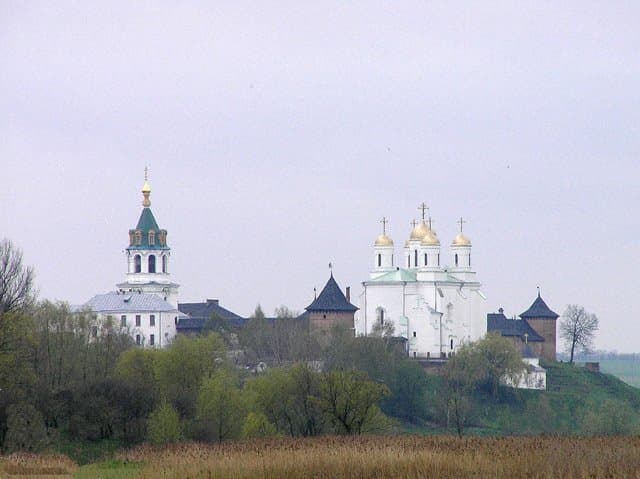
Assumption Cave Monastery
The Assumption Cave Monastery, also known as Sviatohirskyi Uspenskyi Zymnenskyi monastyr, is a significant Ukrainian Orthodox cave monastery located near the village of Zymne. Its origins are attributed to monastic legend, with some accounts suggesting a connection to Vladimir the Great. The monastery has a long and complex history, marked by periods of control by different religious authorities, dissolution, and re-establishment, eventually regaining its status as a stauropegial institution in 1996.

Bakhchysarai Cave Monastery
The Bakhchysarai Cave Monastery, also known as the Dormition Monastery of the Caves, is a significant Eastern Orthodox monastic site carved into cliffs near Bakhchysarai, Crimea. While local tradition suggests an 8th-century founding, the current monastic establishment dates to the 15th century, refounded by monks from Kyiv-Pechersk Lavra. It served as a vital center for Orthodox Christians, particularly those seeking refuge, before periods of decline and closure under Soviet rule, eventually reopening in 1993.