
Kirillo-Belozersky Monastery
The Kirillo-Belozersky Monastery, also known as White Lake St. Cyril's Monastery, is a historic Russian Orthodox male monastery situated on the shores of Lake Siverskoye. Founded in 1397 by St. Cyril of Beloozero, it grew to become one of the largest and most fortified monasteries in the Russian North, serving as both a spiritual center and a strategic fortress. Throughout its history, it was a significant landowner, a political prison, and a repository of valuable religious and cultural artifacts.
Key Facts
- ›Founded in 1397 by St. Cyril of Beloozero.
- ›One of the largest and most fortified monasteries in the Russian North from the 15th to 17th centuries.
- ›Was the second richest landowner in Russia in the 16th century.
- ›Served as a political prison for notable figures like Patriarch Nikon and Tsar Simeon Bekbulatovich.
- ›Its massive walls, constructed between 1654-1680, measure 732 meters long and 7 meters thick.
- ›The monastery was secularized and became a museum around 1924, with monks readmitted to a portion in 1998.

Byzantine-Style, 16th-Century Church Architecture, 17th-Century Fortress Architecture
- Lake Siverskoye
- Dormition Cathedral
- 17th-Century Iconostasis
- Ivanovsky Priory
- St. Vladimir's Chapel
- Massive Fortress Walls
- Various Tower Designs In Fortress Walls
- Discovered 16th-Century Frescoes In the Gate Church of St. Sergius
White Lake St. Cyril's Monastery, Dormition Monastery of St. Cyril
St. Cyril of Beloozero, St. Sergius of Radonezh, Yefrosin, Nil Sorsky, Ivan the Terrible, Vassian Patrikeyev, Tsar Simeon Bekbulatovich, Patriarch Nikon, Boris Morozov, Prince Vorotynsky, Tsar Alexis, Jean De Gron
- Founded In 1397.
- Adopted Athonite Cenobitic Rule Under Hegumen Trifon.
- Established A Byzantine-Style Secondary School.
- Ivan the Terrible Had A Cell and Planned To Take Vows.
- Exiled Politicians Were Imprisoned Here.
- Besieged By Polish-Lithuanian Vagabonds In December 1612.
- Fortress Walls Constructed 1654-1680.
- Secularized and Turned Into A Museum Circa 1924.
- Monks Readmitted To Ivanovsky Priory In 1998.
About Kirillo-Belozersky Monastery
What is Kirillo-Belozersky Monastery?
The Kirillo-Belozersky Monastery, also known in English as White Lake St. Cyril's Monastery, is a significant male monastery of the Russian Orthodox Church located on the shore of Lake Siverskoye in the town of Kirillov, Russia. Its history spans over six centuries, during which it evolved from a humble hermitage into one of the most important spiritual, cultural, and defensive centers of the Russian North. The monastery's development was closely tied to the political and religious landscape of medieval and imperial Russia.
History and Significance
Founded in 1397 by St. Cyril of Beloozero, a disciple of St. Sergius of Radonezh, the monastery initially consisted of a cave, a wooden chapel, and a loghouse. Its strategic location made it important for Northern trade and as a buffer against the Novgorod Republic. By the 16th century, the Kirillo-Belozersky Monastery was the second-richest landowner in Russia, after the Trinity Monastery near Moscow. It also served as a political prison, holding prominent figures such as Patriarch Nikon and Tsar Simeon Bekbulatovich. The monastery's impressive fortress walls, constructed between 1654 and 1680, highlight its enduring role as a formidable stronghold.
Architectural Ensemble and Cultural Legacy
The monastery complex encompasses two distinct priories with numerous churches, many dating from the 16th century. The Dormition cathedral, built in 1497, was one of the largest monastery churches in Russia at the time of its construction and features a notable 17th-century iconostasis. The Ivanovsky priory is dedicated to St. John the Baptist, and houses the St. Vladimir's Chapel, considered the first family mausoleum in Russia. After secularization around 1924, much of the monastery became the Kirillo-Belozersky Museum of History, Art, and Architecture, preserving its vast collection of religious art and historical artifacts. Monastic life was partially revived in 1998, with monks returning to the Ivanovsky priory, making it a site of both historical preservation and continued religious practice.
Source: Wikipedia ↗
Frequently Asked Questions
When was the Kirillo-Belozersky Monastery founded?
The monastery was founded in 1397 by St. Cyril of Beloozero, following the advice of his teacher, St. Sergius of Radonezh. It was established on the bank of Lake Siverskoye.
What was the historical significance of the Kirillo-Belozersky Monastery?
From the 15th to the 17th centuries, it was one of the largest and most fortified monasteries in the Russian North. It also played a strategic role for Northern trade and in conflicts with the Novgorod Republic and served as a political prison.
What architectural styles are present at the monastery?
The monastery features numerous churches, many dating to the 16th century, including the Dormition cathedral built by Rostov masters in 1497. The extensive fortress walls constructed in the late 17th century incorporate various tower designs.
What happened to the monastery after the Bolshevik Revolution?
After the Bolsheviks, the monastery was secularized around 1924 and transformed into a museum, showcasing exhibits including wooden shrines and discovered frescoes. Many of its treasures were transferred to museums in Moscow and St. Petersburg.
Does the Kirillo-Belozersky Monastery still function as a monastery today?
Yes, while the larger part of the monastery complex is administered as a museum, monks were readmitted into the Ivanovsky priory in 1998. As of 2011, it was one of the functioning monasteries in the Vologda Oblast.
What notable figures were associated with the Kirillo-Belozersky Monastery?
St. Cyril of Beloozero founded the monastery. Ivan the Terrible had a personal cell there and planned to take vows. It also served as a place of exile for figures like Patriarch Nikon and Tsar Simeon Bekbulatovich.
Related Monasteries

Descalzas Reales
The Convent of Las Descalzas Reales, meaning "Monastery of the Royal Discalced," is a historic royal monastery in Madrid, Spain. Originally the palace of Emperor Charles V and Empress Isabel of Portugal, it was founded in 1559 by their daughter, Joanna of Austria, as a convent for Poor Clare nuns. Historically a wealthy institution attracting noblewomen, it later faced poverty and was opened as a museum in 1960 to showcase its significant art collection and relics.
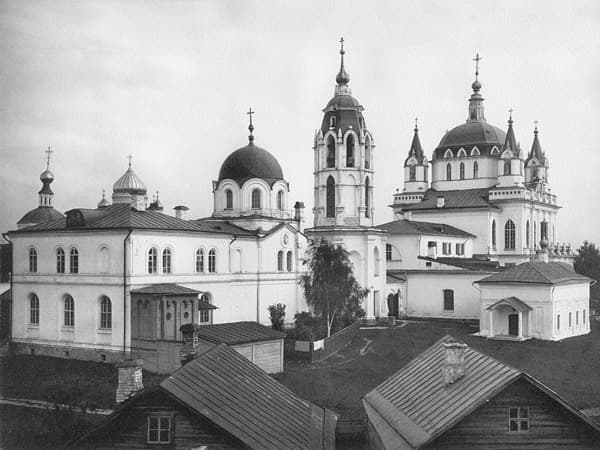
Conception Convent
The Conception Convent, also known as the Zachatyevsky Monastery, is a Russian Orthodox convent located on the Moskva River in Moscow. Originally believed to occupy the site of the oldest nunnery in Moscow, it was reestablished in 1995 after being closed by the Bolsheviks in 1918 and undergoing significant damage and repurposing during the Soviet era. Its reconstruction has seen the rebuilding of its katholikon in a Russian Revival style.

Savvino-Storozhevsky Monastery
The Savvino-Storozhevsky Monastery is a significant Russian Orthodox monastery located in Zvenigorod, west of Moscow. Founded in 1398 by Prince Yuri of Zvenigorod at the request of Saint Savva, it served as a spiritual center and a defensive outpost. The monastery later became a favored suburban residence for Tsar Alexis and continued to be visited by Russian royalty for blessings before coronations, solidifying its importance as a major religious and historical landmark.