
Iraq
Iraq, officially the Republic of Iraq, is a country in West Asia with a history stretching back to the 6th millennium BC as Mesopotamia, the cradle of civilization. It has been home to influential empires and served as the metropole of the Abbasid Caliphate, with Baghdad as a major cultural hub. Modern Iraq gained independence in 1932 and has since experienced periods of growth and significant political instability, including wars and insurgencies, and is currently a federal parliamentary republic focused on reconstruction.
Key Facts
- ›Located in West Asia, bordered by Saudi Arabia, Turkey, Iran, Kuwait, Jordan, and Syria.
- ›Covers an area of 438,317 sq km with a population exceeding 46 million.
- ›Known as Mesopotamia, it is considered the cradle of civilization, fostering early cities and empires.
- ›Baghdad served as a global cultural and intellectual hub during the Islamic Golden Age.
- ›Gained independence in 1932 and transitioned from a monarchy to a republic.
- ›Currently a federal parliamentary republic undergoing reconstruction.

Tigris and Euphrates Rivers, Mesopotamia, Baghdad
Mesopotamia
Ali Ibn Abi Talib, Faisal I of Iraq, Ahmed Hassan Al-Bakr, Saddam Hussein, Abdul Karim Qasim, Winston Churchill, T.E. Lawrence
Arab Conquest of Mesopotamia, Founding of Baghdad, Mongol Sack of Baghdad, Ottoman Conquest, Treaty of Zuhab, British Mandate of Mesopotamia, Independence, 14 July Revolution, Ba'Ath Party Coup, Iran-Iraq War, Invasion of Kuwait, 2003 U.S.-Led Invasion, Iraq War, Conflict With the Islamic State
About Iraq
Overview
Iraq, officially the Republic of Iraq, is a nation situated in West Asia, a land rich with millennia of history and cultural significance. Its territory largely encompasses ancient Mesopotamia, widely recognized as the "cradle of civilization." From the 6th millennium BC, the fertile plains between the Tigris and Euphrates rivers fostered the development of some of the world's earliest cities, complex societies, and influential empires, including Sumer, Akkad, Babylonia, and Assyria. These civilizations laid foundational advancements in areas such as writing, mathematics, timekeeping, and law.
Historical Trajectory
Following the Arab conquest in the 7th century, Iraq became a pivotal region, notably serving as the metropole of the Abbasid Caliphate. Baghdad, founded in 762 AD, emerged as a global center of culture, science, and intellectual life during the Islamic Golden Age, hosting institutions like the renowned House of Wisdom. However, the Mongol destruction of Baghdad in 1258 marked a turning point, leading to successive periods of rule by various empires. From the 16th century until the early 20th century, Iraq was administered as part of the Ottoman Empire.
Modern Iraq
The modern history of Iraq began after the collapse of the Ottoman Empire following World War I. The country gained formal independence in 1932, initially establishing a monarchy before a military coup in 1958 ushered in a republican era. The subsequent decades were marked by significant political upheaval, including the rise of the Ba'ath Party under leaders like Saddam Hussein, and extensive periods of conflict. These included the devastating Iran-Iraq War, the 1990 invasion of Kuwait, the 2003 U.S.-led invasion and subsequent Iraq War, and the fight against the Islamic State. Today, Iraq is a federal parliamentary republic striving for reconstruction and stability, navigating complex geopolitical influences while asserting its state authority.
Source: Wikipedia ↗
Frequently Asked Questions
What is the historical significance of Iraq?
Iraq largely coincides with ancient Mesopotamia, recognized as the cradle of civilization. It fostered the rise of early cities, empires like Sumer, Akkad, Babylonia, and Assyria, and saw the invention of writing, mathematics, and the wheel. Later, it became the metropole of the Abbasid Caliphate, with Baghdad as a significant cultural and intellectual center during the Islamic Golden Age.
When did Iraq become an independent country?
Iraq gained formal independence in 1932, after being under Ottoman rule and then a British Mandate of Mesopotamia following World War I. The country emerged as a Hashemite monarchy before transitioning to a republic in 1958.
What are the main ethnic and religious groups in Iraq?
Iraq is home to a diverse population, primarily Iraqi Arabs and Kurds, with significant minorities including Turkmens, Yazidis, Assyrians, Armenians, Doms, and Shabaks. The majority of Iraqis are Muslims, with notable religious minorities such as Christians, Jews, Mandaeans, Yarsanis, and Yazidis.
What is the capital of Iraq and what is its significance?
The capital city of Iraq is Baghdad. It was founded in 762 AD and became the political, economic, and intellectual core of the Abbasid Caliphate during the Islamic Golden Age, housing important institutions like the House of Wisdom.
What are the major historical periods of conflict in Iraq?
Iraq has experienced several significant conflicts, including the Iran-Iraq War (1980-1988), the invasion and occupation by a U.S.-led coalition in 2003 leading to the Iraq War, and a major conflict with the Islamic State from 2013 to 2017. Post-war conflict continues at a lower scale.
Related Monasteries

Turkey
Turkey, officially the Republic of Türkiye, is a transcontinental country primarily located in Anatolia in Western Asia, with a smaller portion in East Thrace in Southeastern Europe. Its history is marked by the succession of numerous ancient civilizations, including the Hittites, Greeks, Romans, and Byzantines, before the migration of Seljuk Turks in the 11th century and the subsequent rise of the Ottoman Empire. The modern Republic of Turkey was proclaimed in 1923, following the Turkish War of Independence, and has since evolved into a secular nation with a rich cultural heritage and a significant geopolitical presence.
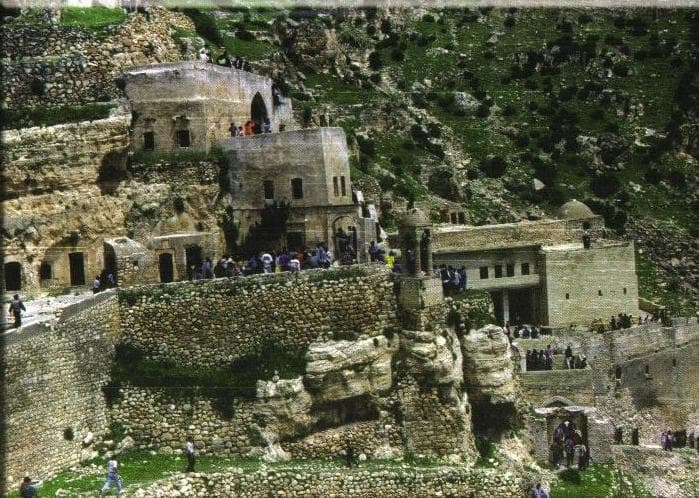
Rabban Hormizd Monastery
Rabban Hormizd Monastery is a historic monastery in Iraq founded around 640 AD by the Church of the East. It served as the patriarchal residence for the Eliya line of the Assyrian Church of the East from the 16th to 18th centuries and later became a significant site for the Chaldean Catholic Church after their union with Rome. Known for its ascetic lifestyle and carved rock cells, the monastery has endured periods of destruction and revival throughout its history.

Abbaye de la Fille-Dieu
The Abbaye de la Fille-Dieu is a Cistercian monastery near Romont in Switzerland, continuously occupied by nuns since its founding in 1268. Initially a Benedictine priory, it later affiliated with the Trappists and has undergone significant restorations, including a notable 1990s modernization and the preservation of medieval murals. The abbey is recognized as a Swiss heritage site of national significance.