
Hovin
Norway·former municipality·19th century
Hovin was a municipality in Telemark county, Norway, established in 1886 and dissolved in 1964. Its administrative center was the village of Hovin, named after an old farm associated with a pagan temple. The municipality's territory was divided between Tinn and Notodden municipalities following its dissolution.
Key Facts
- ›Established on January 1, 1886, from a division of Gransherad municipality.
- ›Dissolved on January 1, 1964, as part of widespread municipal mergers in Norway.
- ›Its administrative center was the village of Hovin.
- ›Named after the old Hovin farm, likely meaning 'meadow of the temple'.
- ›Its area was split between Tinn Municipality and Notodden Municipality.

Establishment From Gransherad, Transfer of Land From Tinn Municipality, Dissolution and Division
About Hovin
Hovin Municipality
Hovin was a municipality located in Telemark county, Norway, with a defined existence from January 1, 1886, until its dissolution on January 1, 1964. The municipality was named after the old Hovin farm, a name derived from Old Norse and likely meaning 'meadow of the temple,' suggesting a historical connection to pagan worship sites.
History and Dissolution
The establishment of Hovin municipality in 1886 marked a division of the former Gransherad municipality. Initially, Hovin comprised the northern section, with a population of 885 residents. An addition to its territory occurred on March 24, 1903, when an unpopulated area was transferred from Tinn Municipality. The modern era saw extensive municipal reorganizations across Norway, driven by the Schei Committee's recommendations. Consequently, Hovin ceased to exist as an independent entity on January 1, 1964. Its lands were subsequently divided: the Rudsgrendi area on the west side of the lake Tinnsjå was incorporated into Heddal and Notodden municipalities, while the remaining eastern portion of Hovin was merged with Tinn Municipality.
Naming Significance
The name "Hovin" carries historical weight, originating from the Old Norse term "Hofvin." "Hof" signifies a "heathen hof" or a temple dedicated to the Norse gods, while "vin" translates to "meadow" or "pasture." This etymology points to a historical landscape where a pagan temple or a significant religious site once stood, with "Hovin" denoting the meadowland associated with it. The first Hovin Church was built on this historic farmstead.
Source: Wikipedia ↗
Frequently Asked Questions
When was the municipality of Hovin established?
The municipality of Hovin was established on January 1, 1886. It was created when the municipality of Gransherad was divided into two parts.
When was the municipality of Hovin dissolved?
Hovin was dissolved on January 1, 1964. This dissolution was part of a broader initiative of municipal mergers across Norway.
What does the name Hovin mean?
The name Hovin is derived from the old farm name Hofvin. The first part, 'hof', refers to a 'heathen hof' or temple for Norse gods, and 'vin' means 'meadow' or 'pasture'. Thus, it likely signifies a meadow associated with a past pagan temple.
What happened to the land of Hovin after it was dissolved?
After its dissolution in 1964, the lands of the Hovin municipality were divided. The western part, including Rudsgrendi, was merged into Heddal and Notodden municipalities, while the eastern part was merged with Tinn Municipality.
Related Monasteries

Elgeseter Priory
Elgeseter Priory was a significant Augustinian monastic house established in Trondheim, Norway, no later than 1183. Strategically located across the Nidelven river from Nidaros Cathedral and connected by a bridge, it played a role in medieval political events, notably the killing of Duke Skule Bårdsson outside its walls in 1240. Suppressed during the Reformation in 1537, its buildings were later destroyed by fire and the site subsequently used as a quarry, leaving no visible ruins today.
Halsnøy Abbey
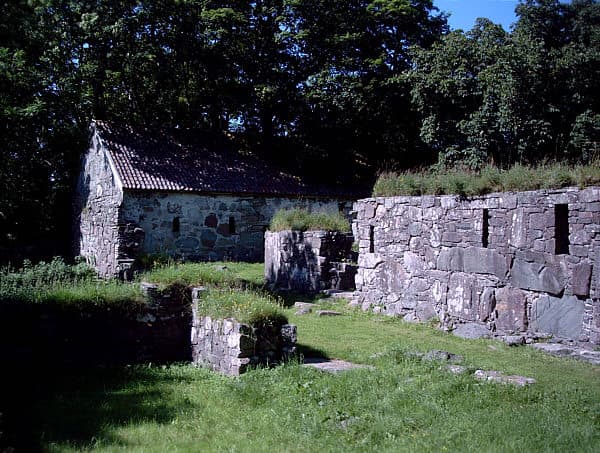
Halsnøy Abbey was a prominent Augustinian priory in medieval Norway, founded around 1163-1164 by Jarl Erling Skakke to support his son's claim to the throne. It became one of the wealthiest monasteries in the country before being dissolved in 1536 during the Reformation. While most monastic buildings were demolished in the 19th century, significant remnants of ancillary structures have been preserved as ruins.

Hovedøya Abbey
Hovedøya Abbey was a significant medieval Cistercian monastery located on the island of Hovedøya in the Oslofjord, Norway. Founded in 1147 by monks from England, it quickly became one of the wealthiest institutions in Norway during the medieval period. The abbey's existence was brought to an end by political turmoil and the Reformation, with its buildings later quarried for stone, leaving behind some of the most complete monastic ruins in Norway.