
Frienisberg Abbey
Christian·Switzerland·former religious house (buildings repurposed)·12th century
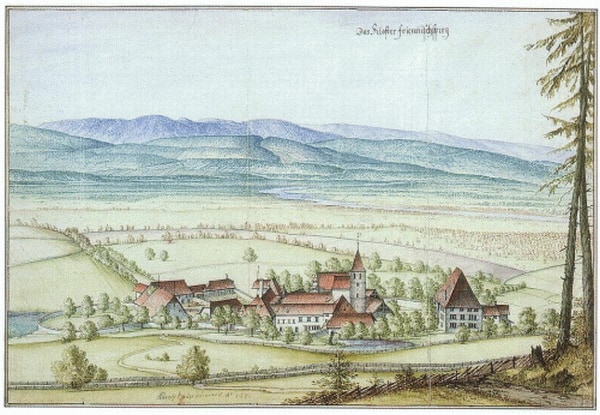
Frienisberg Abbey was a former Cistercian religious house located in Seedorf, Canton of Bern, Switzerland. Founded in 1138 by Lützel Abbey, it initially struggled but expanded significantly in the 13th century, reaching its peak with extensive landholdings and considerable economic influence. Its close ties to Bern led to its secularization in the 16th century following Bern's embrace of the Protestant Reformation, after which its buildings were repurposed for various civic and charitable functions.
Key Facts
- ›Founded in 1138 by Lützel Abbey.
- ›Reached its peak in the 13th century with approximately 300 farmers and 282 vineyard workers.
- ›Owned land in 45 villages west of Bern.
- ›Founded the nunneries of Fraubrunnen, Steinen, and Tedlingen in the second half of the 13th century.
- ›Secularized in 1534 after Bern adopted the Protestant Reformation.
- ›The former convent building has served as a hospital, a bailiff's residence, a home for the deaf-mute, and currently operates as a nursing home.
Extensive Landholdings At Its Peak, Founded Subsidiary Nunneries
Count Udelhard of Saugern, Urs Hirsinger
- Grant of Land By Count Udelhard of Saugern
- Founding of the Abbey By LüTzel Abbey
- Secularization Following the Protestant Reformation
- Demolition of the Abbey Church
About Frienisberg Abbey
Frienisberg Abbey was a significant former Cistercian religious house situated in the Swiss municipality of Seedorf, within the Canton of Bern. Its history is one of growth, economic influence, and eventual dissolution due to religious and political shifts in the region.
History and Development
The establishment of Frienisberg Abbey began in 1131 when Count Udelhard of Saugern generously granted his land at Frienisberg to the Cistercian Lützel Abbey. Four years later, in 1138, Lützel Abbey dispatched settlers to found a new monastic community on this site. The early years of Frienisberg were marked by struggles and a relatively small size. However, its fortunes improved significantly during the first half of the 13th century, a period that saw a substantial expansion fueled by numerous donations. By 1233, the abbey's landholdings were extensive, encompassing properties in various locations including Frienisberg, Allenwil, Ried, Tedlingen, Niederwiler, Werd, Gäserz bei Ins, and Montils bei Nugerol.
At its zenith, Frienisberg Abbey wielded considerable economic power. Approximately 300 farmers were engaged in cultivating 5,000 Juchart (an area equivalent to about 1,800 hectares or 4,400 acres) spread across 45 villages to the west of Bern. The abbey also owned vineyards along the shores of Lake Biel, employing 282 men in their cultivation. Furthermore, it held the patronage rights and the authority to appoint parish priests in several key locations such as Rapperswil, Seedorf, Nieder-Lyss, Bargen, Schüpfen, and Grossaffoltern.
Initially, the abbey's income was primarily derived from rents and produce from its vast farms and estates. However, by the mid-13th century, a gradual economic transformation began. The monastery's financial structure shifted, moving away from land rents and increasingly relying on tithes and offerings for its sustenance. In the latter half of the 13th century, Frienisberg Abbey also played a foundational role in establishing other religious institutions, notably the nunneries of Fraubrunnen, Steinen, and Tedlingen.
Downfall and Transformation
The abbey's fate became closely intertwined with the political landscape of Bern. In 1386, Frienisberg Abbey solidified its connection with Bern by granting Bernese citizenship to its monks and farmers. This close alliance, however, ultimately contributed to its downfall. When Bern embraced the Protestant Reformation, many of the city's monasteries, including Frienisberg, faced secularization. The last abbot, Urs Hirsinger, chose to flee to Hauterive in the Canton of Fribourg rather than remain in Bern under the new religious order.
Following secularization, the abbey church was demolished in 1534. The former convent building underwent a series of transformations. It was converted into a hospital in 1533, later served as the residence for the local Bernese bailiff until 1798, and in 1834, it was repurposed as a home for the deaf-mute. By 1889, the building was converted into a nursing home, a role it continues to fulfill in the present day.
Source: Wikipedia ↗
Frequently Asked Questions
When was Frienisberg Abbey founded?
Frienisberg Abbey was founded in 1138. Settlers were sent from Lützel Abbey to establish the new monastic community on land granted by Count Udelhard of Saugern in 1131.
What was the economic significance of Frienisberg Abbey?
At its peak, Frienisberg Abbey was a significant economic power, with around 300 farmers managing 1,800 hectares of land and 282 men working its vineyards. Its income primarily derived from land rents, produce, tithes, and offerings.
Why was Frienisberg Abbey secularized?
Frienisberg Abbey was secularized in 1534 due to Bern's adoption of the Protestant Reformation. This led to the dissolution of many Bernese monasteries, and the last abbot fled rather than remain in the reformed territory.
What is the current use of the former Frienisberg Abbey buildings?
The former convent building of Frienisberg Abbey was converted into a hospital in 1533 and later housed a Bernese bailiff. Since 1889, it has been used as a nursing home, a function it continues to fulfill today.
Related Monasteries

Bonmont Abbey
Bonmont Abbey, a former Cistercian monastery in Vaud, Switzerland, was founded between 1110 and 1120. Initially adhering to strict Benedictine and Cistercian rules, it grew wealthy through donations, leading to architectural and decorative changes. Secularized in 1536 during the Reformation, its buildings were repurposed for agricultural and administrative uses, though the church was preserved and later restored as a national monument.

Bubikon Commandery
Bubikon Commandery, also known as Bubikon Castle, was a medieval monastery of the Knights Hospitaller. Founded between 1191 and 1198, it grew to own significant lands across the present-day Canton of Zürich. The commandery was secularized during the Reformation, and its buildings now house a museum dedicated to its history and the Order.

Interlaken Monastery
Interlaken Monastery was a significant convent of Augustinian Canons Regular situated in Interlaken, Switzerland, operating from approximately 1133 to 1528. Initially founded by Baron Seliger of Oberhofen and placed under imperial protection, it grew to become a major landholder with authority over numerous churches, villages, and farms. The monastery experienced periods of growth and decline, facing internal disputes and external conflicts before its secularization during the Protestant Reformation, after which its properties were managed by Bernese authorities.