
Fraubrunnen Abbey
Christian·Switzerland·Former monastery, repurposed buildings·13th century
Fraubrunnen Abbey was a Cistercian nunnery founded in 1246 by the Counts of Kyburg in what is now Switzerland. Over time, it grew to become one of the wealthiest abbeys in the canton of Bern, with estates and houses in various cities. Although damaged by fires and eventually secularized following Bern's adoption of the Reformation in 1528, its buildings were repurposed and continued to serve administrative functions for centuries.
Key Facts
- ›Founded in 1246 by Counts Hartmann the Elder and Younger of Kyburg.
- ›Originally established as a Cistercian nunnery.
- ›Acquired significant wealth and estates, becoming one of the richest abbeys in Bern.
- ›Damaged by fires in 1280 and 1375, but rebuilt.
- ›Secularized in 1528 when Bern adopted the Protestant Reformation.
- ›Vacated buildings were converted into a castle and administrative center.
- Acquired Estates and Vineyards
- Owned Houses In Bern, Burgdorf, and Solothurn
- Received Burgrecht In Bern, Burgdorf, and Solothurn
Kloster Fraubrunnen, Fons Beatae Mariae
Hartmann the Elder of Kyburg, Hartmann the Younger of Kyburg
Secularization In 1528, Pillage By French In 1798
About Fraubrunnen Abbey
Fraubrunnen Abbey, known in Latin as Fons beatae Mariae (meaning "spring, or well, or fountain of Our Lady" or "of the Blessed Virgin Mary"), was a significant Cistercian nunnery located in the municipality of Fraubrunnen, in the canton of Bern, Switzerland. Its establishment marked a notable religious and economic development in the region.
History and Development
The abbey's origins trace back to 1246 when Counts Hartmann the Elder and Hartmann the Younger of Kyburg donated lands, farms, and forests in and around the village of Mülinen. Judicial rights over the village were also granted, paving the way for the establishment of the nunnery. By 1249 or 1250, it was placed under the authority of the abbot of Frienisberg. The abbey adopted the name "Fraubrunnen," replacing the original village name of Mülinen. Over the subsequent years, Fraubrunnen Abbey expanded its holdings significantly, acquiring further estates in numerous villages and vineyards, notably on the shores of Lake Biel. Its economic influence grew to the extent that it owned houses in Bern, Burgdorf, and Solothurn, and held the Burgrecht (a form of urban franchise) in these cities, becoming one of the wealthiest abbeys in the canton of Bern.
The community generally comprised nuns from the ministerialis class or from the burgher families of Bern. The physical structures of the cloister and church endured periods of damage and reconstruction. They were rebuilt after a fire in 1280 and again following a fire in 1375. The Kyburg family held the position and title of Kastvogt (landvogt or bailiff) over the abbey's territory.
Secularization and Transformation
Following the extinction of the Kyburg family in 1420, the rights of Kastvogt passed to the city of Bern. This close association with Bern meant that Fraubrunnen Abbey could not remain unaffected by the Protestant Reformation. Between 1481 and 1512, the city made efforts to limit the power of the abbess and regulate the community. However, a decisive shift occurred in 1528 when Bern officially adopted the Reformation. Consequently, the abbey was quickly secularized, and the nuns were relocated.
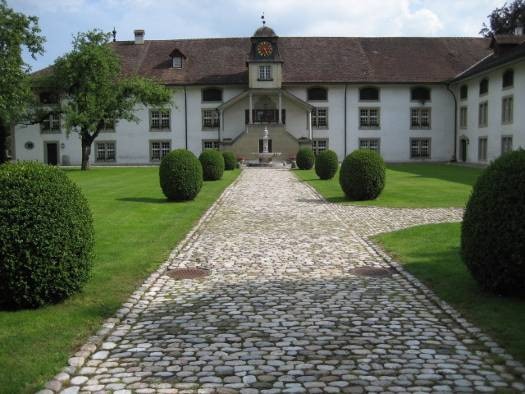
The vacated buildings were then transformed into a castle and served as the administrative center for the bailiwick of Fraubrunnen within the Zollikofen district. Further architectural changes occurred: the church and the east wing were demolished in 1535, and between 1569 and 1574, the cloister passageways were expanded and covered to function as corridors in the main building. In 1647–48, the west wing was converted into a granary. The castle faced further upheaval when it was pillaged by the French during their invasion in 1798. Under the Act of Mediation in 1803, the old Vogtei was dissolved, and Fraubrunnen itself became the seat of a district bearing the same name, marking a new chapter in the history of the site.
Source: Wikipedia ↗
Frequently Asked Questions
When was Fraubrunnen Abbey founded?
Fraubrunnen Abbey was founded in 1246. The Counts of Kyburg donated lands and rights to establish the Cistercian nunnery.
What religious order was Fraubrunnen Abbey part of?
Fraubrunnen Abbey was a Cistercian nunnery. It was placed under the authority of the abbot of Frienisberg shortly after its founding.
What happened to Fraubrunnen Abbey after the Reformation?
Following Bern's adoption of the Reformation in 1528, Fraubrunnen Abbey was secularized. The nuns were moved out, and the buildings were repurposed as a castle and administrative center for the local bailiwick.
Did the abbey suffer any damage during its history?
Yes, the cloister and church were damaged and rebuilt following fires in 1280 and again in 1375. The castle was also pillaged by the French in 1798.
What is the modern status of Fraubrunnen Abbey?
Fraubrunnen Abbey no longer exists as a religious institution. Its buildings were repurposed for administrative and other uses after secularization.
Related Monasteries

Augustinerkloster Zürich
The Augustinerkloster was a prominent monastery of the Augustinian Order within medieval Zurich, Switzerland. Founded around 1270, it played a role in the city's fortifications and religious life until its abolition during the Reformation in 1524. The Augustinian church, now known as the Augustinerkirche, remains on the site and is a parish church.

Barfüsserkloster Zürich
The Barfüsserkloster Zürich was a former Franciscan friary located in the old town of Zurich, first documented in the 1240s. It was dissolved during the Reformation in 1524. Following its dissolution, the buildings underwent significant transformations, serving as a grain depot, casino, and eventually housing the cantonal court of law, with portions lost to construction and a fire over the centuries.

Eschenbach Abbey
Eschenbach Abbey is a Cistercian community of nuns located in Eschenbach, Switzerland. Originally founded around 1290 as an Augustinian convent, it transitioned to the Cistercian Order in 1588. The abbey has undergone several significant architectural expansions and renovations throughout its history, including the construction of its abbey church in 1910.