
Disentis Abbey
Disentis Abbey is a Benedictine monastery located in the Canton of Grisons, Switzerland, around which the town of Disentis grew. Its history is marked by periods of destruction and rebuilding, with its foundation traditionally attributed to local saints but more recent research suggesting an early 8th-century origin. The abbey has played a significant role in regional history, serving as a "Reichskloster" directly answerable to the Emperor and possessing extensive landholdings.
Key Facts
- ›Founded in the early 8th century, with earlier traditions suggesting 614 AD.
- ›Dedicated to Saint Martin of Tours.
- ›Served as a "Reichskloster" (Imperial Abbey) with direct ties to the Emperor.
- ›Possessed extensive landed estates, extending as far as Lombardy.
- ›Buildings were refurbished in the Baroque style between 1683 and 1704.
- ›Currently operates as a Benedictine monastery with an active religious community and a gymnasium.

Baroque
Romansh Library, Grammar School, Gymnasium
Reichskloster Disentis, Cadi
Placidus, Sigisbert, Charles Martel, Saint Pirmin, Tello, Udalric I, Otto I, Frederick Barbarossa, Anselm Huonder
Destroyed By Avars, Rebuilt By Charles Martel and Saint Pirmin, Destroyed By Raiding Saracens, Visited By Charlemagne, Burned and Plundered By Napoleon's Army
About Disentis Abbey
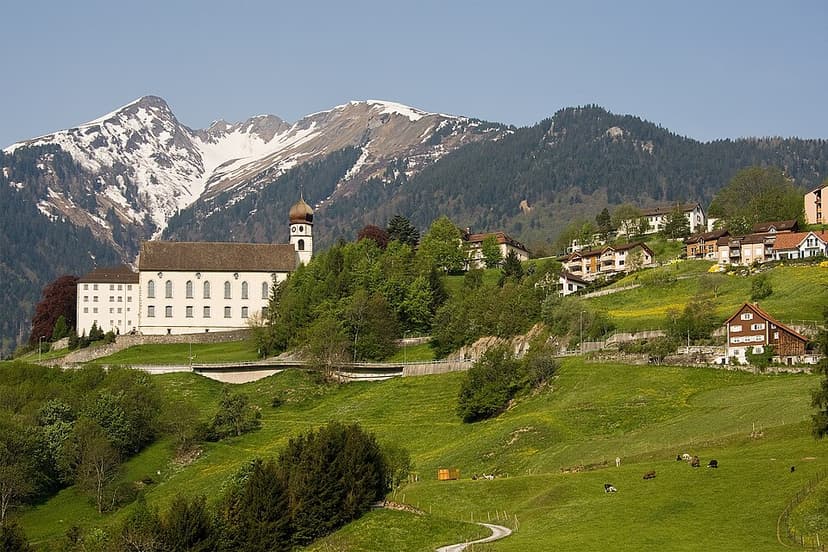
Disentis Abbey, also known in Latin sources as Reichskloster Disentis and historically as Cadi, is a significant Benedictine monastery situated in the Canton of Grisons in eastern Switzerland. The modern town of Disentis (Romansh: Mustér) developed around the abbey.
Early History and Development
Tradition once placed the abbey's foundation in 614 AD, attributing it to local saints Placidus and Sigisbert, with accounts of martyrdom and rebuilding by figures such as Charles Martel and Saint Pirmin. However, more recent research and archaeological findings suggest an establishment in the early 8th century. The first traceable structure dates to around 700, which was later destroyed by Saracen raids circa 940. The "Testament of Tello," Bishop of Chur, dated 765, already records the extensive properties owned by the monastery, indicating its substantial landholdings by that period. Charlemagne visited the rebuilt abbey in 800, bestowing benefactions. Disentis Abbey held the status of a "Reichskloster," meaning it was directly answerable to the Emperor, a position strengthened by its strategic location on the Lukmanier Pass. This status allowed successive abbots to accumulate landholdings extending to Lombardy and establish a considerable monastic state.
Medieval and Modern Transformations
From the medieval period, Disentis Abbey developed its own governance, using its own seal from 1285 and having its own Landammann from 1371. Cadi evolved into an autonomous commune within the Grey League in 1401. The abbey became a member of the Swiss Congregation in 1617, and its buildings were renovated in the Baroque style between 1683 and 1704. The monastery church of St. Martin was constructed in 1712. A devastating event occurred in 1799 when Napoleon's soldiers burned and plundered the abbey, destroying many valuable items, books, and archives. Despite these losses, the abbey was rebuilt by Abbot Anselm Huonder. While its feudal territory was abolished under the Helvetic Republic, the abbey survived the dissolution that affected many religious houses during that era. In the 19th century, it established a secondary school, which continues to operate today.
Present Day Operations
Disentis Abbey remains an active religious community adhering to the Rule of St. Benedict. It presently houses a grammar school and a well-regarded gymnasium (secondary school), with a significant portion of students being boarders. The monastery also maintains a comprehensive Romansh library, contributing to the region's cultural heritage.
Source: Wikipedia ↗
Frequently Asked Questions
When was Disentis Abbey founded?
While older traditions attributed its foundation to 614 AD, more recent research and archaeological evidence suggest that the first traceable structure on the site was built in or around 700, placing its foundation in the early 8th century.
What is the religious tradition of Disentis Abbey?
Disentis Abbey follows the Benedictine tradition and is a member of the Swiss Congregation, now part of the Benedictine Confederation.
What historical events have impacted Disentis Abbey?
The abbey has experienced significant events such as destruction by Avars in the 7th century and by Saracen raids in the 10th century. It was also burned and plundered by Napoleon's army in 1799, leading to the loss of valuable items and archives.
What is the significance of Disentis Abbey in regional history?
Disentis Abbey was a "Reichskloster," directly answerable to the Emperor, and held a strategic position on the Lukmanier Pass. Its abbots were often granted the rank of prince of the empire, and the abbey amassed considerable landholdings, forming a monastic state of considerable size.
Does Disentis Abbey still operate today?
Yes, Disentis Abbey continues to operate as a religious community following the Rule of St. Benedict. It also maintains a grammar school and a gymnasium (secondary school).
Related Monasteries
Pfäfers Abbey
Pfäfers Abbey, also known as St. Pirminsberg, was a significant Benedictine monastery located in Pfäfers, Switzerland. Founded in the 8th century, it played a crucial role as a religious, political, and cultural center in the Chur–Raetian region, controlling important trade routes and establishing numerous parishes. Despite periods of foreign control and internal struggles, it rebuilt in the Baroque style in the 17th century before ultimately being secularized in the 19th century and its buildings repurposed.

Lucerne
Lucerne, a city in central Switzerland, developed around the Benedictine Monastery of St. Leodegar, founded around 750. It gained strategic importance as a trade route gateway and allied with neighboring cantons to form the Swiss Confederacy in 1332. The city remained predominantly Catholic during the Reformation and became a fashionable tourist destination in the 19th century, attracting notable figures like Richard Wagner and Mark Twain. Its iconic Chapel Bridge, first erected in the 14th century, is a significant historical landmark.

Rheinau Abbey
Rheinau Abbey was a significant Benedictine monastery located on an island in the Rhine River in Switzerland, founded around 778. It experienced periods of both prosperity, marked by imperial favor and architectural grandeur in the Baroque style, and hardship, including suppression during the Reformation and its eventual dissolution in 1862. After its closure, the monastic buildings were repurposed for a hospital and later a psychiatric clinic, and have stood empty since 2000.