
Chilcombe Camera
Christian·England·Hamlet and Civil Parish·12th century
Chilcombe Camera, historically known as Ciltecome in the Domesday Book, is a small hamlet and civil parish in Dorset, England. Its significance lies in its historical record, particularly its mention in the Domesday Book of 1086 and its later status as a 'camera' or estate of the Knights Hospitaller. The parish church contains elements dating back to the 12th century, reflecting its long history.
Key Facts
- ›Recorded as Ciltecome in the Domesday Book of 1086.
- ›In 1086, it had 14 households, 3 ploughlands, 25 acres of meadow, 20 acres of pasture, and one MILL.
- ›Formerly part of an estate of the Knights Hospitaller, known as the 'camera' of Chilcombe.
- ›The estate was valued at £4 5s. 4d. in 1338.
- ›Parts of the parish church, including the nave's south wall and chancel, date to the 12th century.
- ›The Tudor manor house was demolished in 1939.

Medieval
12th-Century Church Elements, 18th-Century Farmhouse
Ciltecome
Brictwin the Reeve
Inclusion In the Domesday Book, Recorded As the 'Camera' of Chilcombe, Demolition of the Tudor Manor House
About Chilcombe Camera
Chilcombe Camera is a small hamlet and civil parish located in Dorset, England, situated approximately 4 miles east of Bridport and 10 miles west of Dorchester. Historically known as Ciltecome in the Domesday Book of 1086, the area has a recorded past stretching back over a millennium. Its significance is rooted in its historical documentation and its past association with monastic or chivalric orders, rather than as a large monastic settlement.
Historical Context
The Domesday Book entry for 1086 details Ciltecome as possessing 14 households, 3 ploughlands, 25 acres of meadow, 20 acres of pasture, and a single mill, indicating a modest agricultural community. Later, in 1338, the manor of Chilcombe, along with Toller Fratrum, was identified as the 'camera' of Chilcombe, an estate managed by the Knights Hospitaller. This designation suggests it was a farmed estate rather than a community of religious brothers, valued at £4 5s. 4d. and contributing to the Order's treasury.
Architectural and Present Day
The parish church in Chilcombe contains architectural remnants of considerable age, with parts of its nave's south wall and chancel dating from the 12th century. The hamlet today comprises this church, an 18th-century farmhouse with adjacent farm buildings, and a few cottages. Notably, the Tudor manor house that once stood here was demolished in 1939. As of 2013, the estimated population of the parish was a mere 10 individuals, underscoring its rural and secluded nature.
Source: Wikipedia ↗
Frequently Asked Questions
What is Chilcombe Camera's historical significance?
Chilcombe Camera holds historical significance primarily through its early records, including its entry in the Domesday Book and its later administration as an estate, or 'camera,' by the Knights Hospitaller. The presence of 12th-century church architecture further attests to its long-standing presence.
What was the 'camera' of Chilcombe?
The 'camera' of Chilcombe refers to an estate belonging to the Knights Hospitaller. In this context, 'camera' signifies an estate that was farmed out to a tenant rather than housing a monastic community. It was recorded as such in 1338.
When was the Chilcombe parish church built?
Elements of the Chilcombe parish church date back to the 12th century. Specifically, the south wall of the nave and likely the chancel originate from this period.
What was present in Chilcombe in 1086?
According to the Domesday Book of 1086, Chilcombe (recorded as Ciltecome) comprised 14 households, 3 ploughlands, 25 acres of meadow, 20 acres of pasture, and a mill. It was part of Uggescombe Hundred.
Related Monasteries

Appuldurcombe House
Appuldurcombe House is the shell of a substantial 18th-century English Baroque country house on the Isle of Wight, England. Originally a priory, it evolved into a convent before becoming a Leigh family home. Sir Robert Worsley began constructing the current mansion in 1702, with significant extensions and landscaping undertaken by his great-nephew, Sir Richard Worsley, in the 1770s. Despite periods as a hotel and a school, the house was damaged during World War II and is now managed by English Heritage.
Jervaulx Abbey
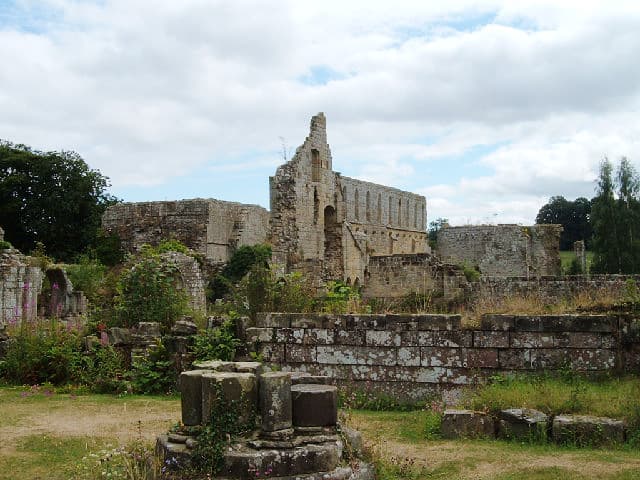
Jervaulx Abbey was a significant Cistercian monastery located in North Yorkshire, England, founded in 1145 and dedicated to St Mary in 1156. At its peak, it was a major landowner and renowned for horse breeding and the original production of Wensleydale cheese. The abbey was dissolved in 1537, and its last abbot was executed for his role in the Pilgrimage of Grace. Today, the extensive ruins are a Grade I listed building and are open to the public.
Bordesley Abbey
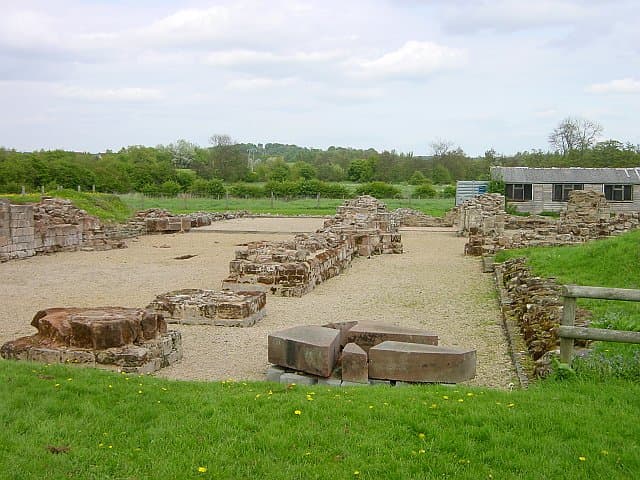
Bordesley Abbey was a significant 12th-century Cistercian monastery located in Worcestershire, England. Founded around 1138, it became a royal house under Empress Matilda and played a vital role as a local ecclesiastical and political center. The abbey was ultimately demolished in 1538 during the dissolution of the monasteries under Henry VIII, and its ruins are now an important archaeological site.