
Burnham Norton Friary
Burnham Norton Friary was a Carmelite friary located near Burnham Market in Norfolk, England. Founded in 1241 by Sir William Calthorp and Sir Ralph Hemenhale, it was the first Carmelite monastery established after the order's expulsion from Mount Carmel. The friary was dissolved in 1538 during the Dissolution of the Monasteries and is now a ruin, though significant parts of its structure, including the gatehouse and precinct wall, still stand.
Key Facts
- ›Founded in 1241 by Sir William Calthorp and Sir Ralph Hemenhale.
- ›The first Carmelite monastery established after the order left Mount Carmel.
- ›Closed in 1538 during the Dissolution of the Monasteries under King Henry VIII.
- ›Notable surviving structures include a Grade I listed ruined gatehouse and an almost intact precinct wall.
- ›The theologian monk Robert Bale served as prior until his death in 1503.

Grade I Listed Ruined Gatehouse, Grade Ii* Listed Free-Standing Gable End, Almost Intact Precinct Wall, Church Ruins
Sir William Calthorp, Sir Ralph Hemenhale, Robert Bale
- Founding of the Friary
- Expulsion of the Carmelite Order From Mount Carmel
- Dissolution of the Monasteries
About Burnham Norton Friary
Burnham Norton Friary was a significant Carmelite (White Friars) monastery situated near Burnham Market in Norfolk, England. Its establishment in 1241 by Sir William Calthorp and Sir Ralph Hemenhale marked a pivotal moment, as it was the first Carmelite monastery founded following the order's expulsion from Mount Carmel in Sinai in 1238. The friary served as a religious center for centuries, with notable figures such as the theologian monk Robert Bale serving as prior until his death in 1503.
Historical Context and Dissolution
The friary's active monastic life came to an end in 1538. It was closed down during the Dissolution of the Monasteries under King Henry VIII, at which point it was occupied by only four monks. Following its closure, the friary passed undamaged into the ownership of Sir Richard Gresham.
Surviving Structures
Today, Burnham Norton Friary exists as a ruin, but substantial elements of its original architecture remain. These include a Grade I listed ruined gatehouse, which stands as a testament to its past grandeur. Adjacent to it is a Grade II* listed free-standing gable end of an unidentified building. The friary's precinct wall is also remarkably well-preserved, alongside the remnants of the church. The proximity of the gable end to the gatehouse suggests it was not part of the main friary church.
Source: Wikipedia ↗
Frequently Asked Questions
When was Burnham Norton Friary founded?
Burnham Norton Friary was founded in 1241. It was established by Sir William Calthorp and Sir Ralph Hemenhale.
What religious order was based at Burnham Norton Friary?
Burnham Norton Friary belonged to the Carmelite order, also known as the White Friars. It was the first Carmelite monastery founded after the order's expulsion from Mount Carmel.
What is the current status of Burnham Norton Friary?
Burnham Norton Friary is now a ruin. However, some structures from the original friary, such as the gatehouse and precinct wall, still remain.
Why was Burnham Norton Friary closed?
The friary was closed in 1538 as part of the Dissolution of the Monasteries under King Henry VIII. At the time of its closure, it was occupied by only four monks.
What remains of Burnham Norton Friary today?
The ruins include a Grade I listed gatehouse and a Grade II* listed free-standing gable end of an unknown building. The precinct wall is also largely intact, as is the church.
Related Monasteries

Gloucester Whitefriars
Gloucester Whitefriars, also referred to as the White Friars or The College of Carmelites, was a Carmelite friary in Gloucester, England. Founded around 1268 or 1269, it experienced a decline by the time of the dissolution of the monasteries, with much of its structure later destroyed and materials repurposed for military use. Today, no remains of the friary survive.

Hitchin Whitefriars
Hitchin Priory, originally a Carmelite friary founded in 1317, was closed during the Dissolution of the Monasteries. The current hotel building, constructed around 1700, incorporates parts of the original structure and is recognized as a Grade I listed building. Despite significant rebuilding in the late 18th century, remnants of the medieval priory are integrated into the modern complex.
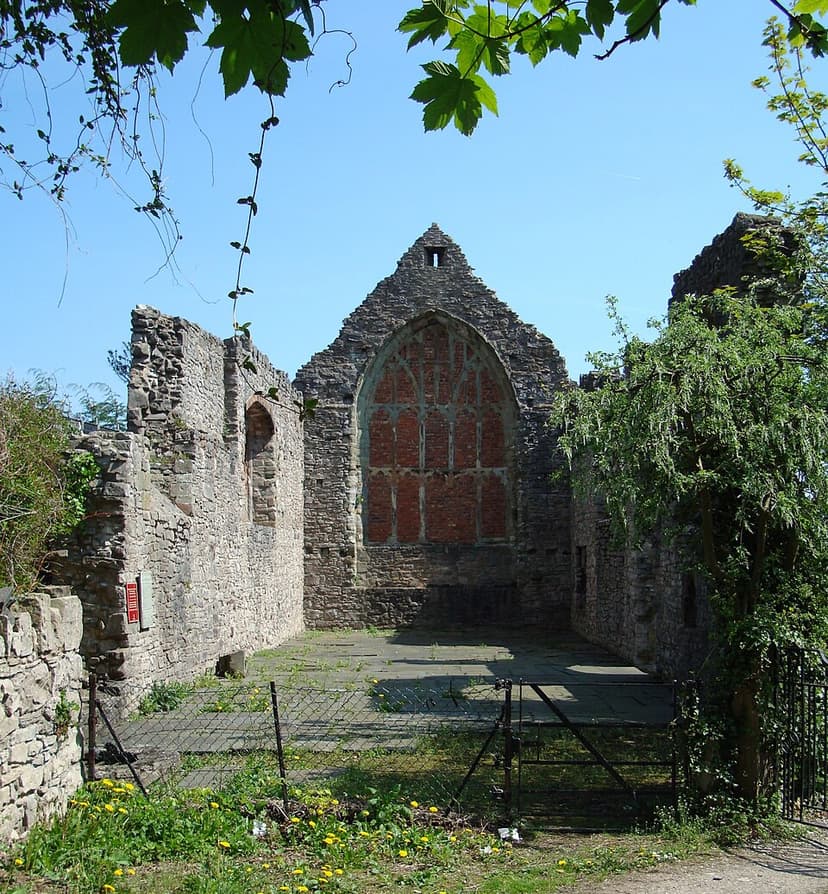
Denbigh Friary
Denbigh Friary, also known as Henllan Friary, was a Carmelite monastic house located in the River Clwyd valley in Wales. Founded between the late 13th century and the mid-14th century, it was dedicated to St Mary. After its dissolution, the friary suffered damage and has been in ruins since an 1898 fire, with its surviving structures primarily dating from the 13th and 15th centuries.