
Blagoveštenje
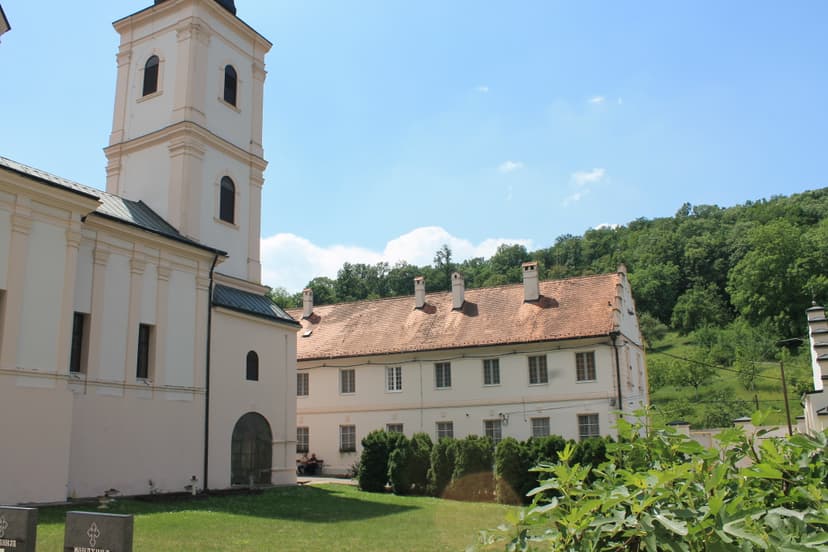
Blagoveštenje Monastery is a Serbian Orthodox monastery situated in the picturesque Ovčar-Kablar Gorge in Central Serbia. While its exact founding date is debated between the 12th and 13th centuries, the first written records date to the 13th century. The monastery is characterized by its church dedicated to the Annunciation, surrounded by monastic residences and secondary buildings in an elliptical shape, all enclosed by stone walls.
Key Facts
- ›The exact founding date of Blagoveštenje Monastery is disputed, with some sources suggesting the 12th century and others the 13th century.
- ›The first written records pertaining to the monastery originate from the 13th century.
- ›The monastic church is dedicated to the Annunciation.
- ›The monastery features monastic residences and secondary objects arranged in an elliptical shape around the church.
- ›The monastery is protected by tall stone walls on its Western and Southern sides.
- ›The inscription above the Western entrance of the church indicates it was rebuilt in 1602 by hegumen Nikifor and other members of the monastic fraternity.

Church Dedicated To the Annunciation, Treasury Housing Gundulić's Four Gospels
манастир благовештење
Nikifor, Pavle
- First Book Printed In Belgrade Kept In Treasury
- Government of the Kingdom of Yugoslavia Planned Evacuation of Manuscripts To the Monastery
- Confiscation of 200 Hectares of Monastery Land By Communist Authorities
- Former Serbian Patriarch Pavle Received Monastic Vows
About Blagoveštenje
Blagoveštenje Monastery
Blagoveštenje Monastery is a significant Serbian Orthodox monastic complex located within the scenic Ovčar-Kablar Gorge in Central Serbia. The precise date of its establishment remains a subject of scholarly debate, with historical conjectures placing its founding in either the 12th or 13th century. Nevertheless, the earliest documented references to the monastery date from the 13th century, attesting to its long-standing presence.
History and Architecture
The monastery's architectural design features a central church consecrated to the Annunciation. This sacred space is encircled by a collection of monastic residences and ancillary structures, arranged in a distinctive elliptical pattern. The entire complex is further fortified by substantial stone walls on its western and southern flanks, providing both architectural definition and a sense of historical protection. An inscription located above the western entrance to the monastic church notes its reconstruction in 1602, attributing the work to hegumen Nikifor and fellow members of the monastic fraternity.
Notable Holdings and Events
Blagoveštenje Monastery holds a place of historical importance as the keeper of Gundulić's Four Gospels, the very first book to be printed in Belgrade in 1552. This makes the monastery a custodian of early Serbian printing and literary heritage. The 20th century brought both challenges and significant spiritual milestones. During the period of the Užice Republic, communist authorities confiscated a considerable tract of 200 hectares of monastery land, redistributing it to local impoverished populations. In a notable spiritual event, the former Serbian Patriarch Pavle received his monastic vows at Blagoveštenje Monastery in 1948, underscoring its continued role in the Serbian Orthodox tradition.
Source: Wikipedia ↗
Frequently Asked Questions
When was Blagoveštenje Monastery founded?
The exact founding date of Blagoveštenje Monastery is a subject of dispute among historians. Some believe it was established in the 12th century, while others point to the 13th century. The earliest written records about the monastery date back to the 13th century.
What is the architectural layout of Blagoveštenje Monastery?
The monastery comprises a church dedicated to the Annunciation, along with several monastic residences and secondary buildings. These structures encircle the church in an elliptical formation. Additionally, tall stone walls provide enclosure on the Western and Southern sides of the monastery.
What significant historical artifacts are associated with Blagoveštenje Monastery?
The treasury of Blagoveštenje Monastery houses Gundulić's Four Gospels, which was the first book printed in Belgrade in 1552. This makes it a repository of important historical printing and literary heritage.
What historical events impacted Blagoveštenje Monastery during the 20th century?
During the period of the Užice Republic, the communist authorities confiscated 200 hectares of land owned by the monastery and redistributed it to impoverished individuals. Later, in 1948, the former Serbian Patriarch Pavle received his monastic vows at Blagoveštenje Monastery.
Related Monasteries

Ajdanovac Monastery
Ajdanovac Monastery is a Serbian Orthodox monastery situated in south-east Serbia on the slopes of Jastrebac. Its origins likely date to the period after the Ottoman invasion of the Balkans in 1485. After serving as a parish church, it was re-established as a monastery in 1936, following renovations in 1887.
Beočin Monastery
Beočin Monastery is a Serbian Orthodox monastery situated on Fruška Gora mountain in Vojvodina, Serbia. While its exact founding date is unknown, it was first documented in 1566/1567. The monastery has undergone significant reconstruction, particularly between 1732 and 1740 for its church and in 1762 for its bell tower, and was declared a Monument of Culture of Exceptional Importance in 1990.

Berkasovo Monastery
The Berkasovo Monastery, dedicated to Saint Petka Trnovska, is a Serbian Orthodox monastery situated near the village of Berkasovo in Serbia's Srem region. Established as a monastery on August 8, 2008, its current church was founded in the latter half of the 19th century, built around a sacred spring believed to possess healing properties. Historically, the area was significant, with mentions of a fortified town in the possession of notable figures like Vuk Grgurević and Jovan Branković.